Institute of Physical and Theoretical Chemistry

Molecular orientation

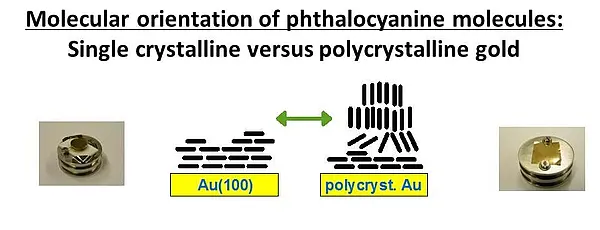
The orientation and order of organic molecules significantly influence their electronic properties, including charge carrier transport. It is not only the molecular orientation within the film that is important for the properties of electronic devices. The orientation of the first layer also cucially affects interfacial properties such as charge carrier injection and extraction. Experiments on single-crystal model substrates are essential for understanding the growth of organic molecules. However, the results cannot always be extrapolated to less well-defined substrates that are more relevant for applications.

At the example of some metal phthalocyanines, we have shown that the substrate roughness is an important parameter for the growth. Although a high degree of ordering for phthalocyanines is observed in many thin films, molecules stand on the rough substrates and lie on the single crystalline substrates. In some cases, in particular for CuPc on polycrystalline gold, differently oriented (“lying”), buried interfacial layers of few monolayers were observed. Importantly, the orientation of molecules directly at the metal-organic interface is related to electronic interface properties.

Methods

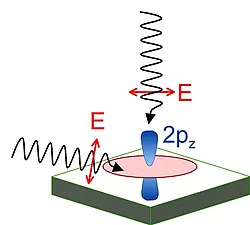
Beside of scanning tunneling microscopy (STM), polarization dependent X-ray absorption spectroscopy (XAS), also called near edge x-ray absorption fine structure (NEXAFS) spectroscopy, is used in the working group. XAS represents an ideal tool to investigate the geometry of molecular adsorbates and thin films especially on disordered substrates. The basic principle is illustrated in the figure.

Related publications:

Orientation and electronic properties of phthalocyanines on polycrystalline substrates (Feature article) H. Peisert, I. Biswas, M. Knupfer, T. Chassé physica status solidi (b), 246 (2009) 1529-1545.

B3N3‑Substituted Nanographene Molecules: Influence of Planarity on the Electronic Structure and Molecular Orientation in Thin Films, Katharina Greulich, Axel Belser, Daniel Bischof, Felix Widdascheck, Marie S. Sättele, Peter Grüninger, Holger F. Bettinger, Gregor Witte, Thomas Chassé, Heiko Peisert, ACS Applied Electronic Materials, 3 (2021) 825–837