Autonomous Vision

Practical: Autonomous Robotics with Duckietown

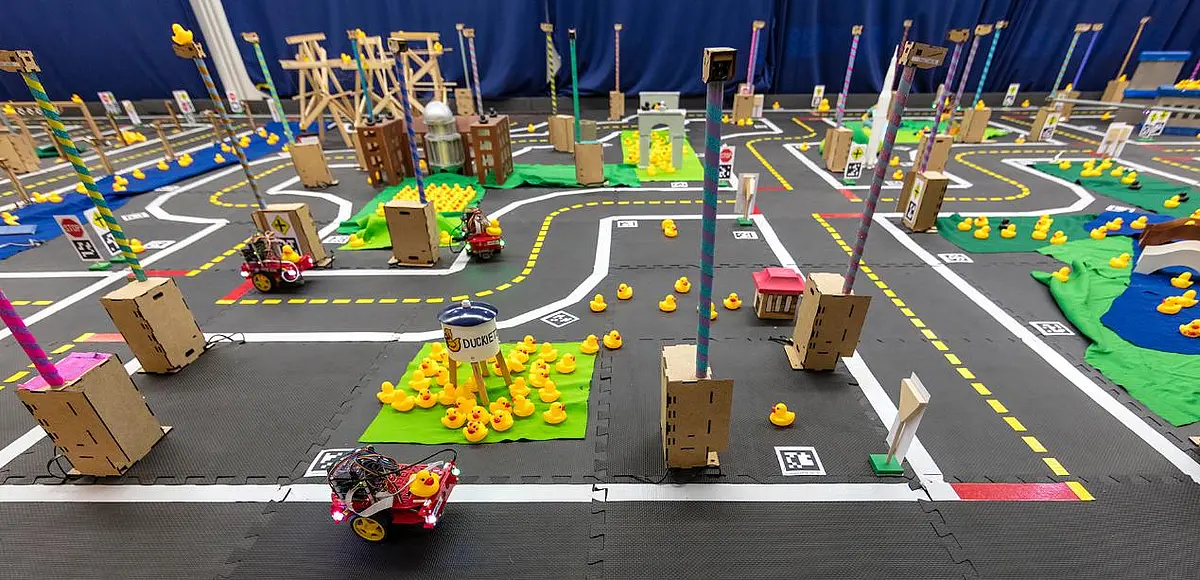
This course introduces students to autonomous robotics using the Duckietown platform, with a focus on perception, planning, control, and system integration. Throughout the course, students will design and implement a complete autonomous driving pipeline for a Duckiebot operating in a miniature smart city environment. As a central outcome, students will develop a fully autonomous Duckiebot capable of completing representative Duckietown missions, including:

  • Lane following
  • Intersection handling
  • Obstacle avoidance
  • Parking

Qualification Goals

Students gain a practical understanding of how learning-based methods can be applied to autonomous navigation in real-world settings. They learn to design, implement, and evaluate imitation and reinforcement learning algorithms for robot control, bridging the gap between simulation and physical deployment. Topics:

  • ROS and robotics software engineering
  • Computer vision for lane detection
  • Localization and mapping
  • Planning and control
  • Reinforcement learning

Overview

  • Course number: ML-4602
  • Credits: 9 ECTS (6 SWS)
  • Total Workload: 270h
  • Format: In-person, lab work
  • Teams: 5
  • Students: 2-3 per team
  • First meeting: Wed, 15.4. 14:00 MvL1 A-417

Deliverables

  • Demonstration of a working autonomous Duckiebot
  • Technical report (4-5 pages)
  • Final presentation

Prerequisites

  • This practical is for Master students only
  • Ideally participated in self-driving cars lecture
  • Deep learning and computer vision knowledge

Registration

  • To participate in this practical, you must register via ILIAS (see sidebar)
  • Registration opens 27.3.26 at 12:00

Templates

Links to Latex/Overleaf templates for reports, reviews and slides. Reports and reviews must use the corresponding template. Presentation slides can be done with other tools, e.g., PowerPoint, Keynote.