SNARE proteins
Vesicle trafficking is facilitated by a complex interplay of protein-protein interactions. Key players are the so-called SNARE proteins (Soluble N-ethylmaleimide-Sensitive Fusion Protein Attachment Protein Receptor) that enable the actual fusion through a tight interaction that helps to overcome the strong dehydration forces associated with lipid bilayers in an aqueous environment (Jahn et al., 2006).
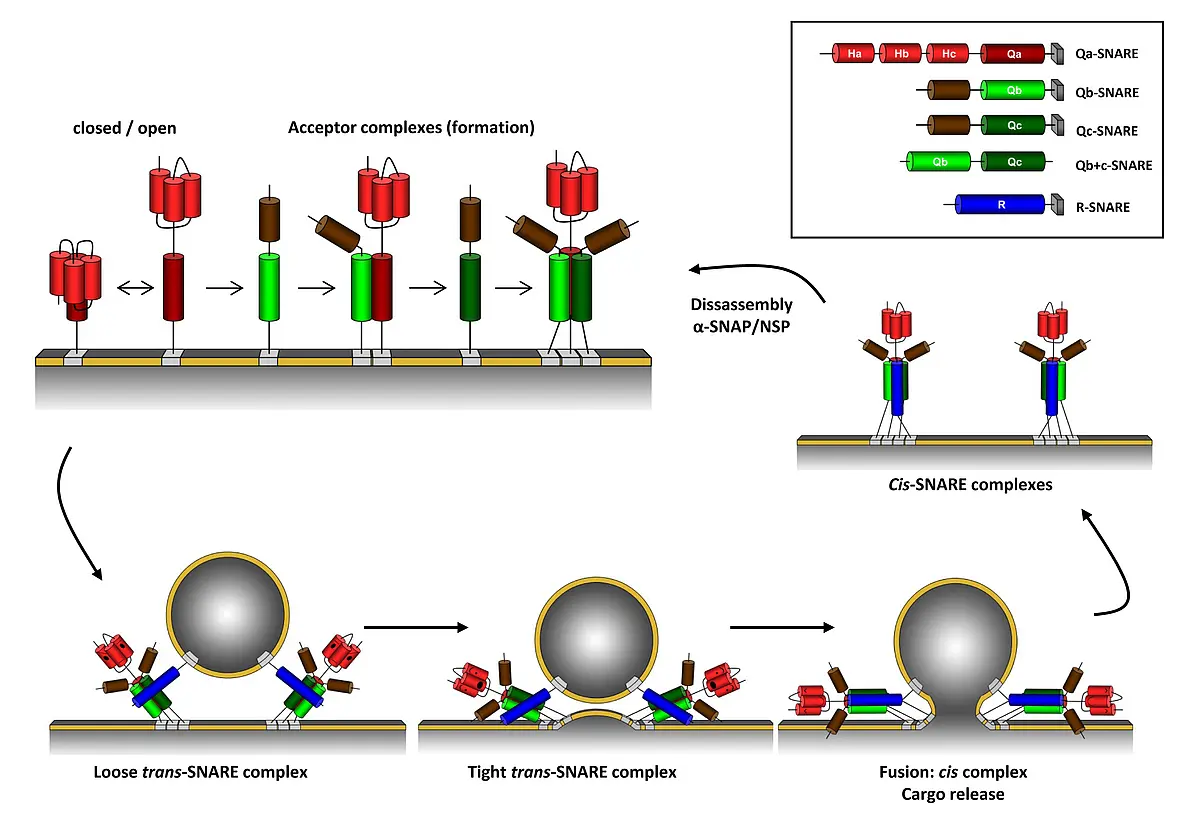
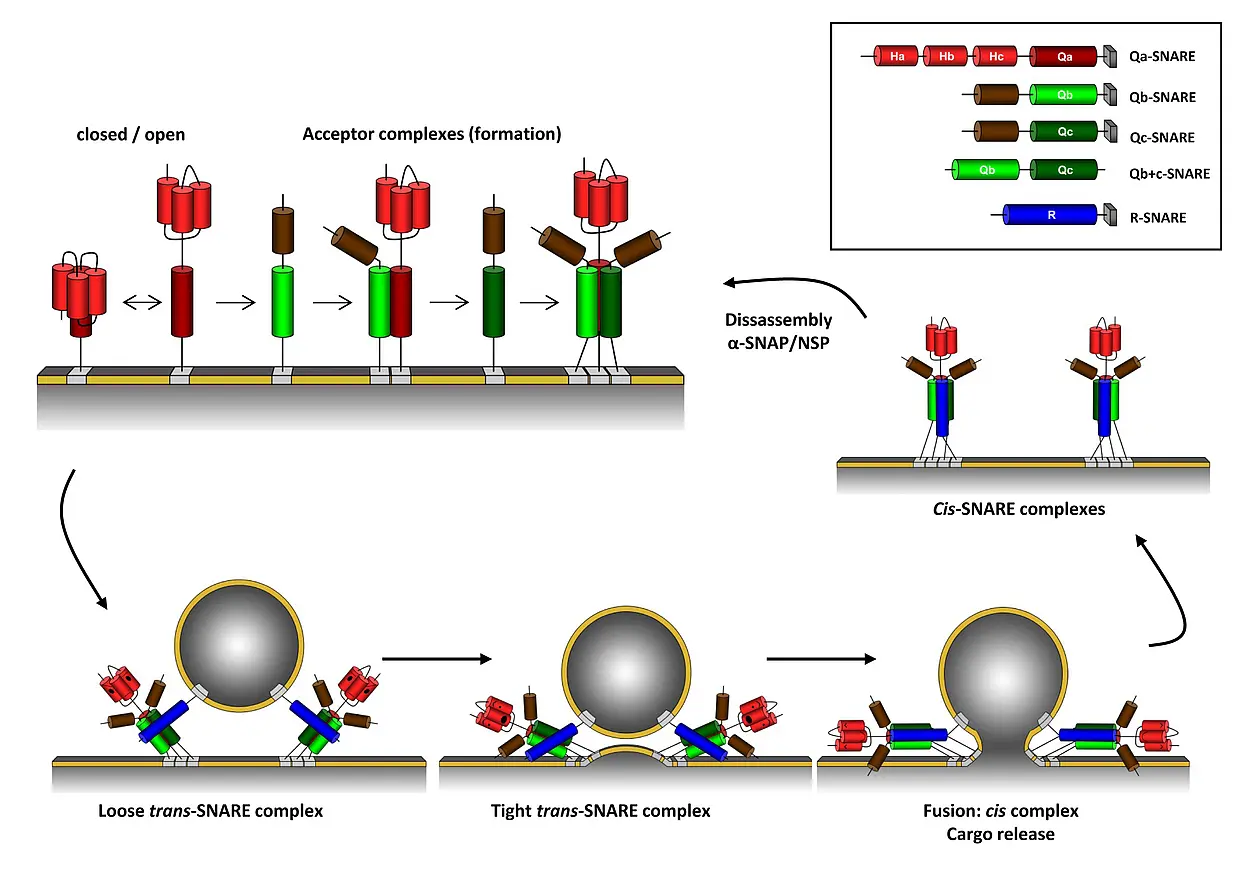
A distinctive feature is the SNARE domain, an α-helical heptad repeat forming a coiled-coil structure with a conserved Glutamine (Q) or Arginine (R) residue at its “zero” position subdividing this protein family into two subclasses: Q- and R-SNAREs. Another terminology uses the terms t-SNARE (target-membrane) and v-SNARE (vesicle) according to their subcellular localization. However, this terminology might prove confusing when homotypic fusion events are analysed. The SNARE core complex that drives membrane fusion consists of four SNARE motifs, three Q and one R-SNARE motif. Q-SNAREs are further subdivided into Qa-, Qb and Qc-SNAREs one of each being essential to form the SNARE core complex that enables membrane fusion (see figure 5).
Interestingly, plant genomes encode twice as many SNAREs than humans; however, the majority of the plant SNAREs are not novel per se but rather arise from gene duplication events that have led to a greater number of homologues suggesting the need for more diverse or specialized roles (Lipka et al., 2007).