Center for Plant Molecular Biology

Research Group Jürgens

Endosomal recycling by ARF-GEF GNOM

The Arabidopsis thaliana genome encodes eight 150-220kDa large ARF-GEFs that are members of a conserved eukaryotic protein family comprising two classes (GBF1, BIG1) named after their mammalian ARF-GEFs. Three proteins (GNOM, GNL1 and GNL2) are related to GBF1 acting atcis-Golgi whereas fiveproteins (BIG1-5) are related to BIG1 acting at trans-Golgi (Anders & Jürgens, 2008). 

            GNL1 regulates the retrograde COPI-mediated traffic from the Golgi stacks to the ER, which is the ancient eukaryotic function of the GBF1 class (Fig. 1; Richter et al., 2007). GNOM can replace GNL1 in retrograde Golgi-ER traffic. However, GNOM primarily regulates polar recycling of the auxin-efflux transporter PIN1 from endosomes to the basal plasma membrane, which is required for cell polarity and axis formation in embryogenesis, and for polar auxin transport to the root pole (Fig. 1; Geldner et al., 2003). The third paralog GNL2 plays a specific role in pollen germination and pollen-tube growth (Richter et al., 2012). The ARF-GEFs BIG1 to BIG4 jointly perform an essential function in the late-secretory pathway from the trans-Golgi network (TGN) to the plasma membrane and during cytokinesis (Fig. 1; Richter et al., 2014). Although acting at different (endo)membranes, all Arabidopsis ARF-GEFs appear to activate GTPases of the same ARF1 class which are 99% identical (Singh et al., 2018).

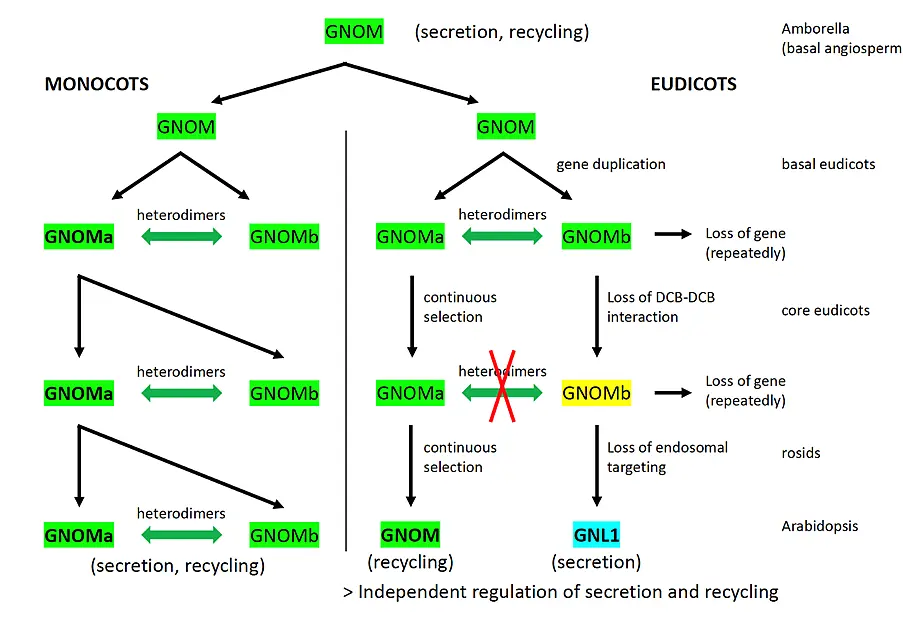
          In evolution, GNOM was the “ancient plant” GBF1-type ARF-GEF and was bi-functional, mediating polar recycling and Golgi-ER retrograde traffic (Fig. 3; Singh, Lauster and Huhn et al., 2025). GNL1 only arose by duplication and diversification during eudicot evolution, although GNL1 has the GBF1-equivalent role in trafficking.


Figure 3. Evolutionary trajectories of GNOM paralogs in angiosperms (model).

Following gene duplication, the formation of GNOMa-GNOMb heterodimers is eventually disrupted in eudicots but not in monocots. In monocots (left), GNOM-paralogous  gene duplicates did not initiate divergent evolutionary trajectories. In eudicots (right), however, while paralog GNOMa (i.e. AtGNOM ortholog) is under strong selection, paralog GNOMb (i.e. AGNL1 ortholog) is free to evolve, repeatedly resulting in degeneration and eventual loss from the genome. In the rosid branch of core eudicots, paralog GNOMb not only experiences loss of endosomal targeting which is a unique feature of AtGNOM, but also seems to acquire a new (selectable) function, eventually giving rise to AtGNL1 (Singh, Lauster and Huhn et al., 2025).

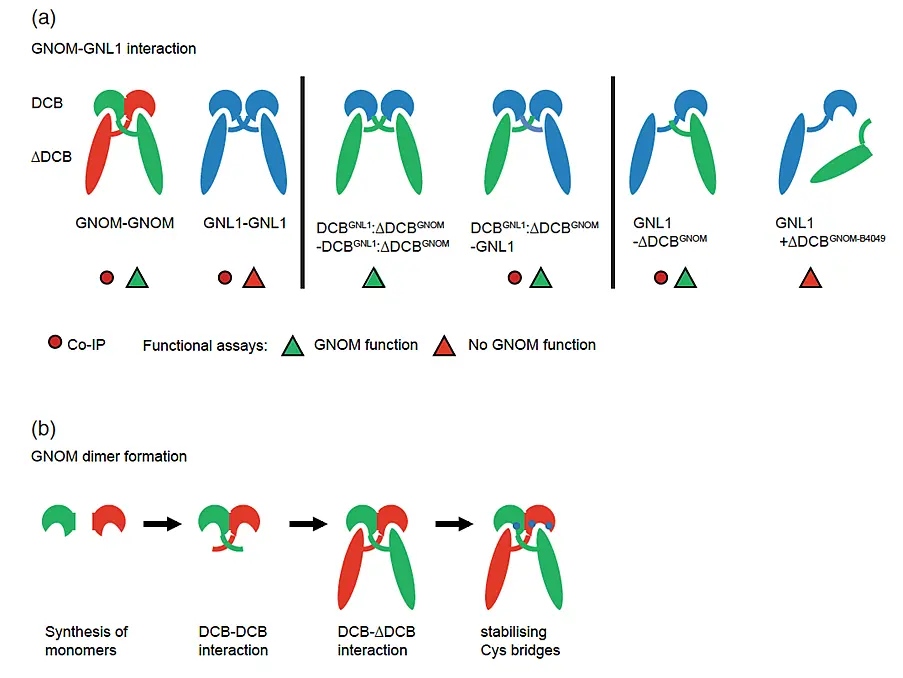
GNOM and GNL1 share a common domain interaction (DCB-DDCB) required for homodimerization and membrane association, which is different from GBF1. GNOM has an additional DCB-DCB interaction that prevents the formation of GNOM-GNL1 heterodimers (Fig. 4; Brumm & Singh et al., 2022).

Δ

Figure 4. Domain interaction of GNOM and GNL1, and a proposed role for DCBGNOM in heterodimer prevention.

(a) GNOM-GNL1 interactions established after translation. Unlike GNOM, GNL1 and a chimeric DCBGNL1:ΔDCBGNOM protein with GNOM function form dimers only mediated by DCB-ΔDCB interactions. Chimeric DCBGNL1:ΔDCBGNOM protein can form both, homodimers and heterodimers with GNL1. GNL1 interacts with ΔDCBGNOM but not with the mutant variant ΔDCBGNOM-B4049 that cannot interact with the DCB domain (Anders et al., 2008).

(b) Stepwise GNOM dimer formation. Interaction between two N-terminal DCB domains initiates dimer formation during or soon after translation. The pair of fully translated proteins undergoes two DCB-ΔDCB interactions followed by the formation of stabilizing Cys bridges (blue dots). (Brumm & Singh et al., 2022)

            Our current research aims to reveal mechanisms underlying the pathway specificity of endosomal ARF-GEF GNOM action. To this end, we analyse how GNOM associates with endosomal membranes and attempt to identify interacting proteins as well as associated coat proteins for cargo selection.