Center for Plant Molecular Biology

Research Group Jürgens

Principles of vesicle trafficking

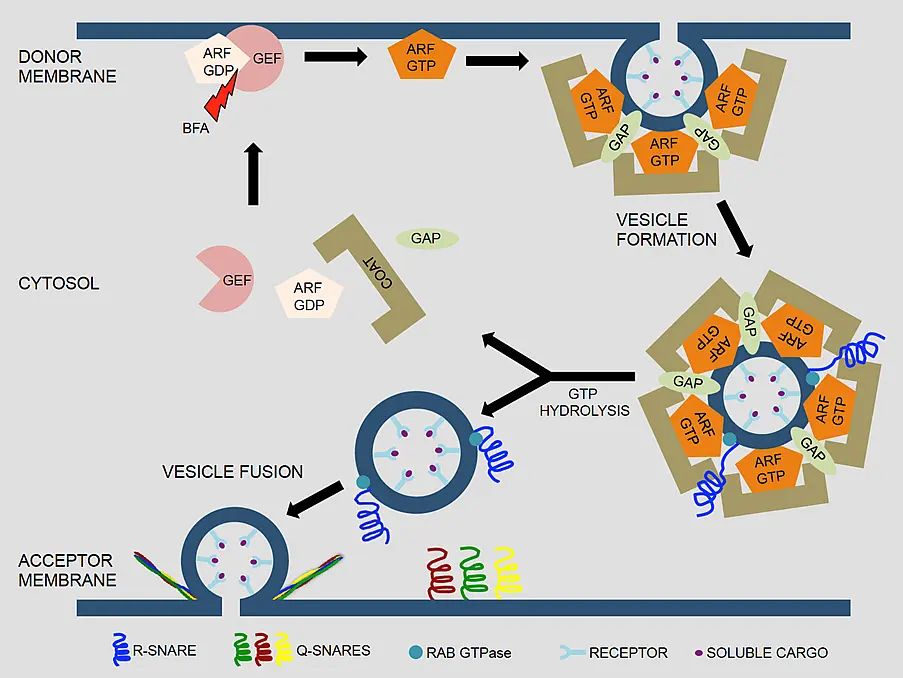
Membrane vesicles are formed on donor membranes and fuse with specific target membranes. Cell division is a special case where initially vesicles fuse with one another to form a new target membrane (the so-called cell plate) with which later-arriving vesicles can fuse. Vesicle formation requires the activities of conserved protein families such as ADP-ribosylation factor (ARF) GTPases and their activating ARF guanine-nucleotide exchange factors (ARF-GEFs) as well as GTPase-activating proteins (ARF-GAPs) that inactivate the ARFs (Fig. 2). Specific coat proteins are recruited by activated ARF GTPases (ARF•GTP) and in turn select cargo proteins for delivery to target membranes. After shedding of the coat, transport vesicles interact with their target membrane via RAB GTPases and tethering proteins. Subsequent membrane fusion is mediated by the formation of 4-helical trans-SNARE complexes between R-SNARE (aka v-SNARE or VAMP) on the vesicle and Q-SNAREs (aka t-SNAREs) on the target membrane (Fig. 2).

Figure 2. Schematic diagram of vesicle formation and fusion

Vesicle formation at a donor membrane is initiated by membrane recruitment of cytosolic ARF-GEF and GDP-bound ARF. On the membrane, ARF-GEF activates the ARF by exchanging its GDP for a GTP. The GTP-bound ARF recruits the coat protein complexes and other factors required for formation and scission of a vesicle. The newly formed coated vesicle, carrying the sorted cargo on its membrane or in its lumen, also harbors various other regulatory proteins such as ARF-GAPs, RAB GTPases and SNAREs. The ARF-GAP stimulates the hydrolysis of the bound GTP by ARF, resulting in the release of the ARF-GDP and the coat proteins. The uncoated vesicle, using RAB and SNARE proteins, fuses with the acceptor membrane and releases the soluble cargo in the lumen of acceptor compartment. (Singh & Jürgens, 2018).