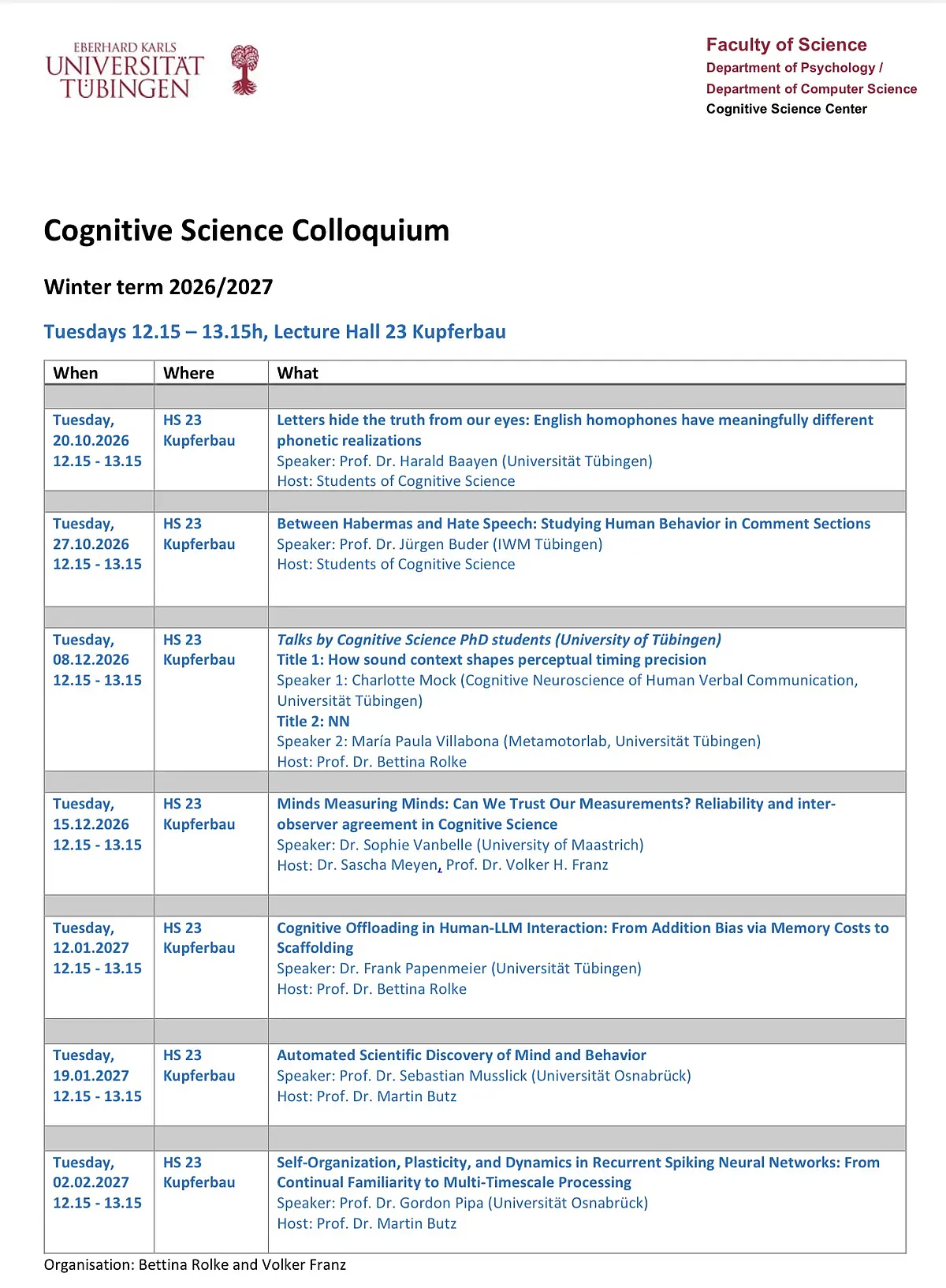
Apart from the Cognitive Science Colloquium, there are also many other Cognitive Science related talks / talk series in Tübingen that are listed here.

Abstracts

28.04.2026 Cognitive Processing of Uncertain Information

Speaker: Dr. Manuela Glaser (IWM Tübingen)

Scientific information is uncertain due to different reasons. However, it is not yet clear how uncertain information is cognitively processed. Manuela Glaser presents her work on this research question: In her theoretical model, she postulates a discarding of very uncertain information leading to better learning of certain than of uncertain information; a mental tagging of uncertain information as being uncertain leading to a better memory of uncertainty values of certain than of uncertain information; and a dissociation of information and uncertainty tags over time leading to a higher probability to falsely remember uncertain information as certain than falsely remembering certain information as uncertain. The results of her empirical studies largely confirm these three processes and additionally show that also the memory of uncertainty justifications is biased depending on the uncertainty of the information. Manuela Glaser will also present first results of her current DFG project, in which she examines the influences of other aspects of learning situations on the cognitive processing of uncertain information such as the credibility of the information source, the presence of uncertainty justifications, consistency of information with prior knowledge, and reception goals of the learners.

05.05.2026 Multimodal interaction across languages

Speaker: Dr. Paula Rubio-Fernandez (MPI Nijmegen) 


Demonstratives, words like ‘this’ and ‘that’ in English, are a special class of function
words: They appear in all documented languages, and are acquired early in ontogeny,
together with pointing, which is another linguistic universal. Demonstratives are also
supposed to have emerged early in language evolution, since historical linguists and
typologists have not been able to trace back their origins. In a bid to explore these
features of demonstratives, I will present cross-linguistic data from adults and
computational models of demonstrative use, exploring the spatial and social parameters
underlying demonstrative choice across languages. I will also present the results of a
recent study investigating the role of demonstratives in early language acquisition.
Combining head-mounted eye-tracking with machine-learning modeling of naturalistic
interactions between mothers and infants, we show that demonstratives provide
augmented inputs that scaffold early word learning. I will argue that demonstratives
orchestrate attentional dynamics in multimodal social interaction, which is a
fundamental pragmatic function that might explain their unique characteristics.

19.05.2026 Contextualization in the ARC Challenge

Speaker: Prof. Martin Butz (University of Tübingen)


The Abstract and Reasoning Corpus (ARC) Challenge has been proposed as a benchmark for progress toward artificial general intelligence. While large language models (LLMs) and vision-language models (VLMs) have shown promising results on Versions 1 and 2, Version 3 remains highly challenging. At the same time, it is still largely unclear how humans solve these tasks. In this talk, I present a cognitive model that outlines possible human reasoning processes involved in solving ARC problems. I further relate these processes to general principles of problem solving in the human mind. A central idea is the inference of appropriate contextual frames when searching for solutions—both in ARC tasks and in real-world situations. While this approach may point in a promising direction, much work remains. In particular, further research is needed to develop artificial systems that solve ARC tasks in a genuinely human-like way. 

02.06.2026 Space and Memory in the Hippocampus

Speaker: Prof. Sen Cheng (University of Bochum)


A fundamental question in neuroscience is why the hippocampus, which is critical for episodic memory in humans, primarily exhibits spatial representations like place cells in many species. We study this question using a novel computational model based on memory-augmented neural networks. The model autonomously learns to store and retrieve information from an external memory buffer and shows remarkable flexibility: When solving visual tasks requiring category information in supervised learning, it develops concept cells. When learning to navigate a simulated maze based only on visual inputs using reinforcement learning, it spontaneously develops population-level representations of the maze's 2D spatial structure. These findings suggest that spatial representations in the hippocampus emerge as a consequence of using episodic memory systems to solve spatial problems, reconciling two major lines of research on the hippocampus that have largely remained separate until now. 

09.06.2026 Brain substrates of communicative function understanding

Speaker: Prof. Rosario Tomasello (FU Berlin)

In everyday communication, linguistic signs serve as tools of communication, enabling us to express our intentions to others. These intentions, described in linguistic-pragmatic theory as speech acts, are embedded in contextualized action sequences and social commitments that shape their function in interaction. In this talk, I will present a series of studies investigating the neural signatures underlying fine-grained distinctions between speech act types conveyed by the same linguistic utterance across written, spoken, prosodic, and gestural modalities. Focusing on both temporal and spatial dimensions, I address two central questions: “When”, in time, and “Where”, in the brain, are communicative functions processed? And what do these findings imply for linguistic-pragmatic theories of speech acts? I will end by presenting neurophysiological evidence from individuals with post-stroke aphasia showing that targeted, speech-act-based therapy leads to greater language improvement than standard approaches, accompanied by patterns of therapy-induced neural reorganisation.

23.06.2026 Pitfalls in Measuring Unconscious and Implicit Processing

Speaker: Dr. Sascha Meyen (University of Tübingen)


Research on unconscious processing suffers from a methodological fallacy. In many studies on unconscious processing, a priming paradigm is used. There, it is argued that a prime stimulus can influence the processing of a subsequently presented target stimulus, even if the prime is not consciously perceived. Evidence for such findings typically comes from two tasks: In an indirect task, response times to the target stimulus are shown to be affected by the prime stimulus. In a direct task, participants are then asked to discriminate the prime stimulus, showing very low performance. This pattern of results seems to demonstrate that response times in the indirect task are more sensitive to the prime stimulus than participants’ direct task reports. Based on this apparent difference in sensitivities, researchers routinely infer that the prime stimulus was processed unconsciously, that is, the sensitivity of response times to the prime stimuli was higher than the sensitivity of participants' direct reports to them. Here is the problem: Sensitivities in the indirect task are never actually calculated. To resolve this issue, we conduct the appropriate relative sensitivity analysis in which we show that sensitivities in both tasks are very similar. Thus, there is a lack of evidence for a difference between the two tasks and, thus, no empirical basis for claims about unconscious priming. We demonstrate the same problem in a different paradigm on implicit learning. Given this pervasive, fundamental methodological flaw, reports of unconscious processing and implicit learning require serious reevaluation.

30.06.2026 On the early visual cortex involvement in working memory

Speaker: Dr. Pablo Grassi (MPI Tübingen)

Neuroimaging has consistently shown that storage of visual information in visual working memory (VWM) involves memory-specific activity in early visual areas. However, it is unclear whether this memory-specific activity is in fact relevant for, or reflective of, the storage of visual information per se, or whether it rather reflects feedback-mediated activity from higher-level areas that are responsible for the actual storage of visual information. Moreover, in contrast to the largely consistent and robust neuroimaging findings, studies using non-invasive brain stimulation methods, such as transcranial magnetic stimulation (TMS), report inconsistent effects of visual cortex stimulation during working memory tasks. In this talk, we review existing evidence and present results from four novel TMS experiments specifically designed to investigate the causal role of early visual cortex in working memory. We report retinotopically specific disruption of VWM performance during visual, but not semantic, working memory tasks. Yet, while we observed a retinotopic and task-specific effect in the effectiveness of VWM performance, we did not observe an effect on the fidelity of the VWM representations. This suggests that early visual cortex might not be central to the storage of working memory items.

14.07.2026 TBA

Speaker: Prof. Niels Henze (University of Tübingen)


Tba