Urgeschichte und Naturwissenschaftliche Archäologie

News from the Department of Early Prehistory and Quaternary Ecology

Colloquium of the Department for Early Prehistory and Quaternary Ecology

The colloquium of the Department for Early Prehistory and Quaternary Ecology takes place every Thursday at 11 c.t. in the practice room of the castle.

09.07.2026

10:15h

Olivier Scancarello (Universite Cote d'Azur)

An LSA Without Backing Technology? Implications for Functional, Sociocognitive, and Technological Organization during the Early Holocene in the Horn of Africa

Fei Yang (University of Tübingen)

Taxonomic and Taphonomic Change through the Middle Palaeolithic Sequence at Hohle Fels 

2.7.2026

10:15h

Sara Watson (Indiana Sate University)

Mobility, Exchange, and Human Behavioral Evolution in Late Pleistocene Southern Africa

Joshua Preetz (University of Tübingen)

Beyond MIS 5e: Preliminary Evidence for Technological Similarities in the Lower Sequence of Jebel Faya (UAE) 

25.6.2026

10:15h

Keegan Patterson (University of Tübingen)

How Cultural-Group-Selection Tamed Us: Rethinking Hominin Domestication


Montana Reid (University of Tübingen)

The Symbolic Ceramics of Movila Lui Deciov


Cassidy Heller (University of Tübingen)

The Frontier Was Everywhere: Raw Material Procurement and Landscape Use of the Middle-Upper Paleolithic Transition from Nietoperzowa Cave, southern Poland


Orhan Efe Yavuz (University of Tübingen)

The Diverse Genetic Imprint of the Roman Empire 

18.6.2026

Andrzej Wiśniewski (University of Wroclaw)


Open-Air Sites of the Keilmessergruppe: The Example of Pietraszyn 49a, Poland

11.6.2026

Emil Schummers (Universität Tübingen)

Beer and Metal: Contextualizing spatially distributed excavation areas
at Holley Shelter, KwaZulu-Natal, South Africa


Melodie Bergeron (Universität Tübingen)

A Preliminary Taphonomic Analysis of Hohle Fels Layer AH Vb

Joshua Hamman (Universität Tübingen)

The Mesolithic Assemblage from Langmahdhalde: Lithic Analysis and Interpretation
 

21.5.2026Dennis Batz (University of Tübingen)

Potential Upper Palaeolithic Dwelling Structures in Western, Central, and Eastern Europe: Quantitative Analyses and Spatio-Chronological Patterns
7.5.2026
David Boysen (University of Tübingen) 

Constrained Variation in Reduction Sequences of Late Middle Palaeolithic Handaxe Production: Technological Organization and Socioeconomic Implications at Charbonnières (Saône-et-Loire, France)
30.4.2026Karen Lupo & Nicolette Edwards (Southern Methodist University)  

The Power of Multi-Method Ethnoarchaeology in Central Africa: 
Foragers, Farmers, and Emerging Data
23.4.2026Amélie Challier (University of Tübingen)

Detailed Luminescence Chronologies of Loessic Palaeolithic Sites in Tajikistan
16.4.2026

Patrick Cuthbertson (University College London) 


The Role of Mountainous Environments in the Earliest Occupation of Central Asia: A Lower Palaeolithic of an Open ‘Savannahstan’ or of a Topographically Complex ‘Inner Asian Mountain Corridor’?

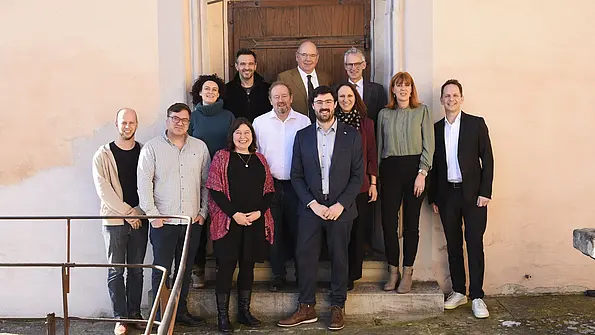
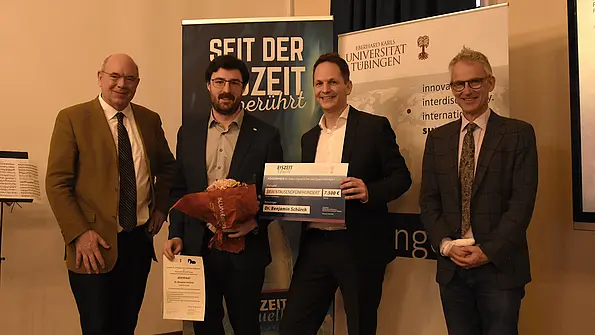
Award ceremony for the Tübingen Prize for Early Prehistory and Quaternary Ecology 2026, Award winner: Benjamin Schürch

The 28th Tübingen Prize for Early Prehistory and Quaternary Ecology goes to Dr. Benjamin Schürch of the University of Erlangen-Nürnberg (FAU). He will receive the award on 5 February 2026 at Hohentübingen Castle. The University of Tübingen Institute of Prehistory, Early History and Medieval Archaeology makes the 7,500-euro award annually to a researcher who has written an outstanding doctoral thesis. Schürch’s theses revisits finds from the Vogelherd Cave in southwest Germany’s Lone Valley, which was first excavated in 1931. The finds of up to 120,000 years old from the period of Neanderthals and the first modern humans had been analysed in previous decades; working in recent years, Schürch was able to reexamine the material using a greater variety of innovative methods. This enabled him to uncover further details of human life during the Aurignacian cultural phase. This is the period from around 42,000 to 35,000 years ago, in which anatomically modern humans spread into central Europe after the extinction of the late Neanderthals. In this time, humans created figurative art and musical instruments for the first time. 

The Vogelherd Cave is considered one of the most important Paleolithic sites in Europe. “With his use of various techniques, Benjamin Schürch has unlocked new secrets at the cave, almost a hundred years after the site was discovered,” says Tübingen’s Professor Harald Floss from the Institute of Prehistory, Early History and Medieval Archaeology, who will give the laudation for the award winner.

Schürch subjected finds such as stone tools to a technological and typological reassessment. With the aid of modern analytical methods, he demonstrated that the people of that time must have brought some materials considerable distances to the cave – unworked stone, for example, and mollusk shells used for jewelry. “Schürch also proved for the first time that there was human habitation at the Vogelherd Cave during the Gravettian cultural phase, which followed the Aurignacian, as well as during the later Mesolithic period. His award-winning work is an important contribution to our understanding of the Paleolithic settlement history of the Swabian Jura,” says Floss.

Benjamin Schürch studied Prehistory and Medieval Archaeology at the University of Tübingen and completed his doctorate here in 2024. “Due to his personal commitment, he made significant contributions to the Department of Ancient Prehistory and Quaternary Ecology,” says Floss. His career has included research stints in the US at the University of Connecticut and in Belgium at the University of Liège. As curator and research assistant, Schürch was responsible for various collections and exhibitions at the Vogelherd Archaeological Park in Niederstotzingen and in the Early Prehistory Collection at the University of Tübingen for most of 2025. Since October 2025, he has been a research assistant at the Institute for Prehistory and Early History at the University of Erlangen-Nuremberg.

“This prize, aimed at early-career researchers worldwide, already has a long tradition. It highlights the importance of this successful field of research in Tübingen,” says University of Tübingen president, Professor Dr. Dr. h.c. (Dōshisha) Karla Pollmann. The Tübingen Prize for Early Prehistory and Quaternary Ecology is sponsored by mineral water brand EiszeitQuell. The award is now in its 28th year.

More information on the Tübingen Prize for Early Prehistory and Quaternary Ecology can be found here

Cluster of Excellence: Human Origins

With participation of the Department of Early Prehistory, the University of Tübingen has earned funding for the Cluster of Excellence “Human Origins” which will start 2026.
Budget: 40 Million Euros.

Further Information:
https://uni-tuebingen.de/en/research/core-research/cluster-of-excellence-human-origins/

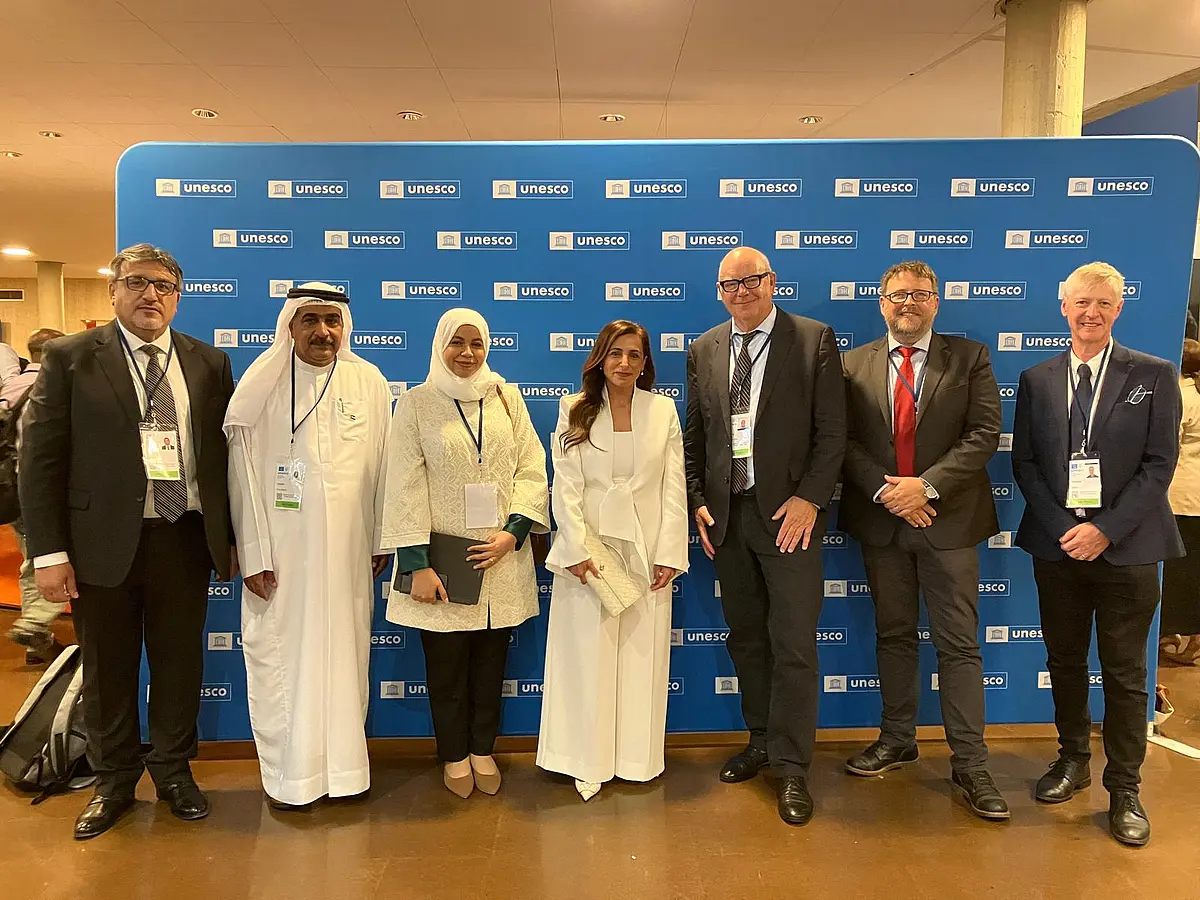
2025: Faya palaeolandscape inscribed on the UNESCO World Heritage List at the 47th session of the UNESCO World Heritage Committee in Paris

2023: DGUF Study Prize for Archaeology awarded to Dr. William Daniel Snyder

In May 2023, William Daniel Snyder will be awarded the German Study Prize for Archaeology by the DGUF in Frankfurt / M. for his dissertation "New Experimental Insights into Early Hominin Cultures and Oldowan Technology". Snyder conducted his dissertation in Prehistory and Early History at the Eberhard Karls University in Tübingen.

Supervised by Claudio Tennie and Nicholas Conard, the work questions the prevailing view in research that the Oldowan technology complex represents the earliest cumulative culture - i.e. a copying of know-how based on specific cognitive mechanisms. The work was carried out as part of the ERC "STONECULT" project (PI Tennie).

The award ceremony will take place after the DGUF general meeting on May 18, 2023, starting at 4:30 pm. The event will be held at the Archaeological Museum in Frankfurt / M.

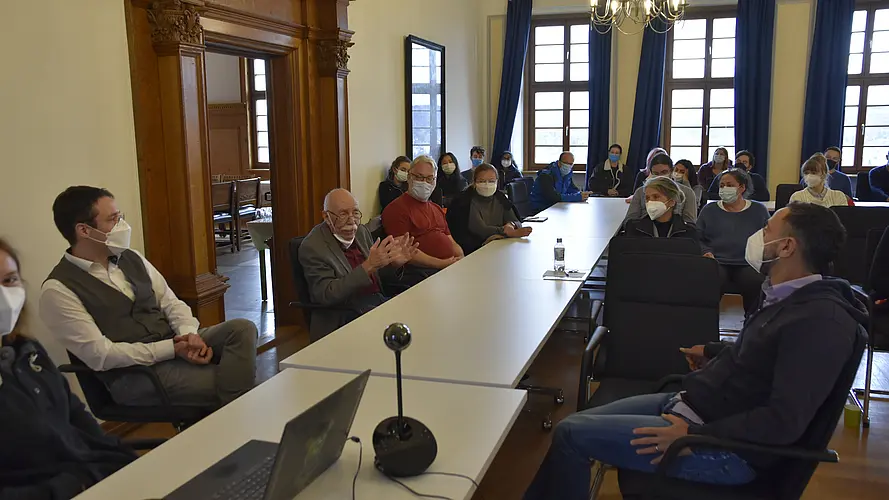
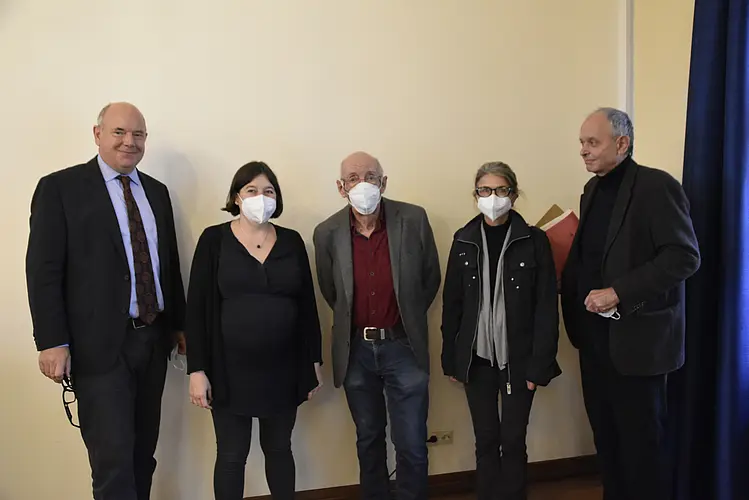
Celebratory colloquium in honor of the 80th birthday of Prof. Dr. Dr. Hans-Peter Uerpmann on November 4th 2021

CIERA-Meeting Arch. Alsace - Univ. Tübingen 23.5-25.5

The program of the conference can be downloaded here.


Ice Age Cave Art

Archaeologists from Tübingen find 12,000 year old animal depictions in France

Archaeologists from the University of Tübingen have discovered two caves with prehistoric cave art in the east of France. The carvings and paintings are at least 12,000 years old; they depict a horse and a stag-like animal amongst others. Professor Harald Floss from the Department of Early Prehistory and Quaternary Ecology and his working group managed to date the art with the help of colleagues from Spain.

The researchers from the University of Tübingen have been working in the East of France, especially the southern Bourgogne for more than 20 years. In this region, Neanderthals and modern people most likely met in the middle paleolithic. 

The full article can be found here.


Interview with Nicolas J. Conard

In this podcast, Luke Fannin from the Undergraduate Anthropology Club at Ohio State interviews Dr. Nicholas Conard, an archaeologist at the University of Tubingen in Germany. In the interview, Dr. Conard discusses what drove his early interest in archaeology, how he began to study the relations between modern Homo sapiens and Neanderthals, and how his discoveries of early human symbolic culture - including some of the earliest examples of figurative sculpture and musical instruments - can tell us about the development of our species. You can find the podcast on soundcloud.


Ice age caves are World Heritage Sites

The UNESCO committee has named six caves in the Swabian Jura as World Heritage Sites: Krakau, Vogelherd, Bockstein, Hohlenstein-Stadel, Sirgenstein, Geißenklösterle and Hohle Fels.

Scientists from the University of Tübingen have been researching the caves of the Ach- and Lone valley since the beginning of the 20th century. Among the finds is some of the oldest evidence for art and music: the famous animal figurines from Vogelherd, the Venus from Hohle Fels and a bone flute were crafted more than 40,000 years ago during the last ice age. They constitute a unique insight into human history. 

"We are thrilled about these news: this award honors the decade-long archaeological and palaeontological research done at the University of Tübingen", says principal Professor Bernd Engler. "Once again, it displays the fact that Tübingen is doing remarkable scientific work with international importance."

This award is of outstanding merit, says Nicolas J. Conard, professor at Tübingen for Early Prehistory and Quaternary Ecology. He oversees the field work in the Swabian Jura since 1996. "The finds from the ice age caves display thee first modern humans' extraordinary creativity. Scientists from Tübingen have analysed these finds and made them accessible for the public. It is an important to us that this region has now been named a World Heritage Site."

"A university and its museum being a central part of a UNESCO-Heritage entry, that's unique in the world", says Professor Ernst Seidl, director of the MUT museum at the university of Tübingen. 

Most of the original finds are displayed at the Museum Alte Kulturen at the Hohentübingen castle; among them many ivory statuettes from Vogelherd and the newest of the finds, a bone flute fragment. 

Congratulations!

On April 24th 2017, Stefanie Bealek was awarded the Rudolf-Virchow-Preis der Berliner Gesellschaft für Archäologie, Ethnologie und Urgeschichte for her master's thesis on teen pregnancies in archaeological/anthropological contexts  (palaeoanthropology): „Teenagerschwangerschaften" – ein modernes Phänomen? Junge Mütter im archäologisch-anthropologischen Kontext“. 

On November 17th 2017, Dr. Sybille Wolf was awarded the Kurt-Bittel-Preises für Süddeutsche Altertumskunde der Stadt Heidenheim. Her dissertation was about mammoth ivory jewellery: "Schmuckstücke - Die Elfenbeinbearbeitung im Schwäbischen Aurignacien".