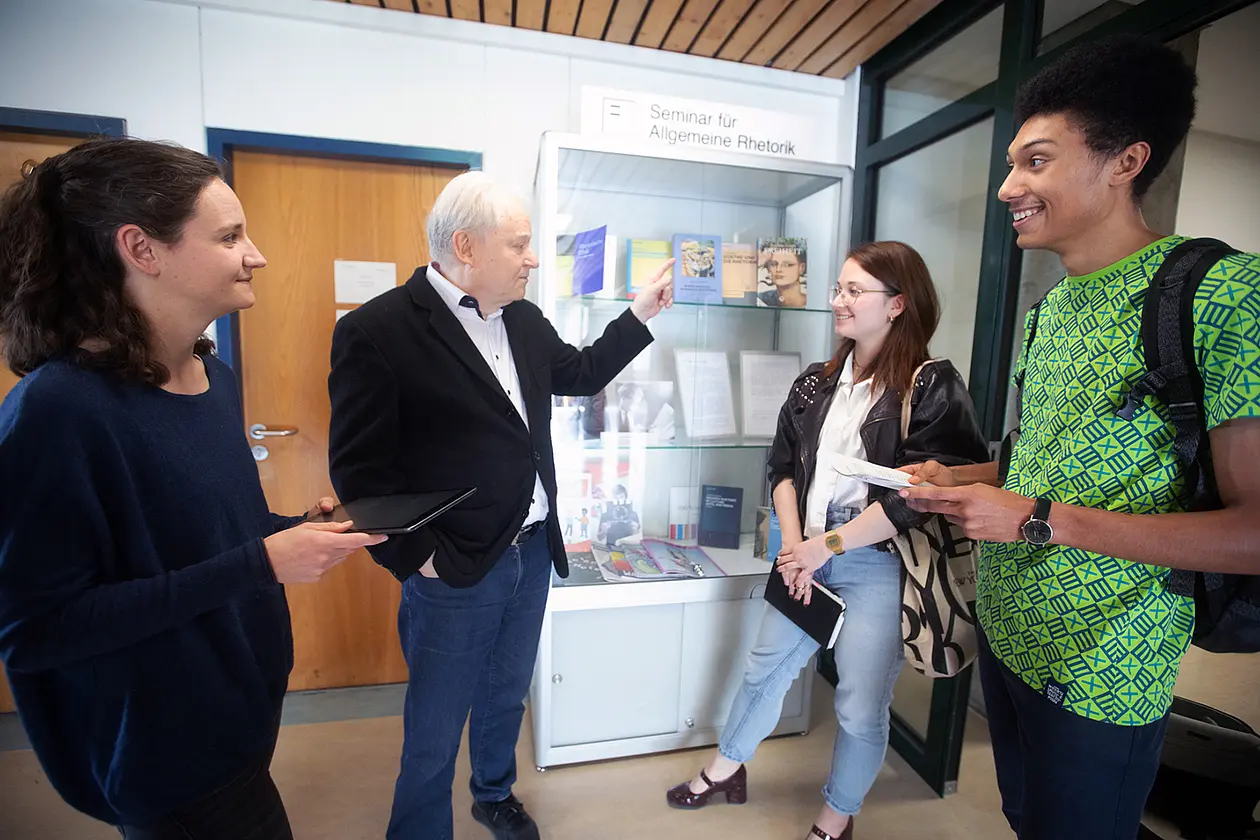
The practice of strategic communication aimed at effective persuasion: in everyday life, in politics, in business, in science.
The theorie of strategic communication, which dates back to ancient Greece and, together with philosophy, represents the oldest systematic theory in European intellectual history.
Science of strategic communication, which is taught at the University of Tübingen at a separate institute with an inter- and transdisciplinary orientation.
The renowned journal Argumentation et Analyse du Discours, edited by Israeli linguist and rhetorician Ruth Amossy, has published a special issue on Tübingen: https://journals.openedition.org/aad/
Machine Talk: What AI Reveals about Conversation (Compact Course)
October 1/2, 2026, 9:00–17:00 each day, Brechtbau, Room 119, University of Tübingen
This short seminar explores conversation as a genre and asks how conversational AI draws on it and reshapes it. We will trace a line from the early history of conversational machines to today's chatbots. Reading theories of conversation alongside literary works, we will consider how dialogue works between humans and machines and develop more reflective ways of talking with AI.
Successful completion of the seminar earns 3 ECTS credits.
Guest Lecture with Dr. Nana Ariel (Tel Aviv University, Israel): A Bug or a Feature? Clichés and the Future of Writing with AI
October 6, 2026, 18:15 , Brechtbau, Room 119, University of Tübingen
The lecture traces the history of the cliché from ancient rhetoric to generative AI, Dr. Ariel will ask whether cliché is a failure of machine-generated language or a fundamental feature of language use, and explore what this question means for the future of writing pedagogy.
Guest Lecture with Dr. Zoltan Majdik (North Dakota State University, USA): How AI Systems Argue … and how to study them
October 27, 2026, 18:15 , Brechtbau, Room 119, University of Tübingen
The lecture focuses on the rhetorical tradition and how it can be used to examine AI systems. In his lecture, Dr. Majdik highlights four ways in which this can be done: as an object, as an instrument, as a rhetorician, and as a site of intervention. Based on this, he argues that persuasion and AI systems have less to do with individual persuasive power and more to do with the norms of rhetorical culture itself.
Inside the Machine: How Language Models Work (Compact Course)
October 28/29, 2026, 9:00–17:00 each day, Room -1.04, Doblerstraße 21/1, University of Tübingen
In the compact seminar, participants will explore the fundamentals of artificial intelligence: how LLMs function, how mathematical algorithms generate text, and how training and fine-tuning shape models. Using the knowledge gained, the seminar will then discuss how AI systems are increasingly influencing the way we communicate and interact with one another. In addition, through hands-on exercises, participants will be empowered to experiment with artificial intelligence on their own and to use it to conduct and reflect on their own research.
Successful completion of the seminar earns 3 ECTS credits.

The institute colloquium always takes place from 18.15 to 19.45 in room 119 of the Neuphilologicum. Organisation: Dr. habil. Franz-Hubert Robling
28.04.2026
Dr. habil. Franz-Hubert Robling: “Textinterpretation: John Bender, David E. Wellbery: Rhetoricality: On the Modernist Return of Rhetoric”
12.05.2026
Prof. Dr. Laura Lindenfeld: “Rhetorik und Wissenschaftskommunikation”
19.05.2026
Dr. Roman A. Seebeck: “Rhetorik des Brückenschlags. Thomas Manns transatlantische Vortragspraxis zwischen politischer Rede und kultureller Vermittlung”
09.06.2026
Prof. John Dryzek: Rhetoric in Democracy
23.06.2026
Jun. Prof. Blake Scott: Argument Strength and the Levels of Its Analysis: An Exercise in Confused Notions
07.07.2026
Alexander Puschmann: “Thukydides‘ Melierdialog als textrhetorisches Problem”
21.07.2026
Dr. Simon Wolf: “Das Publikum verstehen. Prinzipien der Trainingsgestaltung.”
28.07.2026
Dr. Christopher Basgier: The History and Future of US Writing Instruction Across the Curriculum
Studies
Research
Team
Address
University of Tübingen Institute of Rhetoric Wilhelmstraße 50 72074 Tübingen