Hector Research Institute of Education Sciences and Psychology

Hector-Seminar

Talent-Study
Talent Development in Secondary Education - Scientific Monitoring of the Hector Seminar

The Hector-Seminar offers a voluntary and supplementary support programme for gifted secondary school students in the North Baden region. The focus of the support is on an in-depth offer in the STEM area, starting in grade 6 up to the upper school level.

Our Goal

The aim of the longitudinal study is to examine talent development in secondary school and, in this context, to look at support effects and success factors of continuous enrichment. Specifically, we want to find out:

  • How do gifted students develop in secondary school?
  • What are positive developmental factors, and to what extent do gifted students in the STEM fields benefit from participating in the Hector Seminar?
  • What academic skill gains do the students achieve?
  • To what extent does attending the Hector Seminar promote the development of socio-emotional competencies and creativity in gifted students?
The Challenge


Our Solution

Since the 2022/2023 school year, the Hector Research Institute of Education Sciences and Psychology has been providing scientific support for the Hector Seminar and conducting a longitudinal evaluation of the programme.

The scientific support is commissioned by the Hector Foundation II and is initially scheduled to run for four years. The results are presented to the advisory board at least once a year.


Procedure of the Study

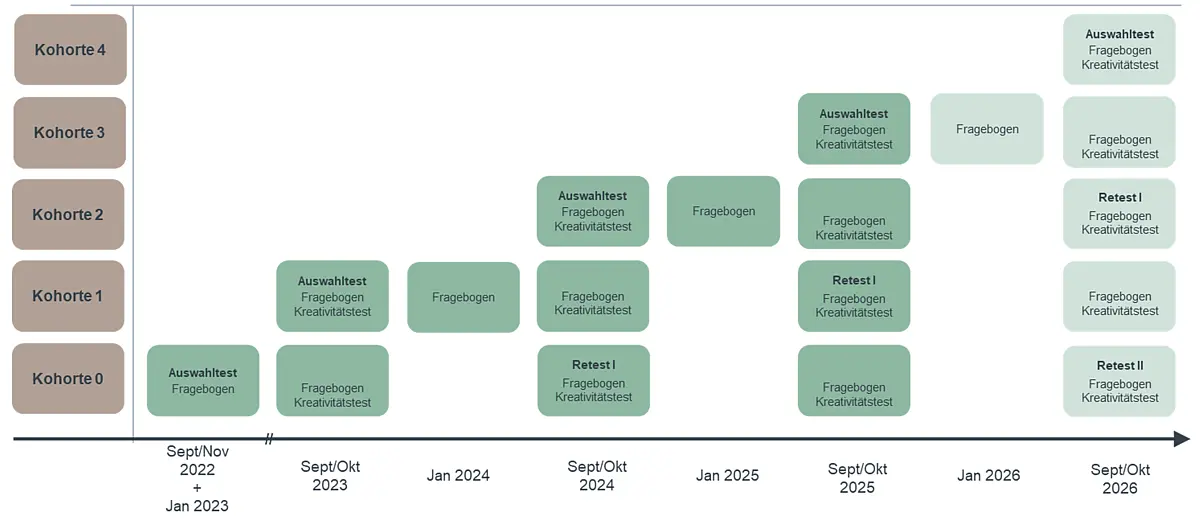
Pupils who are identified as gifted by their teachers are invited to a central selection test for the Hector-Seminar, which is conducted at the beginning of the 6th school year. Of the approximately 800 pupils who take part in the selection test each year, the top ten percent, i.e. 80 pupils per school year, are selected for the Hector-Seminar.

In order to make statements about the general development of gifted pupils and about the effectiveness of the Hector-Seminar, the aim is to include all 800 pupils in the sample each year. The design of the study is to repeat the entrance test every two years.

A shorter test, which can be performed online, will take place annually. Also annually, online questionnaires will be completed by the students and parents. A one-time additional online questionnaire takes place in January of the first year of study participation (see Graph 1).