Astronomy - News
06.07.2026
Congratulations to Dr. Robert McCulloch!
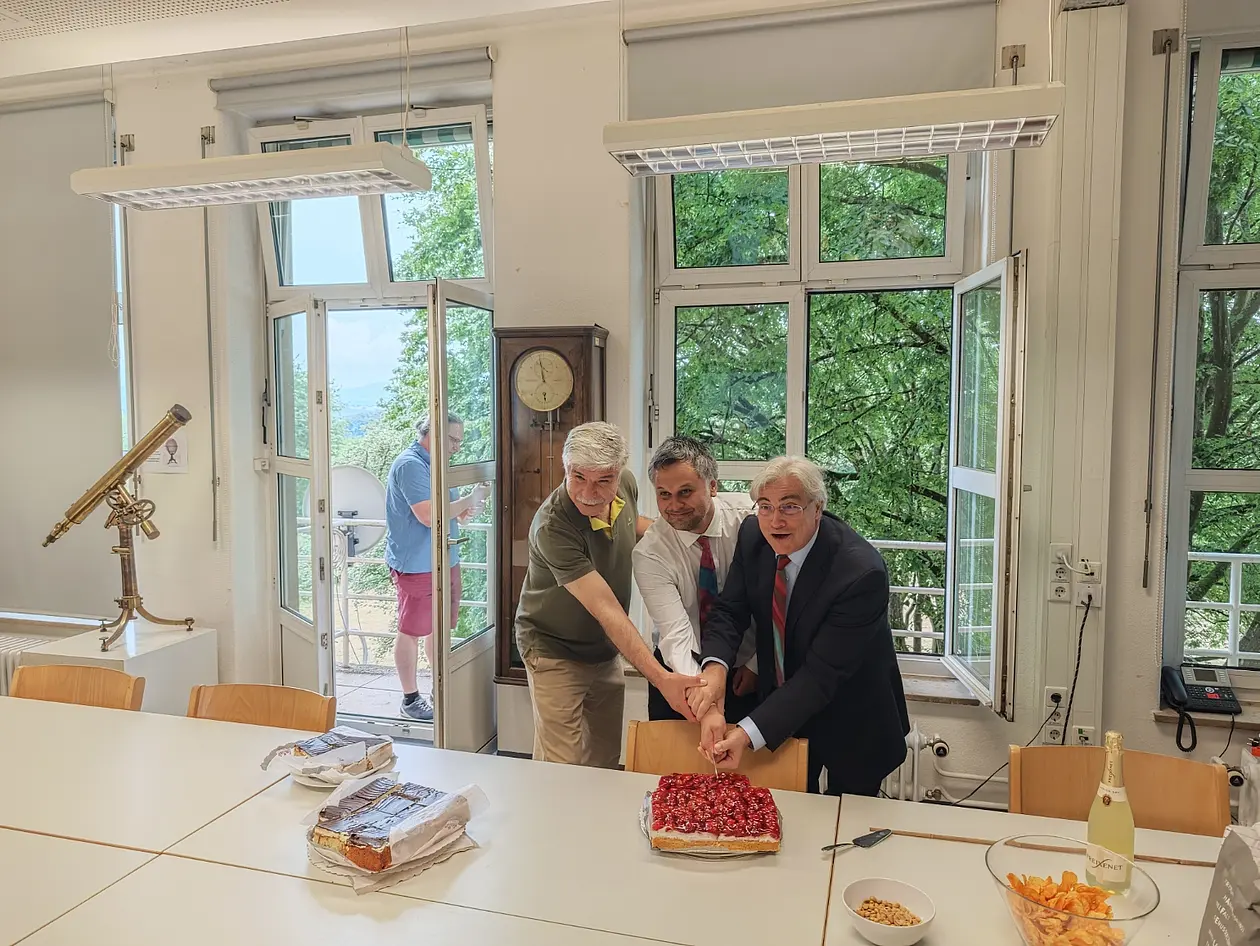
On 1 July 2026, Robert McCulloch successfully defended his doctoral thesis at the Institute for Astronomy and Astrophysics, University of Tübingen, earning the degree of Doktor der Naturwissenschaften

Robert's dissertation, entitled "Investigating the Accretion Structure of Vela X−1 and Cyclotron Resonant Scattering Features in GX 301−2", addresses some of the most challenging problems in the physics of accreting neutron stars. Using observations from ESA's XMM-Newton and NASA's NuSTAR observatories, he investigated how matter from the powerful stellar winds of massive companion stars is captured and channelled by the intense magnetic fields of neutron stars, producing some of the brightest X-ray sources in our Galaxy.
A major achievement of the thesis is the detailed characterization of the complex circumstellar environment of Vela X-1, one of the archetypal wind-fed high-mass X-ray binaries. Through high-resolution X-ray spectroscopy, Robert identified reflected emission from the structured stellar wind, measured the physical conditions and chemical composition of the photoionized plasma surrounding the neutron star. These results provide valuable observational constraints for future hydrodynamical models of wind accretion onto strongly magnetized neutron stars.
In a second major study, Robert performed one of the most comprehensive investigations to date of the cyclotron resonant scattering features in the X-ray pulsar GX 301−2. Cyclotron lines provide one of the very few direct methods for measuring the enormous magnetic fields of neutron stars, reaching trillions of times the Earth's magnetic field. By developing optimized analysis techniques and carefully assessing instrumental and modelling uncertainties, he significantly contributed to the long-standing debate concerning the existence of a second cyclotron line in this source.
The work represents a significant contribution to high-energy astrophysics and strengthens our understanding of how matter behaves under the combined influence of extreme gravity, intense magnetic fields, and powerful radiation.
Robert's graduation is also significant from a broader perspective. He is the first doctoral graduate of Māori heritage to obtain a PhD in Astrophysics at the University of Tübingen. His success reflects both outstanding personal dedication and the increasingly international character of our Institute.
We believe that scientific excellence and diversity go hand in hand. Diversity is most meaningful when it is reflected in opportunities, achievements, and inclusion—not simply in statements of intent. Robert's accomplishment is a clear example that diversity is best demonstrated through actions and success, not only through words.
We warmly congratulate Dr. Robert McCulloch and wish him every success in the next stage of his scientific career.