Interdisciplinary Centre for Global South Studies

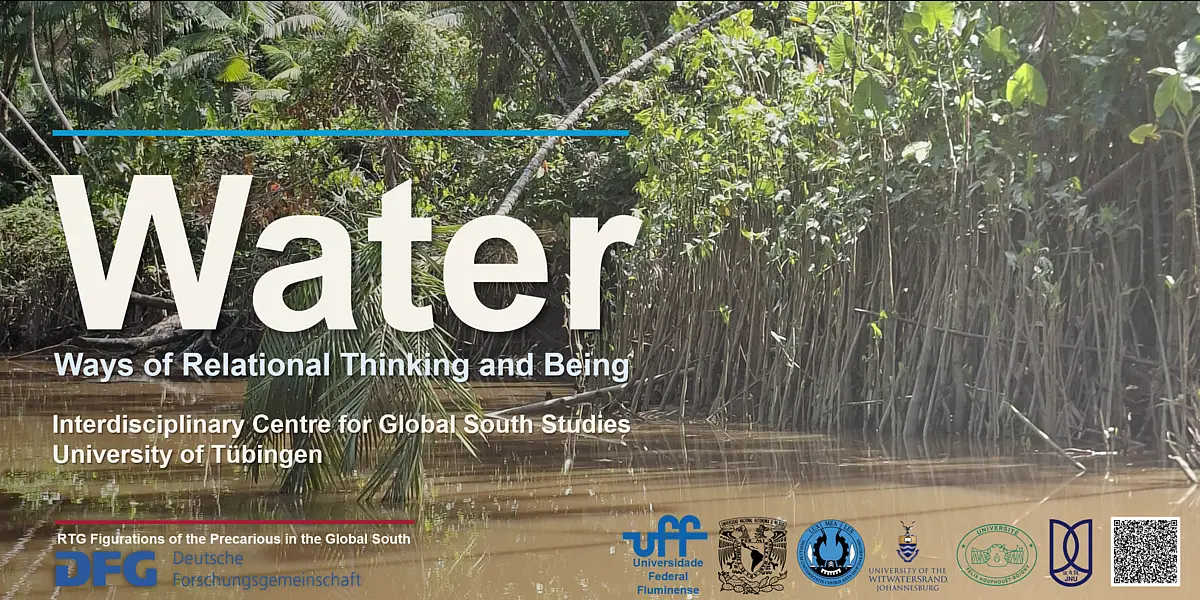
7th International Forum on Global South Studies Water

Ways of Relational Thinking and Being

7th International Forum on Global South Studies

University of Tübingen, 16 to 27 November 2026

Description

The Interdisciplinary Centre for Global South Studies, together with its partner universities, dedicates the seventh International Forum to water: as a substance and a medium, as a way of thinking, and as an ever scarcer commodity. Access to water is central to the survival of humans, animals and plants alike, and lies at the heart of some of today’s most intractable economic and political conflicts.

Taking up the epistemologies of confluence (Bispo dos Santos) and the idea of a world of many worlds (de la Cadena and Blaser), the Forum approaches water as an analytical tool for reading life on our planet across the humanities, the social and political sciences, the earth sciences, and artistic and activist practice. Thinking through water in its material and symbolic dimensions, as water bodies, hydrological ecosystems, hydro-infrastructures and oceans, opens up questions about the relationship between nature and culture, about social practice and political agency, and about what extraction and colonial modernity have done to territories, bodies, languages and memories. Because water is governed as either too much or too little, the Forum attends equally to its absence, bringing oceanic and water studies into dialogue with desert studies.

Over two weeks, scholars, activists and artists from Africa, Asia, Latin America and Europe meet in panels, keynote lectures, workshops, screenings and artistic interventions, on site in Tübingen and at partner universities, and online. Sessions are held in English, Spanish, French and Portuguese.

Topics include the climate crisis, hydropolitics and geopolitics, indigenous knowledges of water, figurations of water in literature, media discourses and the arts, memory and archive, island and ocean studies, blue humanities, the militarisation of water, and gendered relations with water.

Contact: internationalforumtuebingenspam prevention@gmail.com

Organising Committee
Jacky Kosgei (University of Tübingen)
Esteban Morera Aparicio (University of Tübingen)
Adalberto Müller (Universidade Federal Fluminense, Brazil)
Louis Nana (University of Tübingen)

Scientific Committee
Susanne Goumegou (University of Tübingen)
Ángela Iranzo (Universidad Autónoma de Madrid, Spain)
Douglas Andrews (University of the Witwatersrand, South Africa)
Brahma Prakash (Jawaharlal Nehru University, India)
Saliou Dione (Université Cheikh Anta Diop, Senegal)
Louis Obou (Université Félix Houphouët-Boigny, Côte d’Ivoire)
Armando Velázquez (UNAM, Mexico)

Mon, 16th November

14:00-15:30 – Opening event, phase 1 (EN) (Hybrid Event)

Room: Brechtbau 027

Opening of the Forum:

Susanne Goumegou (Universität Tübingen)
Sebastian Thies (RTG Figurations of the Precarious in the Global South

Jacky Kosgei (Universität Tübingen)
Esteban Morera Aparicio (Interdisciplinary Centre for Global South Studies)
Louis Nana (Universität Tübingen)

Opening Panel: Figurations of Water in Guaraní and Maya Mythology

Adalberto Müller (Universidade Federal Fluminense, Brazil) and Kristell Pech-Oxte (University of Tübingen, Germany)

Link access: zoom.us/j/99386707829

16:00-17:30 – Opening event, phase 2 (EN)

Indigenous epistemologies and water knowledge

1. Indigenous Ecologies of Water: Mathie Pani in Grassroots Odisha, India (Pranab Kumar Mandal, Jawaharlal Nehru University, India)
2. Shaping the Indigenous Knowledge of Water: An Ethnographic Inquiry among Chepang Communities in Nepal (Jhabindra Bhandari, Tribhuvan University, Nepal)
3. Shifting Tides: Cyclone Idai, Njuzu and Mhondoro Cosmopolitics, and the Confluence of Relational Ontologies in Zimbabwe's Waterlore (Charles Murata, University of Tübingen, Germany)
4. Knowledge systems and water survival practices in the Seereer community (Birane Sene, Université Cheikh Anta Diop, Senegal)
Link access: zoom.us/j/99386707829


18:00-19:30 – Keynote 1 (EN)

Room: Brechtbau 027

Thinking with Water, Rethinking Migration Politics: Power, Spectrality and Death along the Atlantic Route to Europe
Ángela Iranzo (Universidad Autónoma de Madrid, Spain)
Link access: zoom.us/j/99386707829


Tue, 17th November

14:00-15:30 – Panel 1 (PT)

Literatura e representações da água

1. O fim do mundo, o fim da “natureza”: viver nas ruínas em Ana Paula Maia (Natália Lima Ribeiro, University of Hamburg, Germany)
2. Praias fora do mundo (Nathália Cioffi de Lima, University of Coimbra, Portugal)
3. Balada da Traição do Mar: simbologia, imaginário e identidade marítima nas canções do Festival RTP da Canção (Gil Duarte Ribeiro, Universidade do Porto, Portugal)
Link access: zoom.us/j/99386707829

14:00-15:30 – Panel 3 (EN)

Hydrocolonialism, extraction and dispossession

1. Hydrocolonialism, Extractivism, and Biopolitics in Helon Habila's Oil on Water and Imbolo Mbue's How Beautiful We Were (Lassana Kanté, Université Cheikh Anta Diop, Senegal)
2. Hydropolitics and Self-Provisioning in Postcolonial Côte d'Ivoire: SODECI, Water Distribution, and Urban Water Scarcity (Ahmadou Siendou Konaté, Université Félix Houphouët-Boigny, Côte d'Ivoire)
3. Undamming the River: Confronting the Absence of Dam Removal in the Global South (Monti Aguirre, International Rivers)
4. Amazonia, A World of Water: Rethinking rivers and infrastructure in the early twentieth century (Javier Uriarte, Stony Brook University, United States)
Link access: zoom.us/j/98649288365 

16:00-17:30 – Panel 2 (EN)

Literary imaginaries of water

1. Imaginarios anfibios y organización comunitaria en Tierra mojada de Manuel Zapata Olivella (Nicolás Sepúlveda Perdomo, Friedrich-Schiller-Universität Jena, Germany)
2. Putting Water in Dialogue with Air in Mackintosh's The Water Cure (Isabel María Osuna Montilla, University of Tübingen, Germany)
3. Water between Cosmos and Subsoil: Bodily Invasion and Extractivism in Giovanna Rivero's Alma oscura del alba (Annabelle Katharina Jerger, University of Tübingen, Germany)
4. Underwater bestiary: Paula Sampaio's photo essay of the Tucuruí Dam's lake (Roberto Robalinho, Centro Técnico do Audiovisual (CTAv), Brazil)
Link access: zoom.us/j/99386707829

18:00-19:30 – Panel 4 (ES)

Tramas sensibles del agua: Puel Mapu / Abya Yala

1. Desbordar las formas: multilingüismo, multimodalidad y multigenericidad en las nuevas antologías sobre el agua en Abya Yala (Melisa Stocco, CONICET; CELLPA-UNP, Argentina)
2. Sujeto de lucha, agencia y respeto: el agua en la poesía mapuche contemporánea (Viviana Ayilef, CELLPA-UNP, Puel Mapu/Argentina)
3. Escuchar el cauce o desaparecer: cartografía sonora como práctica de cuidado en torno al río Chubut (Paulo Paniagua, Universidad Nacional del Arte, Argentina)
Link access: zoom.us/j/99386707829
 

Wed, 18th November

10:00 – Panel (EN) (Hybrid Event)

[Entangled Relations] of Artificial Intelligence and Water: Conflicts over Infrastructures, Epistemologies, and Power in Latin America

Beatrice Bonami (University of Edinburgh, United Kingdom); Francielle Vargas(Universidad de Chile); Anne Burkhardt (University of Tübingen, Germany)

ICGSS Working Group on “AI and Global Justice”
Link access: zoom.us/j/99386707829

14:00-15:30

Invited lecture of the AI day (PT)

Our land is not a backyard for data centres: Anacé cosmologies, spectral warnings and the struggle for the Kauipe river
Paulo Anacé


Chair: Javier Uriarte (Stony Brook University, United States)
Link access: zoom.us/j/99386707829

16:00-17:30 – Panel 5 (EN)

Memory, archive and the colonial past

1. Water, Memory and Slavery in the Autobiographical Narrative (Ahou Alphonsine N'Guessan, Université Félix Houphouët-Boigny, Côte d'Ivoire)
2. What Water Cannot Keep: Poetic Form and the Mediterranean as Liquid Archive in A. E. Stallings's “Refugee Fugue” (Maria Nefeli Giannia, University of Tübingen, Germany)
3. Africas in the Mediterranean: cinema of Africa's trans-continental illegal migration (Addamms Mututa, University of Johannesburg, South Africa)
4. The Drowned Archive: Cinema, Caste and the Non-Blue Waters of Kuttanad (Arun Kumar N. A, English and Foreign Languages University, India)
Link access: zoom.us/j/99386707829

16:00-17:30 – Panel 6 (EN)

Sacred waters and religious geographies

1. Buddhist sacred geographies in the Himalayan region: connecting Khecheopalri Lake in West Sikkim and Rewalsar Lake in Himachal Pradesh (Debraj Chhetri, University of North Bengal, India)
2. Religious Responses to Water Scarcity on the Canary Islands (Laura Dierksmeier, University of Tübingen, Germany)
3. Saint waters: Other-than-human landscapes in the Reinado of Chapada do Norte (Iasmyn Lídia Gonçalves, Universidade Federal de Minas Gerais, Brazil)
4. Cosmologias indígenas e paisagens aquáticas em Mar Paraguayo de Wilson Bueno (Ana Clara Demier Gonçalves Silva, Universidade Federal Fluminense, Brazil)

Link access: zoom.us/j/98649288365 
 

Thu, 19th November

09:00-16:00

Workshop (EN) (Hybrid Event)

Making Peace with Nature. Many Methods, Many Worlds

Wendy He, Andrzej Stuart-Thompson, and Rachel Macreadie

Co-organised with the Global Encounters platform, University of Tübingen, Germany

Location: 
College of Fellows
Villa Köstlin, Rümelinstr. 27
72070 Tübingen
Link access: zoom.us/j/99386707829

14:00-15:30 – Panel 7 (EN)

Science, climate and water futures

1. Weather engineering by sea water evaporation in arid depressions (Reinhold F. Fink, University of Tübingen; Majda Sekkal-Rahal, University of Sidi Bel Abbès, Algeria; Heidi Megerle, Hochschule für Forstwirtschaft Rottenburg)
2. The Water We Owe: Rethinking Justice in the Anthropocene (Janflor Mc.Louie S. Ullero and John Christopher V. Dela Cruz, National University, Philippines)
3. Imaging Water: Listening as Method Across Deep and Urgent Times in the Cradle of Humankind (Meghan Judge, University of the Witwatersrand, South Africa)
4. Governing Water, Governing Knowledge: Indigenous Epistemologies and the Politics of Sanitation in India (Himanshu Khanna and Dewang Mishra, University of Delhi, India)
Link access: zoom.us/j/99386707829

16:00-17:30 – Panel 8 (EN)

Water, Ecologies and Religious Rituals in India: Ambiguities and Intersection

Ludovica Tozzi (Sapienza University of Rome)

Souraja Chakraborty (University of Tübingen), 

Mukul Menon(University of Tübingen) 


Link access: zoom.us/j/99386707829

17:00-18:30 – Hybrid event hosted by UNAM (ES) (Hybrid Event)

Figuraciones del agua en la literatura, los discursos mediáticos y las artes

Ana Vallarta (University of Tübingen)

Armando Octavio Velázquez Soto (Universidad Nacional Autónoma de México)

Gabriela González Ortuño (Universidad Nacional Autónoma de México) 

Emilio Gordillo Lizana (Universidad Diego Portales, Chile) 

Location: Universidad Autónoma de México
Link access:

19:00-20:30

Screening and discussion (ES)

Guardianes del Río Colorado. Reflexiones sobre las luchas por el agua en territorios fronterizados


Escuelita de Comunicación Popular Grafito Activo, Mexicali, Mexico
Link access: zoom.us/j/98649288365 

Fri, 20th November

14:00-15:30 – Panel 9 (EN)

Rivers, poetics and more-than-human worlds

1. Poetics of Rivers: The Ganga, Yamuna, and Human–Nonhuman Worlds in Early Modern South Asia (Nagwant Singh, University of Delhi, India)
2. From Gomukh to Gangasagar: Mapping Riverine Entanglements in Songs of the River (Vanya Jaiswal, independent research scholar, India)
3. Hydrohermeneutics: Amazonian Indigenous Water Cultures in Poetry and Art (Patrícia Vieira, University of Coimbra, Portugal)
4. Thinking through Water: The Orinoco, Extractivism, and Coloniality in Chris Gude's Morichales (Laura Meltke, University of Technology Chemnitz, Germany)
Link access: zoom.us/j/99386707829

16:00-17:30 – Panel 10 (EN)

Living with Water: Collective Action, Knowledge and research-Creation across Colombian Waterscapes

Juliana Marín Taborda (moderator); Carlos Alberto Palacio Tobón; Natalia Quiceno Toro; Ana María Vallejo de la Ossa; Flora Rodríguez; Alex Rufino (Universidad de Antioquia, Colombia; Université Toulouse – Jean Jaurès, France; Semillas Ticunas)
Link access: zoom.us/j/99386707829

16:00-17:30 – Artistic intervention (EN)

What the River Knows: Damming the Global South Through the Lens of the Xingu River

Ana Luisa Linan Aguilar (University of Tübingen, Germany)
Link access: zoom.us/j/98649288365 


Mon, 23rd November

14:00-15:30 – Panel 11 (ES)

Agua, memoria y archivo urbano

1. El río Tijuana y Cartolandia: un análisis sobre cambio urbano a mediados del siglo XX y la consecuente construcción colectiva de memoria (Pilar Adriana Rey Hernández, Universidad Autónoma de Baja California, Mexico)
2. Lo que no existe: anámnesis del agua en el paisaje socioterritorial (Lourdes Sofía Mendoza Bohne, Universidad de Guadalajara, Mexico)
3. Hidrocolonialismo en la cuenca del río Colorado y Memorias del Agua: herramientas para la construcción de un pensamiento rebelde en la frontera México-Estados Unidos (Blanca Nathalia Carrillo Ortiz, Universidad Autónoma de Baja California; Jessica Sevilla, Archivo Familiar del Río Colorado; Malena Manríquez, Comunidades Eclesiales de Base-Mexicali; Gabriela González Ortuño, Universidad Nacional Autónoma de México)
Link access: zoom.us/j/99386707829

14:00-15:30 – Panel 12 (EN)

Watery Aesthetics and Fluid Economies: Neoliberal Extractive Encounters in Selected Cultural Imaginaries from Africa

1. Kule: Sinking as Condition and Metaphor (Ryan Poinasamy, University of the Witwatersrand, South Africa)
2. Liquid Violence: The Effluent and Refusal in Imbolo Mbue's How Beautiful We Were (2021) (Buhle Dlodlo, University of the Witwatersrand, South Africa)
3. The Politics and Poetics of the Lesotho Highlands Water Project in Jeremiah Mosese's This Is Not A Burial, It's A Resurrection (2019) (Luck Makuyana, University of the Witwatersrand, South Africa)
4. The Islands: Hydropolitics of the Lesotho Highlands Project (Nina Barnett, University of Johannesburg, South Africa)


Link access: zoom.us/j/98649288365 

16:00-17:30 – Panel 13 (EN)

Water, gender and resistance

1. Hydro-Literacy and Moving Beyond Victims: Women's Water Knowledge and Ecofeminist Resistance in Chioma Okereke's Water Baby (2024) and Jennifer Nansubuga Makumbi's A Girl Is a Body of Water (2020) (Oulimata Diop, Université Cheikh Anta Diop, Senegal)
2. Where Women Linger: The Water Source as Third Space in Southern African Literature (Connie Joseph, University of the Western Cape, South Africa)
3. Writing the decline of the aquatic ecosystem in A Long Walk to Water by Linda Sue Park: A Gynocentric Approach (Amara Diabaté, Université Félix Houphouët-Boigny, Côte d'Ivoire)
4. Sea as Mother (Kadalamma): Religion, Gender, and Traditional Ecological Knowledge among Kerala's Traditional Fisherfolk (Asya Dilsha M.P, University of Tübingen, Germany)


Link access: zoom.us/j/99386707829

18:00-19:30 – Critical Conversation (ES)

International relations and pluriversal water governance

1. Pluriversal water governances (Amaya Querejazu Escobari, Universidad de Antioquia, Colombia)
2. Del barco negrero al barco negro (Wooldy Edson Louidor, Ambassador of Haiti to Spain)
3. Pluriversal worlds at the impasse between critique and the political (Ignasi Torrent, Open University of Catalonia, Spain)
Chair: Ángela Iranzo (Universidad Autónoma de Madrid, Spain)


Link access: zoom.us/j/99386707829

Tue, 24th November

14:00-15:30 – Panel 14 (PT)

Human Development, Families, and Territories: Experiences and Responses to Socio-Hydrological Transformations in the Brazilian Amazon

Jonas Carvalho e Silva and Cristiane Batista Salgado (coordinators) and eleven further contributors (Universidade Federal do Pará; Federal Institute of Brasília; TU Dortmund, Germany; Integrated College of the Amazon; University of Tübingen, Germany; University of Illinois Springfield, United States)
 

Link access: zoom.us/j/99386707829

16:00-17:30 – Panel 15 (EN)

Water governance, geopolitics and diplomacy

1. Water, Power, and Hydro-Diplomacy: Heterarchical Resource Governance in the Middle Senegal Valley (Alioune Deme, Université Cheikh Anta Diop, Senegal)
2. The Geopolitics of Water: Between Governing Thirst and Water Control in the Sahel and Lake Chad Basin (Moussa Sy, Université Cheikh Anta Diop, Senegal)
3. The South Atlantic as a Relational Ocean: Trade, Maritime Insecurity and South-South Cooperation in the Zone of Peace and Cooperation of the South Atlantic (ZOPACAS) (Vitor Piagetti Aimi, Universidade Federal do Rio Grande do Sul, Brazil)


Link access: zoom.us/j/99386707829

18:00-19:30 – Panel 16 (EN)

Ways and Waves: Imaginaries, Epistemology, Borders

Eva Nossem (Saarland University, Germany)

Astrid M. Fellner (Saarland University, Germany) 

Tobias Schank (Saarland University, Germany)


Link access: zoom.us/j/99386707829

Wed, 25th November

14:00-15:30 – Panel 18 (EN)

Hydrocolonial Currents: Water, Violence and Agency in Selected Cultural Imaginaries

1. Echoes on Water: Refiguring Cycles of Liquid Violence in Selected Visual Narratives (Buhle Dlodlo, University of the Witwatersrand, South Africa)
2. Some Kinds of Floods: Hydro-modernity and Indigenous Hydro-cosmologies in Namwali Serpell's The Old Drift (2019) (Luck Makuyana, University of the Witwatersrand, South Africa)
3. Thinking with Water: Hydro-Colonialism and More-Than-Human Agency in Khadija Abdalla Bajaber's The House of Rust (Dianaross Rono)
4. Conscious Drowning: Water, Consciousness, and the Limits of Agency in Amitav Ghosh's Sea of Poppies (2008) (Alexandra Wiorek)
 

Link access: zoom.us/j/99386707829

14:00-15:30 – Panel 17 (FR)

Eau, société et imaginaires de l'eau I

1. De l'inégalité de genre et de l'autonomisation des femmes dans l'économie bleue au Sénégal : une approche écoféministe et stiwaniste (Saliou Dione, Université Cheikh Anta Diop, Senegal)
2. Vivre avec l'eau en banlieue dakaroise : entre précarité hydrique, solidarités communautaires et quête de bien-être (Khadim Dieng, Université Cheikh Anta Diop, Senegal)
 

Link access: zoom.us/j/98649288365 

16:00-17:30 – Keynote and on-site event at UCAD (FR) (Hybrid Event)

L'eau au Sahel : source de vie, de joie et de larmes

Amadou Oury Ba (Université Cheikh Anta Diop, Senegal)
Link access: 

18:00-19:30 – Panel 19 (FR)

Eau, société et imaginaires de l'eau II

1. Les images de l'eau dans le roman africain postcolonial : entre crime et châtiment (Stéphane Amougou Ndi, Université de Yaoundé 1, Cameroun)
2. Appellations endogènes et écosymbolicité de l'eau dans les proverbes du Nord-Cameroun (Jean Bognare, Université de Maroua, Cameroun)
3. Le rapport des Dida de la région du Lôh Djiboua aux eaux du Boubo, une tradition du « possibilisme » à valeur antispéciste (Louis Obou, Université Félix Houphouët-Boigny, Côte d'Ivoire)


Link access: zoom.us/j/98649288365 

Thu, 26th November

14:00-15:30 – Panel 20 (EN FR)

Decolonial Hydropoetics of the Pluriverse

Ben Spatz; María Florencia Iannuzzi Dolmann; Vanessa Lee; Neli Dobreva (University of Birmingham, United Kingdom; Université de Perpignan Via Domitia, France; Universitat de Girona, Spain; Université Côte d'Azur, France; Université Paris 1 Panthéon-Sorbonne, France)


Link access: zoom.us/j/99386707829

16:00-17:30 – Panel 21 (EN FR)

Dreaming-Thinking with Water: Pluriversal Hydroresistances

Ailin Calderon; Alberto Jori; Aline Bernardo da Silva; Yamile Villamil Rojas (Université Toulouse – Jean Jaurès, France; University of Tübingen, Germany; University of Ferrara, Italy; Universidade Federal Fluminense, Brazil; Université du Québec à Montréal, Canada)


Link access: zoom.us/j/99386707829

16:00-17:30 – Panel 22 (PT)

Cosmologias, oralidade e memória

1. A Grande Enchente e a origem dos brancos em A queda do céu (Izabela Leal, Universidade Federal do Pará, Brazil)
2. O rio-mulher e a mulher como rio: uma leitura ecocrítica ancestral do corpo-território feminino em O som do rugido da onça (2021) (Thaynara Souza Batista, Universidade Federal do Espírito Santo, Brazil)
3. Água, memória e pertença: imaginários hídricos na literatura oral tradicional portuguesa (Natália Albino Pires, Polytechnic University of Coimbra; Vanessa Henriques Antunes, Centre for Historical Studies of Lourinhã, Portugal)


Link access: zoom.us/j/98649288365 

18:00-19:30 – Keynote (ES) (Online)

Water in literature, the Guaraní aquifer and indigenous thought on water

Nancy Calomarde (Universidad Nacional de Córdoba, Argentina)


Chair: Adalberto Müller (Universidade Federal Fluminense, Brazil)


Link access: zoom.us/j/99386707829

Fri, 27th November

14:00-15:30 – Panel 24 (ES)

Imaginarios del agua en la literatura y el cine

1. Pensar desde el agua: imaginarios hidrológicos y epistemologías del Sur en Habana Underguater de Erick J. Mota (Aída Chacón Castellanos, SECIHTI-IIFL, Mexico)
2. Pensar con el agua desde lo audiovisual: perspectivas relacionales en el cine mapuche (Christina Enders, Friedrich-Schiller-Universität Jena, Germany)
3. Las aguas del acuífero guaraní en la mirada jesuita: entre el control económico y la fascinación (María José Sabo, IDH-CONICET; Universidad Nacional de Córdoba, Argentina)


Link access: zoom.us/j/99386707829

16:00-17:30 – Panel 25 (EN)

Scarcity, infrastructure and community agency

1. The archive of drying streams: listening to water, voice and scarcity in Kericho's semi-arid margins (Carolyne Cherotich Rono, University of Kabianga, Kenya)
2. Beyond Infrastructure: Water, Community Agency and Decolonial Governance in Rural Senegal (Youssouf Diallo, Université Cheikh Anta Diop, Senegal)
3. Water Stress in a Water-Rich Country? Agroforestry Systems as a Solution Strategy? (Heidi Elisabeth Megerle and Jannis Bahnmüller, Hochschule für Forstwirtschaft Rottenburg, Germany)
4. The Adivasi versus Coca-Cola. A local environmental conflict and its global resonance (Bernd-Stefan Grewe, University of Tübingen, Germany)


Link access: zoom.us/j/99386707829

18:00-19:30 – Keynote and closing session (EN)

Problematics of Water in Performance: Spectacle, body and agency

Kimingichi Wabende (University of Nairobi, Kenya)


Chair: Jacky Kosgei (University of Tübingen, Germany)


Link access: zoom.us/j/99386707829

Partner universities

Organising Committee
Jacky Kosgei (University of Tübingen)
Esteban Morera Aparicio (University of Tübingen)
Adalberto Müller (Universidade Federal Fluminense, Brazil)
Louis Nana (University of Tübingen)

Scientific Committee
Susanne Goumegou (University of Tübingen)
Ángela Iranzo (Universidad Autónoma de Madrid, Spain)
Douglas Andrews (University of the Witwatersrand, South Africa)
Brahma Prakash (Jawaharlal Nehru University, India)
Saliou Dione (Université Cheikh Anta Diop, Senegal)
Louis Obou (Université Félix Houphouët-Boigny, Côte d’Ivoire)
Armando Velázquez (UNAM, Mexico)