
"The best way to decolonize this agenda is to speak of a plurality of natures"
Interview with Amaya Querejazu, Global Encounters Fellowship
Prof. Dr. Amaya Querejazu, researcher at the Universidad de Antioquia (Colombia), is visiting Tübingen as a fellow of the Global Encounters Fellowship scheme, whose theme this year is peace with nature. Her work critically examines dominant frameworks of environmental governance and proposes alternative relational approaches grounded in decolonial thought.
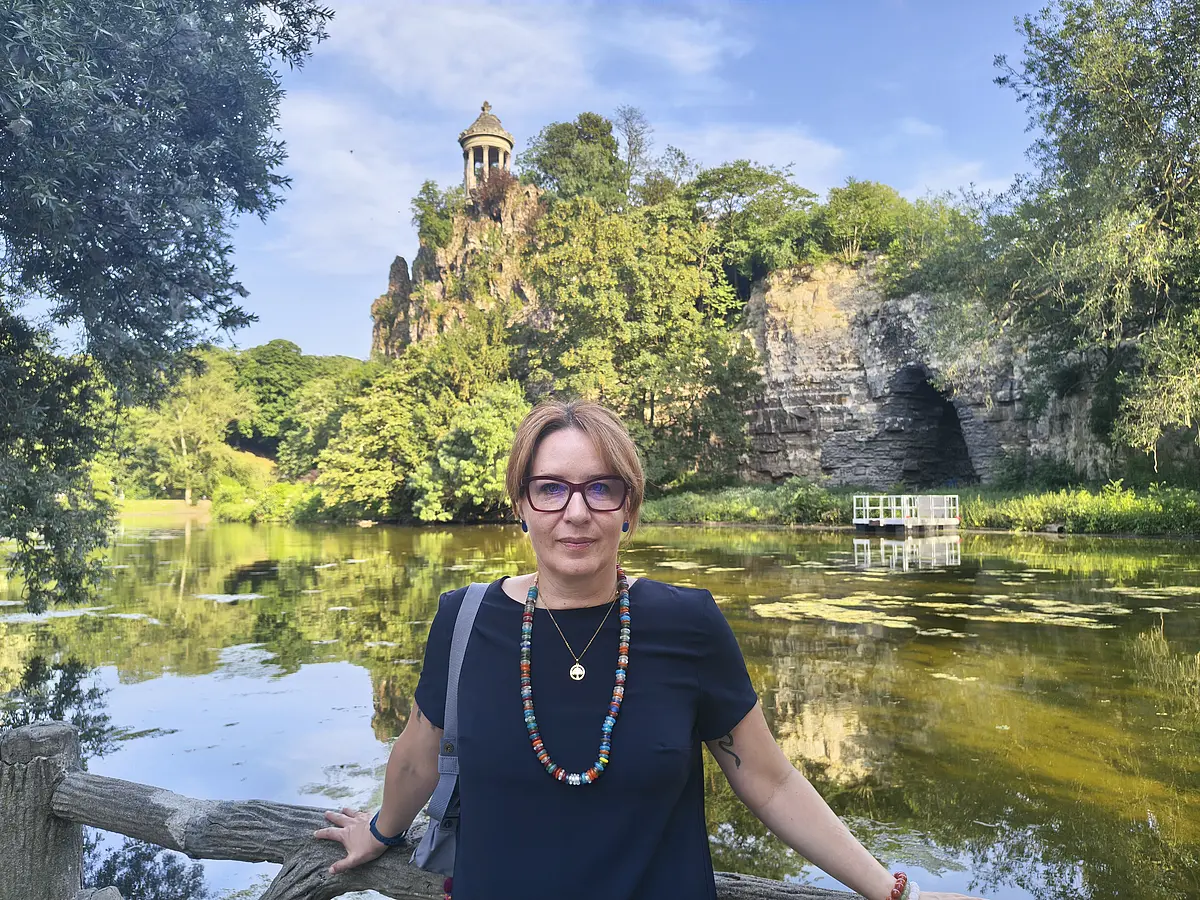
Interview · Global Encounters Fellowship · Tübingen
V.W. — Your research focuses on peace with nature. Why do you think current approaches to environmental crises are no longer sufficient?
I believe I was granted this fellowship because I hold a very critical view of what "peace with nature" means, as it frames the landscape of governance in a very binary way: either we act as heroes who save nature, or as people who are in conflict with it. I think this is highly problematic, because it renders invisible the plurality that lies between this dichotomy — for instance, people who already live in balance or in harmony with nature. Furthermore, this is not a teleological project; it is something you cultivate constantly through everyday practices. Peace with nature requires ongoing negotiation, and demands that we see nature as an active agent in our lives, rather than as a passive object at the service of human beings. Current approaches are no longer sufficient because everything is framed in anthropocentric terms. If we shift this paradigm toward a more ecocentric one, we can begin to see that nature is not merely a resource, but also a living entity, or the home of many entities that coexist with human beings.
V.W. — In your lecture you speak about the plurality of nature. What does this idea mean in practice?
When the United Nations Secretary-General calls for a peace with nature program, the encapsulating use of the term "nature" — as though everyone understands it in the same way — is also problematic, because it leads to absolute truths. Every community around the world may have a different understanding of what nature is: it can be an intelligent living entity, a home, a network of collaborating species, or it can shift its identity. Many Indigenous communities have no single word for nature, because its meaning depends on the kind of relationship one is engaging with, as well as on the specific moment and community being considered. I therefore believe that the best way to decolonize this agenda is to speak of a plurality of natures, and of the possibilities this plurality may bring to thinking alternatively about what it means to have a better relationship with what we might call nature.
V.W. — You work with concepts such as relational ontologies and cosmopraxis. How can these ideas become meaningful beyond academic debates?
I think it is actually the other way around. Cosmopraxis is already a well-established practice throughout the world. It refers to how we engage daily with everyday life — we can find it in the ways we eat, dance, sing, or dream. It refers to how the experience of living, knowing, and being happens to us simultaneously: we cannot detach ourselves from reality in order to know it from the outside; we come to understand reality at the same time that we experience life. What I have tried to do is make cosmopraxis meaningful within academic debates, because it is through colonial gazes that these practices are not considered as facts, data, or serious theories. My political commitment is for these relational cosmologies to be taken seriously in academia.
V.W. — What role do Indigenous and Afro-descendant perspectives play in imagining new ways of relating to nature?
I think they have a unique connection to nature — but this must be approached with care, because I do not mean to essentialize that belonging to an Indigenous community will always entail a closer connection to nature. What working within a decolonial or postcolonial framework means is recognizing that these Afro-descendant and Indigenous ways of engaging with nature are important because, in Western contexts, we have forgotten how to connect with nature. Indigenous peoples and Afro-descendant communities live within relational cosmologies, which means that the human being is understood as part of nature, natural environments, and spiritual ways of engaging with it — all of which offer important lessons on ethical commitments toward the environment. They should be considered as integral to global environmental governance and policy.
V.W. — You argue that peace with nature is not a universal solution but an ongoing practice. What can societies in Europe learn from this perspective?
What I aim to propose in my research here is a concept I call pluriversal diplomacies. Diplomacy is an institution traditionally belonging to international relations, but if, instead of thinking about making peace with nature, we take seriously these diplomacies as an ongoing conversation — as establishing contact and negotiation with a radical other, which can be the environment, a specific species, or a specific spirituality — then we adopt a more humble approach to cultivating our engagement with our surroundings. I believe Europe is also part of the pluriverse, and that there are many worlds within Europe as well. There is already much happening in Europe that can count as pluriversal diplomacies. Europe is not outside of this conversation, and that is an important acknowledgment.
Recent Publications by Amaya Querejezu
2026
2025
Pluriversal IR in the classroom
Alternatives: Global, Local, Political, 0(0)
2025
Naturaleza(s)
In A. Iranzo, I. Ruiz-Giménez & M. Iñiguez Heredia (eds.), Manual de estudios críticos: cartografías disidentes para comprender las relaciones internacionales. Madrid: Tirant lo Blanch
2024
Are the international tribunals of rights of nature pluriversal?
International Relations, 38(3), 369–387
2024
Animacy and the agency of spiritual beings in pluriversal societies
International Political Sociology, 18(2)