
03.12.2025
Digital Education Day 2025: Bridging Technology and Education
Digital Education Day 2025 brought together experts from research, technology, and school practice in Tübingen on December 2. Under the motto "Bridging Technology and Education," they discussed how interdisciplinary collaboration contributes to the effective integration of digital technologies in educational contexts.
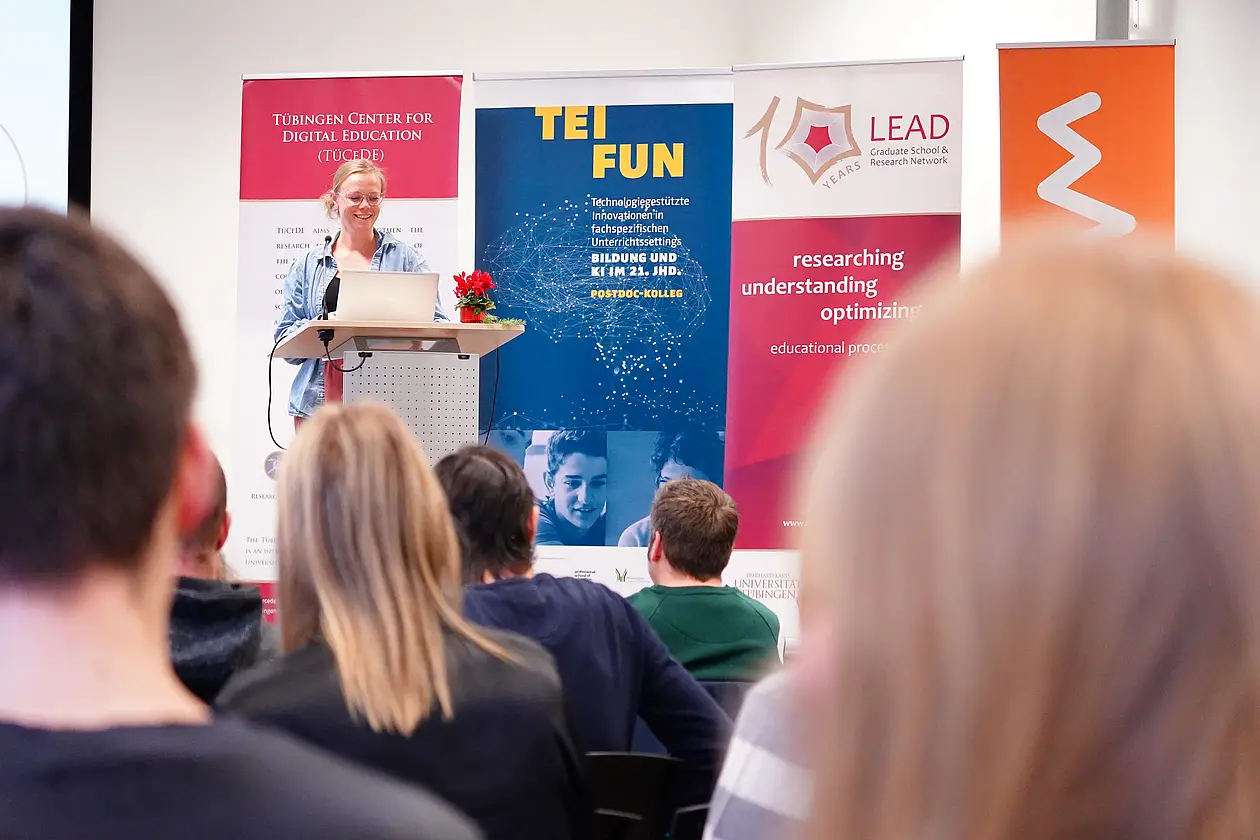
Under the motto "Bridging Technology and Education," this year's Digital Education Day took place in Tübingen on December 2, 2025. The joint event, organized by the Tübingen Center for Digital Education (TüCeDE), the Tübingen School of Education (TüSE), the LEAD Graduate School & Research Network, and the Leibniz Institute for Knowledge Media (IWM), brought together experts from the Tübingen ecosystem around digital education. The focus was not only on exchanging ideas about current developments, but above all on the question of how education and technology can be conceived and developed together.
This idea was already taken up in the keynote speech by Jacqueline Bellon (IZEW). Using the example of artificial intelligence, she showed why close cooperation between the fields of technology, ethics, and education is crucial for shaping technical innovation in a responsible and effective way. This impetus led directly into the workshop program, in which Caroline Schmidt (AI Makerspace Tübingen), Stefan Kohlmeier (SAP), and Florian Hofmann (University of Erlangen–Nuremberg) worked with participants on how communication can be designed as a connecting bridge between technical and educational perspectives.
This interdisciplinary focus continued in the afternoon: the Technology and Education Fair offered insights into ongoing research and development projects and provided an opportunity for spontaneous, practical exchange. The subsequent panel discussion followed on from this and focused on a key question: what skills will a technology-supported school of the future need? Representatives from school (Nina Klett), computer science education (Barbara Pampel), educational psychology (Benjamin Nagengast), and computational neuroscience (Matthias Bethge) examined this question from different professional perspectives and made it clear how closely pedagogical, technical, and scientific expertise must work together.
Digital Education Day clearly demonstrated the potential that lies in dialogue between disciplines, especially when working together to integrate technologies into educational contexts in a meaningful and effective way. The organizers would like to express their sincere thanks to all participants for their enthusiastic involvement, stimulating discussions, and numerous ideas.
See you next year!