
News
03.11.2026
Mattia Bottino Joins the IfP as Visiting Fellow
The Italian-Brazilian researcher will spend three months at the European Centre for Research on Federalism (ECRF/EZFF), exploring decolonial approaches to federalism and popular self-government in Latin America
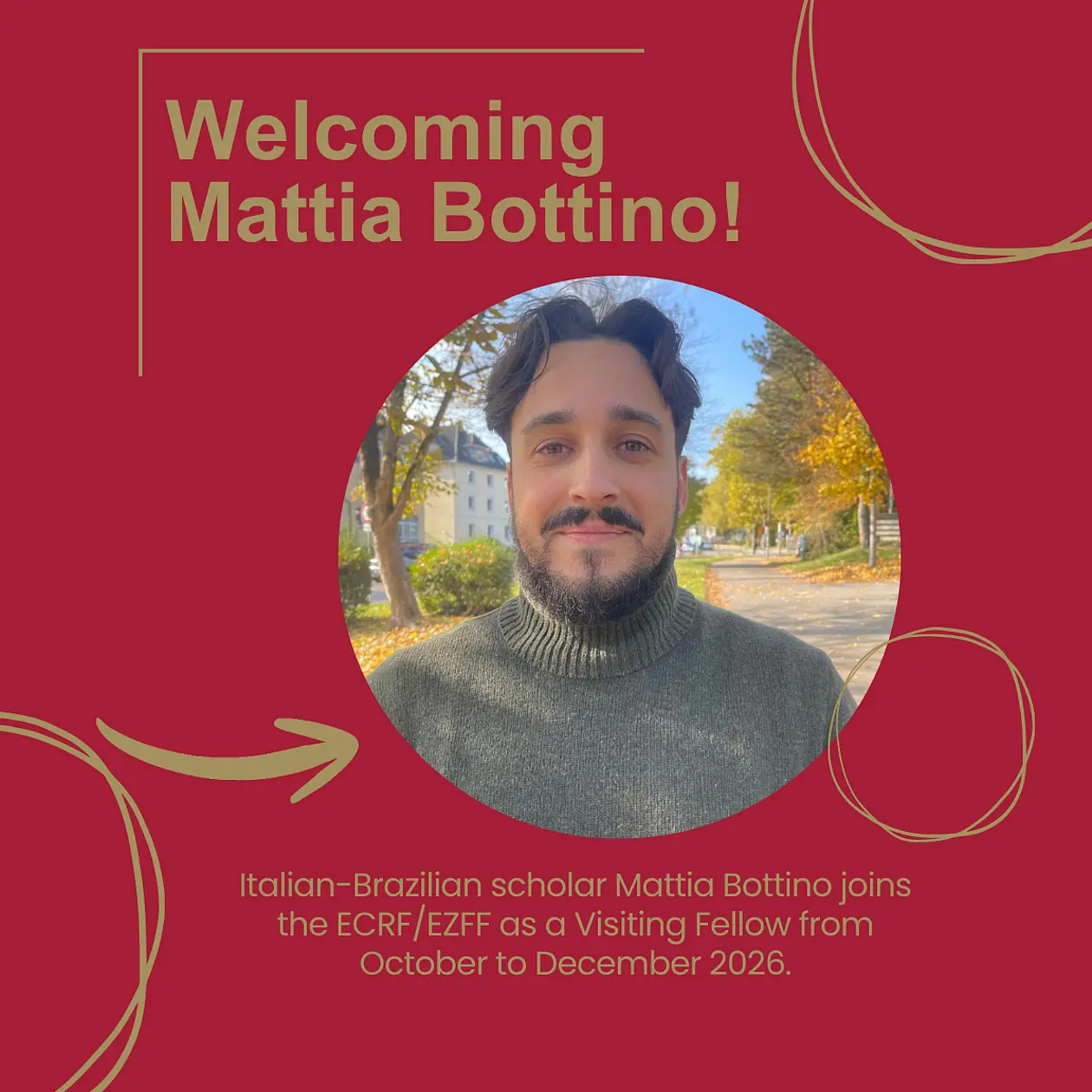
The Institute of Political Science (IfP) and the European Centre for Research on Federalism (ECRF) – in German Europäisches Zentrum für Föderalismus-Forschung Tübingen (EZFF) – at the University of Tübingen welcome Mattia Bottino, PhD candidate in Public Governance, Management and Policy at the University of Bologna, for a research stay as a Visiting Fellow from October to December 2026.
Mattia is also a member of INCT Participa (National Institute of Science and Technology for Transformations in Participation, Associativism and Contention), within the Nucleus for Democracy and Collective Action at the Brazilian Centre for Analysis and Planning (CEBRAP). He holds a BA in Political, Social and International Sciences and an MA in International Relations from the University of Bologna. He also completed a practice-oriented master’s programme in Urban Participatory Governance, jointly offered by the University of Bologna and the Fondazione per l’Innovazione Urbana. From 2022 to 2025, he worked as a researcher at the Institute for Comparative Federalism at Eurac Research.
Before joining the ECRF, Mattia held visiting positions at the École des Hautes Études en Sciences Sociales (EHESS) in Paris and the Centre for Metropolitan Studies (CEM), associated with the University of São Paulo and CEBRAP.
During his stay at the ECRF, Mattia is studying the communal confederal arrangement established in Venezuela under the Bolivarian Revolution, commonly known as the Estado comunal. He examines the institutional framework of this decolonial form of federalism and its contested character, torn between enabling popular self-government outside the state and buttressing authoritarian rule.
Fully understanding this federal experiment, he argues, requires taking seriously its fundamental challenge to the deeply rooted assumption that federalism can only exist within the hegemonic European model of market-economy-bound, highly procedural, parliamentary democracy. According to Mattia, this calls for an effort of decolonial delinking that can help scholars better grasp how the nexus between federalism and democracy has taken shape outside the Global North. His research thus opens the way to a broader study of how, across Latin America, the language and tools of federalism (autonomy, self-rule, etc.) are being reclaimed to sustain popular self-government, even where liberal democracy is in retreat.
More information about Mattia Bottino