
News
21.09.2026
Scientific Field Trip to Rio Tinto, Spain: A Window from Earth to Mars
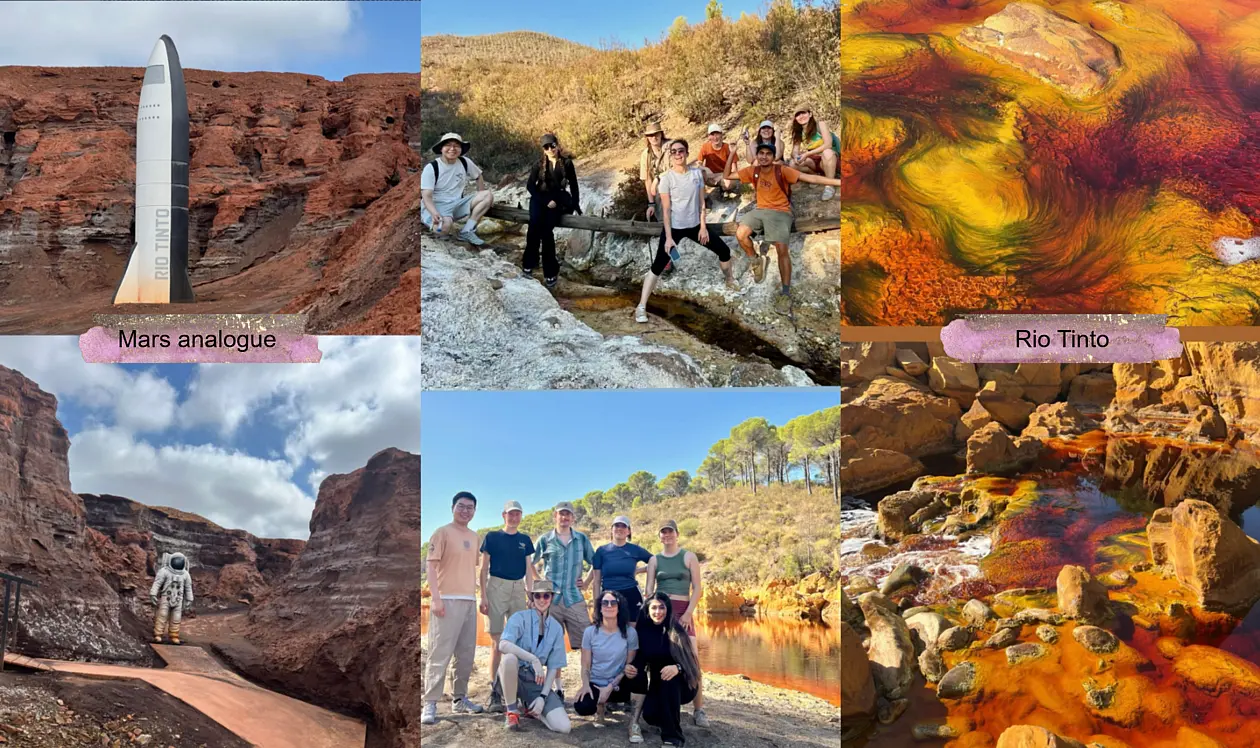
Pegah Khosravani, a researcher in the Soil Science and Geomorphology Group at the University of Tübingen, recently participated in a scientific field trip to Rio Tinto, Spain, a unique environment characterized by highly acidic conditions, enrichment in iron and other elements, and diverse microbial communities adapted to extreme conditions.
With its striking red and orange waters, together with sediments and mineral formations displaying shades of black, red, and orange, Rio Tinto represents a remarkable example of an extreme terrestrial environment and an important terrestrial analogue for Mars. The study of iron-bearing minerals, sediments, and the interactions between microbial activity and geochemical processes in such environments can provide valuable insights into the formation and preservation of biosignatures and geochemical signatures in Martian environments.
The field trip provided a valuable opportunity to directly observe processes at the interface of geology, geochemistry, geomorphology, and microbiology, while gaining a deeper understanding of extreme environments and their relevance to planetary science and astrobiology.
Working alongside researchers from the Geomicrobiology Group at the University of Tübingen, the field experience also provided an opportunity for scientific exchange, discussion, and learning about field-based approaches to studying extreme environments.
We sincerely thank Dr. Cristina Escudero Parada and Dr. Muammar Mansor from the Geomicrobiology Group at the University of Tübingen for their dedicated efforts in organizing and leading this scientific field trip and for creating such a valuable opportunity for scientific learning and exchange.
This field trip was much more than a visit to a unique landscape. It was an opportunity to observe, firsthand, the connections between geological, chemical, and biological processes, and a reminder that Earth itself remains one of the best natural laboratories for understanding extraterrestrial environments.