
News
Termin
21.10.2025
TREELINE–II: Highlights from Major European Conferences (DBG2025 & IMC2025)
The TREELINE–II research project continues the long-term collaborative effort that began in 2013 with TREELINE–I, focusing on sensitivity and responses of treeline ecotones in Nepal Himalaya to climate warming, funded by the German Research Foundation (DFG), the project entered its second phase in mid-2023, and its latest scientific findings are now emerging.
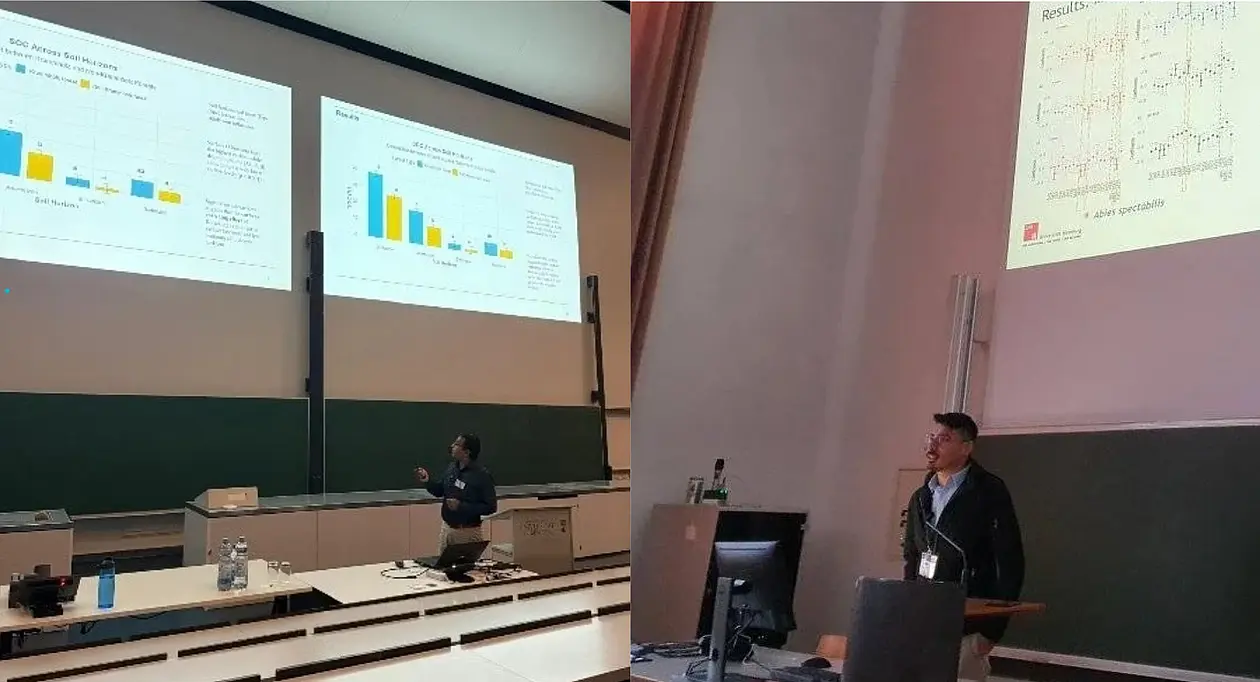
Recently, two PhD researchers from the project - Mr. Rabindra Adhikari and Mr. Amrit Maharjan - presented their latest research results at prestigious international conferences: the Annual Meeting of the German Soil Science Society (#DBG2025) held in Tübingen, Germany (13–18 September 2025), and the International Mountain Conference (#IMC2025) in Innsbruck, Austria (10–14 September 2025).
Mr. Rabindra Adhikari, whose doctoral research focuses on belowground (soil) processes in alpine treeline ecotones, delivered a presentation titled:
“Himalayan krummholz vs non-krummholz region: Soil organic carbon, total nitrogen and C:N ratio indicates nutrient limitation for plant growth in treeline ecotones.”
His findings reveal that Rhododendron campanulatum mats (Krummholz) not only physically block treeline advancement but also biochemically lock nutrients through nitrogen limitation - forming a double barrier to the upward migration of subalpine species.
Meanwhile, Mr. Amrit Maharjan presented his study entitled:
“Do tree-ring data reflect contrasting climate sensitivity in a Himalayan treeline ecotone? A comparison of Abies spectabilis (D. Don) Mirb. and Rhododendron campanulatum (D. Don).”
His research demonstrated contrasting climate responses between the two species: Abies spectabilis showed greater drought sensitivity, while Rhododendron campanulatum displayed stronger growth and resilience under stress. Together, these studies highlight the complex interplay between nutrient dynamics and species competition in shaping Himalayan treeline responses to climate change. Both conferences offered valuable opportunities for discussion, collaboration, and networking, allowing the TREELINE–II team to share insights and connect with the broader international mountain research community.