
News
03.06.2025
TREELINE Study Highlights Nutrient Limitations at Alpine Forest Edge in Nepal Himalaya:
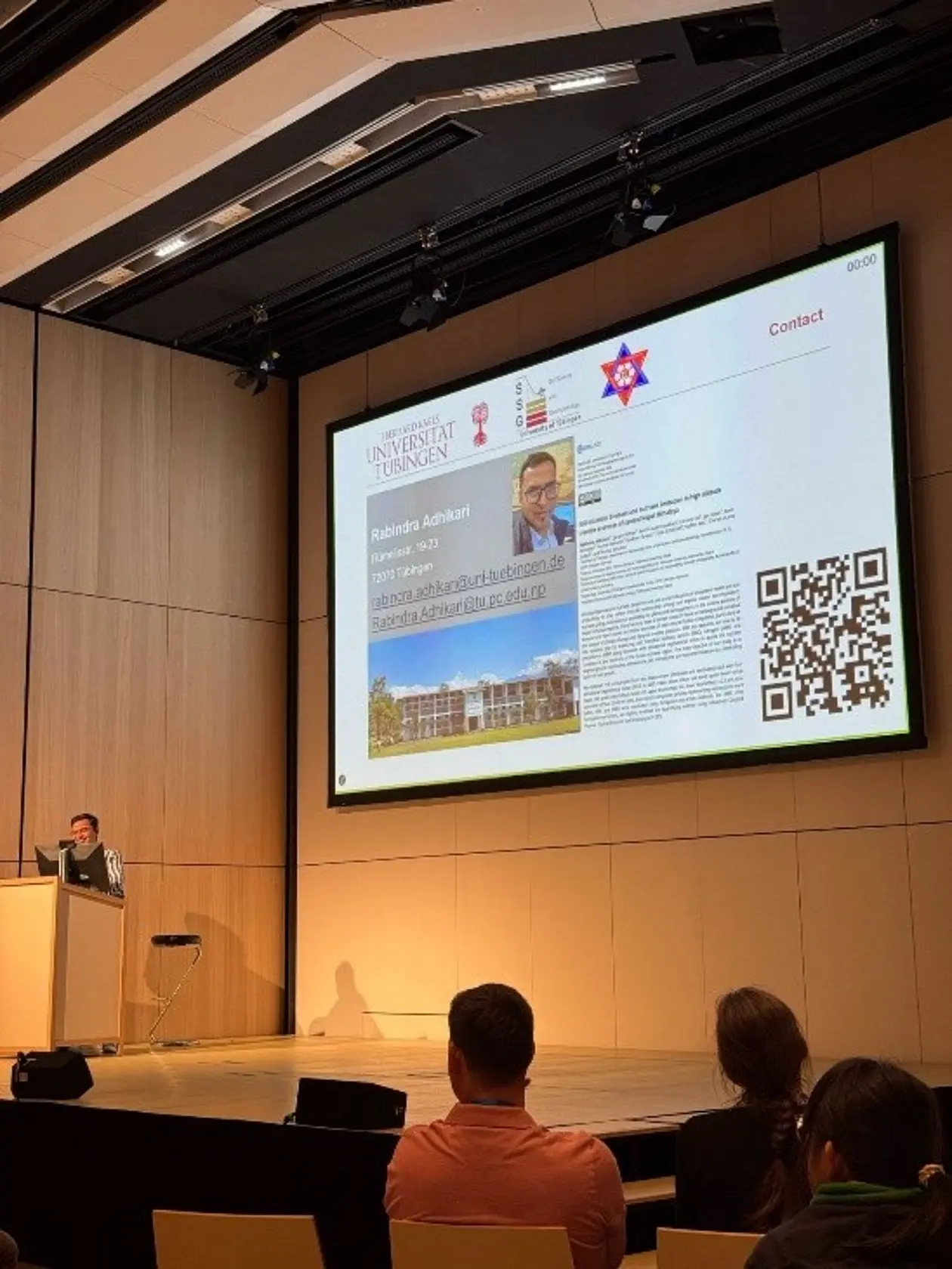
Presented at European Geoscience Union (EGU2025)
Treeline dynamics under the warming climate era are of interest to many researchers. However, the how dynamics occur in Himalayas treelines from the soil nutrient limitation perspective is still unclear. Under the TREELINE -II research project – a collaborative research project funded by German Research Foundation (DFG), our PhD student Rabindra Adhikari presented (oral) the recent findings at the European Geosciences Union (EGU2025)—the biggest event for geoscientists in Europe, with 20,00 plus participants in Vienna, Austria (27 April–3 May 2025).
The study, part of the TREELINE-II project, focuses on microbial biomass as a key indicator of ecosystem health and soil productivity at the forest-alpine ecotone, where trees meet tundra. The research team analyzed soil samples across elevational gradients (3910 – 4260 m amsl), revealing significant variation in microbial biomass carbon (MBC), nitrogen (MBN), and phosphorus (MBP). Research finding shows a consistent decline in microbial biomass with soil depth and among different altitudinal vegetational zones. These findings provide important insight into how belowground nutrient availability can regulate treeline shift in high-mountain ecosystems. Understanding this relationship is essential as Himalayan treelines respond to warming trends.