

21.10.2025
Dr. Wan-Chun Cheng: Childbirth, Divination, and Spatial Arrangement in Medieval China
Thursday, October 30, 2025, 14:00-16:00 pm, Seminarraum, China Centrum Tübingen(CCT), Hintere Grabenstr. 26, 72070 Tübingen
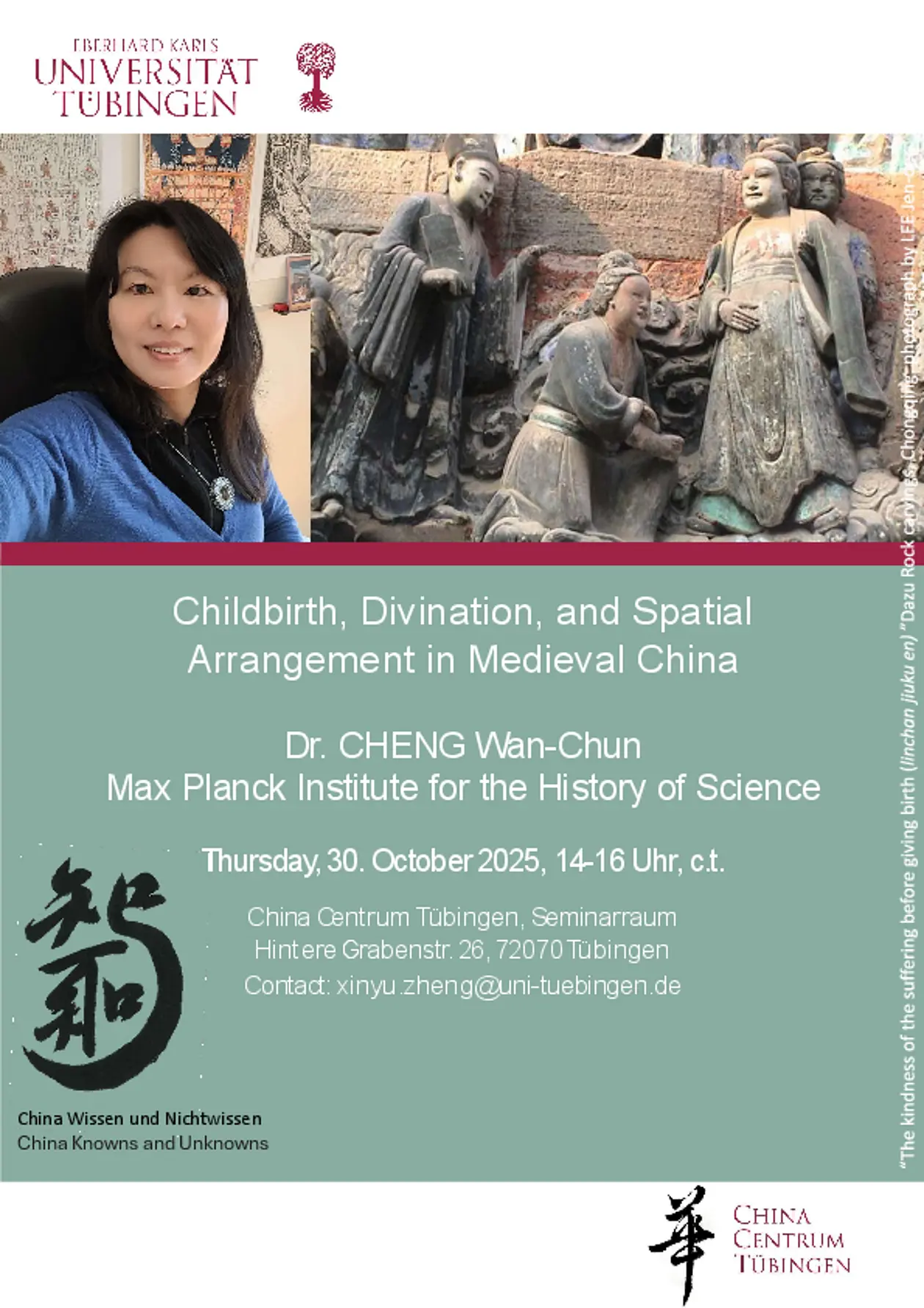
This lecture investigates how childbirth in medieval China was regulated through divinatory and cosmological systems that framed reproduction as an act of spatial and temporal alignment. Focusing on Tang and Song medical treatises alongside Dunhuang calendrical manuscripts, it reconstructs the procedures through which medical specialists devised birth chambers according to the twelve-month delivery charts and the itineraries of spiritual forces (shen sha). These materials reveal an elaborate epistemology in which the safety of birth depended on harmonizing bodily processes with celestial motion. By examining how medicine, astrology, and ritual intersected in the design of birthing space, the study reconsiders the birth chamber as a cosmotechnical site—where the principles of auspicious direction, calendrical precision, and embodied care converged. This integrated perspective illuminates the moral and environmental dimensions of childbirth in premodern China, and the enduring dialogue between cosmology and the management of life.
Wan-Chun Cheng studies the historical intersections of astral sciences, divination, and ritual practices in East Asia. She focuses on the Brahmahoranavagraha (梵天火羅九曜), examining how mandala diagrams, textual formulas, and ritualized chanting transformed complex cosmological knowledge into embodied, performative practices. She is now working at the Research Group “Astral Sciences in Trans-Regional Asia (ASTRA)" in the Max Planck Institute for the History of Science (MPIWG). Before joining MPIWG, she worked as a Senior Researcher at IKGF Erlangen and the CAS-E Center, Cheng investigated how Liuren divination guided childbirth practices in Tang and Song China, integrating medicine, astrology, and ritual. Her research highlights how spatial, temporal, and moral considerations converged in the design of birthing spaces, revealing the practical and cosmological sophistication of premodern Chinese knowledge systems.
Cheng earned her Ph.D. in Chinese Medicine from China Medical University, Taiwan, and also holds an M.A. in East Asian Studies and a B.A. in Chinese Literature & Japanese Language and Literature. Her work traces the transmission and adaptation of esoteric knowledge across East Asia, emphasizing the interplay between theoretical knowledge and ritual practice in shaping conceptions of body, time, and cosmos. Recent presentations include Destiny Tied to the Stars: Calculating One's Life Destiny through Palm Mnemonics at DOT 2025 and Hands: Chinese Hand-Memory Techniques Workshop (FAU, Germany, 2025).