Brief description:
Heterogeneous student groups constantly present challenges for teachers. Adaptive teaching counteracts this by tailoring lessons and materials to the individual needs of students. Digital media offer a wide range of possibilities for implementing this approach. However, the potential of digital media in the classroom is hardly being exploited, nor is adaptive teaching being specifically promoted.
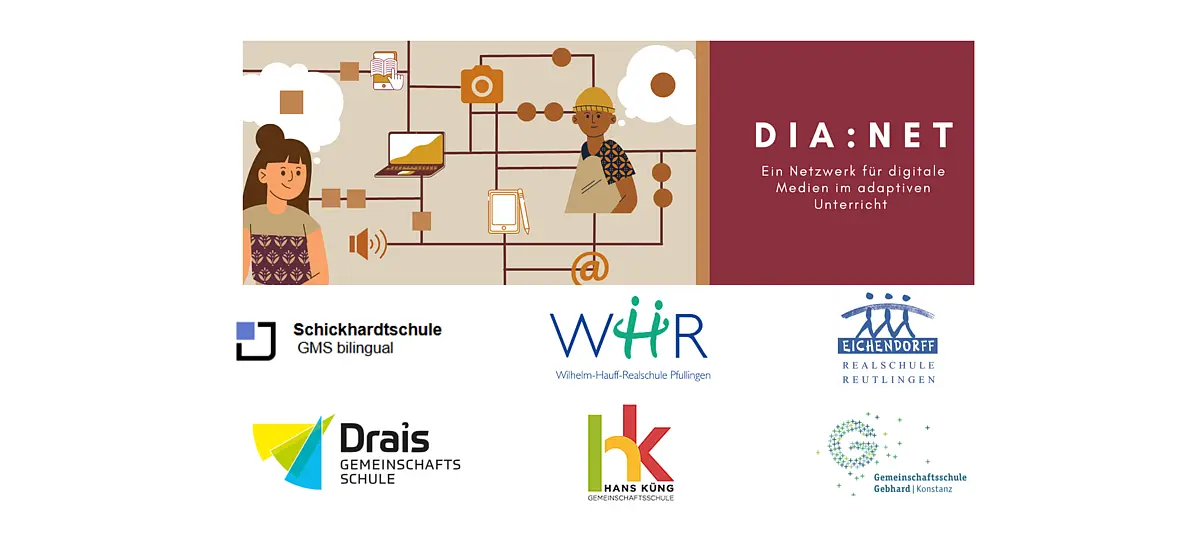
Therefore, building on the initial project “Digital Media in Adaptive Teaching in Upper Secondary Schools” (DiA:GO, 2019-2022), aims to provide teachers with further training in media didactics within a professional development program and to establish adaptive media didactics concepts for promoting subject-related skills and media literacy among students.
The initiation and support of a productive network is intended to establish cross-school professional learning communities. Within the network, group formation processes are to be initiated in which teaching practice is reflected upon with the aim of stimulating innovative and sustainable teaching development processes. To this end, training measures are offered that also serve to promote exchange, discussion, and transfer between academia and schools, thereby increasing the visibility of the project and enabling its results to be implemented and disseminated in a practical manner.
The network focuses on adaptive teaching processes in order to productively address heterogeneity at the student level. The project thus serves to increase individual learning performance and self-regulation among students by improving the quality of teaching. In collaboration with seconded teachers, adaptive teaching units are being developed in which adaptive teaching is supported in a didactically elaborate manner with the help of digital media. These teaching units are scientifically monitored and then made freely available as examples of good practice in the form of OER (Open Educational Resources). Within the previous project, twelve teaching units have been successfully developed, implemented, and evaluated at the Hans-Küng-Gemeinschaftsschule and the Uhlandgymnasium Tübingen.
In the current project phase, we are working with other comprehensive schools with upper secondary and secondary schools in the region.