29.10.2025
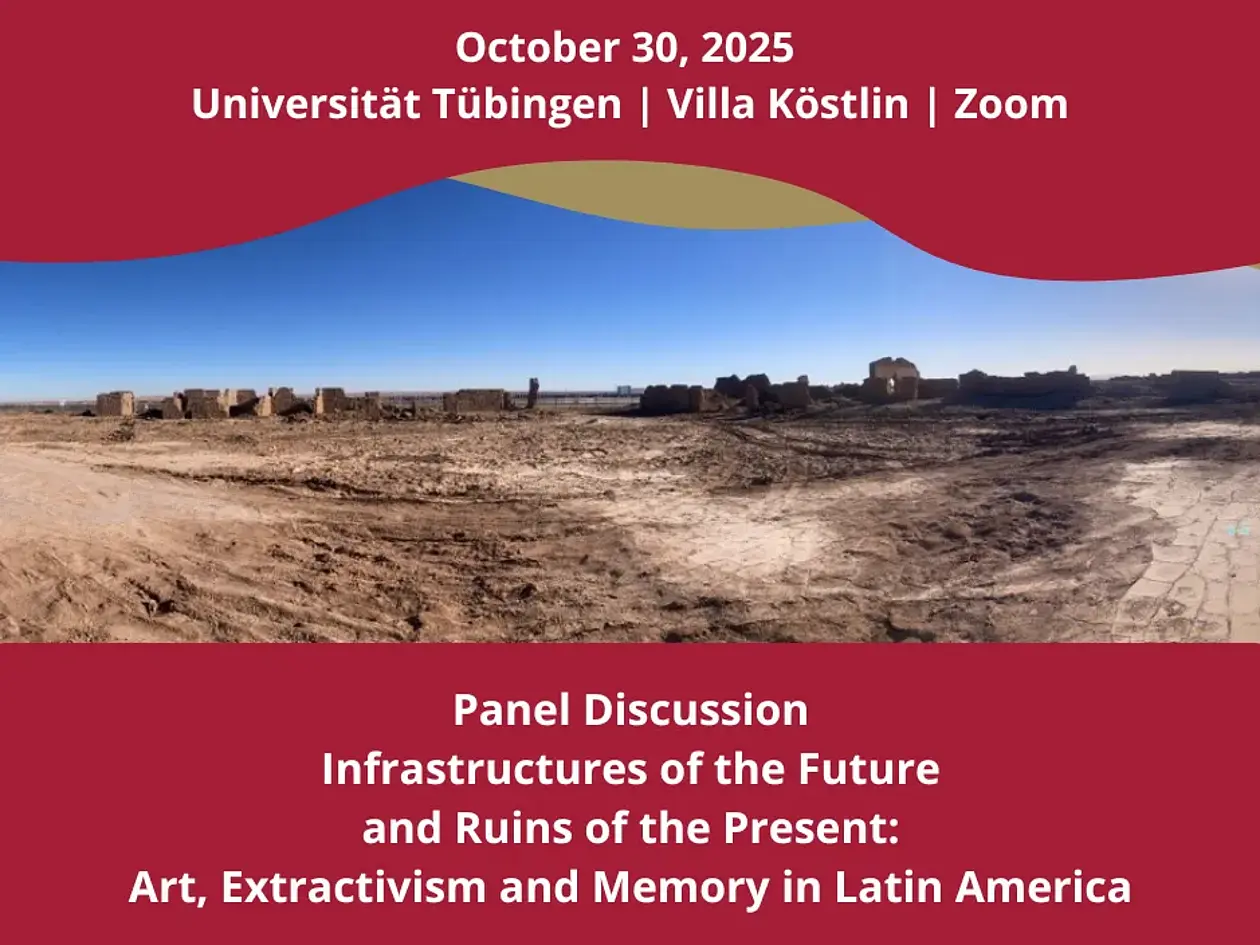
Panel Discussion (30.10): Infrastructures of the Future and Ruins of the Present Art, Extractivism and Memory in Latin America
Art, Extractivism and Memory in Latin America
The Centre for Brazil and Latin America is involved in this event as a funding institution, and highlights the participation of Fernando Resende, who also took part in the project Images of the Invisible Territories, developed within the framework of the Tübingen Research Takeoff (TRT) — an initiative of the Centre itself.
30 October 2025, 15:30h Villa Köstlin and online.
College of Fellows | Villa Köstlin | Zoom
Round table/Panel I (3.30–5 p.m. – Seminar Room and online
https://zoom.us/j/98534227994):
Round table/Panel II (5.15–6.45 p.m. – Common Room and online
https://zoom.us/j/98534227994):
Program
Round table/Panel I (3.30–5 p.m. – Seminar Room and online https://zoom.us/j/98534227994):
Infrastructures of the Future and Ruins of the Present: Art, Extractivism and Memory in Latin America
moderated by RICCARDA FLEMMER
Moderated by Riccarda Flemmer (Unviersity of Tübingen, Germany)
Panelists: Fernando Resende (Universidade Federal Fluminense, Brazil)
Kristell Pech Oxte (University of Tübingen, Germany)
Frederico Tavares (Federal University of Ouro Preto, Brazil)
Carlos Sanhueza (Universidad de Chile, Chile)
This panel offers a collective reflection on the use and meaning of land in Latin America, taking the Capricorn Bioceanic Corridor (Chile–Brazil) and other projects as an infrastructure that projects extractive futures onto territories in the Global South marked by histories of dispossession, violence, and fragmented memory. Based on an ongoing transdisciplinary research project—bringing together scholars, artists, and activists from Chile, Brazil, Argentina, Germany, and Mexico—we approach these projects not only as physical objects, but also as imaginary artifacts that produce forms of time, inhabiting, and exclusion. Rather than accepting its promise of linear development, we analyze them as “hyperobjects” (Morton), whose scale and complexity render it overwhelming and precarious. We do so through artistic practices, techno-environmental approaches, historical analysis, and critical cartography, recognizing that these planned futures are built upon landscapes already wounded by colonial modernity. From this perspective, our interventions seek to render visible the “ruins of the future”—infrastructures that do not yet exist but already produce displacements, extractivisms, and anticipated violence.
Break
Round table/Panel II (5.15–6.45 p.m. – Common Room and onlinehttps://zoom.us/j/98534227994):
Infrastructures of the Future and Ruins of the Present: Art, Extractivism and Memory in Latin America
NELSON ARELLANO, LOUISE GANZ, ARMANDO VELAZQUEZ, MARIA GABRIELA LUGONES
moderated by DOROTHEE KIMMICH
You can see the program here

TRT Project Images of the invisible territories: Transects of the Bioceanic Corridor Brazil/Chile
Final workshop of the Tübingen Research Takeoff (TRT) project Images of the invisible territories: Transects of the Bioceanic Corridor Brazil/Chile
Coordinated by Dorothee Kimmich and Fernando Resende in cooperation with the Baden-Württemberg Centre for Brazil and Latin America
Organized by Fernando Resende and Nelson Arellano in the framework of the opening of the International Forum of the ICGSS
More about the TRT Project Images of the invisible territories: Transects of the Bioceanic Corridor Brazil/Chile
Funded as part of the Excellence Strategy of the German Federal and State Governments | Funded by the Centre for Brazil and Latin America
More about the Tübingen Research Takeoff (TRT) Initiative
The Tübingen Research Takeoff (TRT) is an ongoing program of the Baden-Württemberg Centre for Brazil and Latin America at the University of Tübingen, launched in 2022. The initiative aims to revitalize and diversify the University’s scientific cooperation with Latin America by supporting project-based joint activities with new research partners.
The first call, issued in November 2022, focused on Brazil and Chile, and the projects selected by the committee received financial support to initiate these new collaborations. TRT continues to promote funding that strengthens the exchange of researchers and fosters long-term academic partnerships.
International Forum on Global South Studies 2025: Doing Futures in Precarious Times.
For the full program 30 October to 14 November 2025, see on our Website:BraLat nimmt am 6. Internationalen Forum für Global South Studies teil | Universität Tübingen
You can find more information on how to participate in person or online in the program. Please direct any questions you may have to the official email address: internationalforumtuebingenspam prevention@gmail.com.