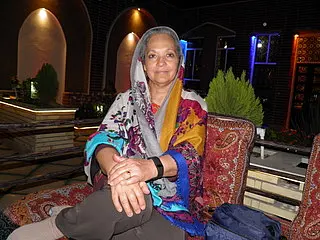
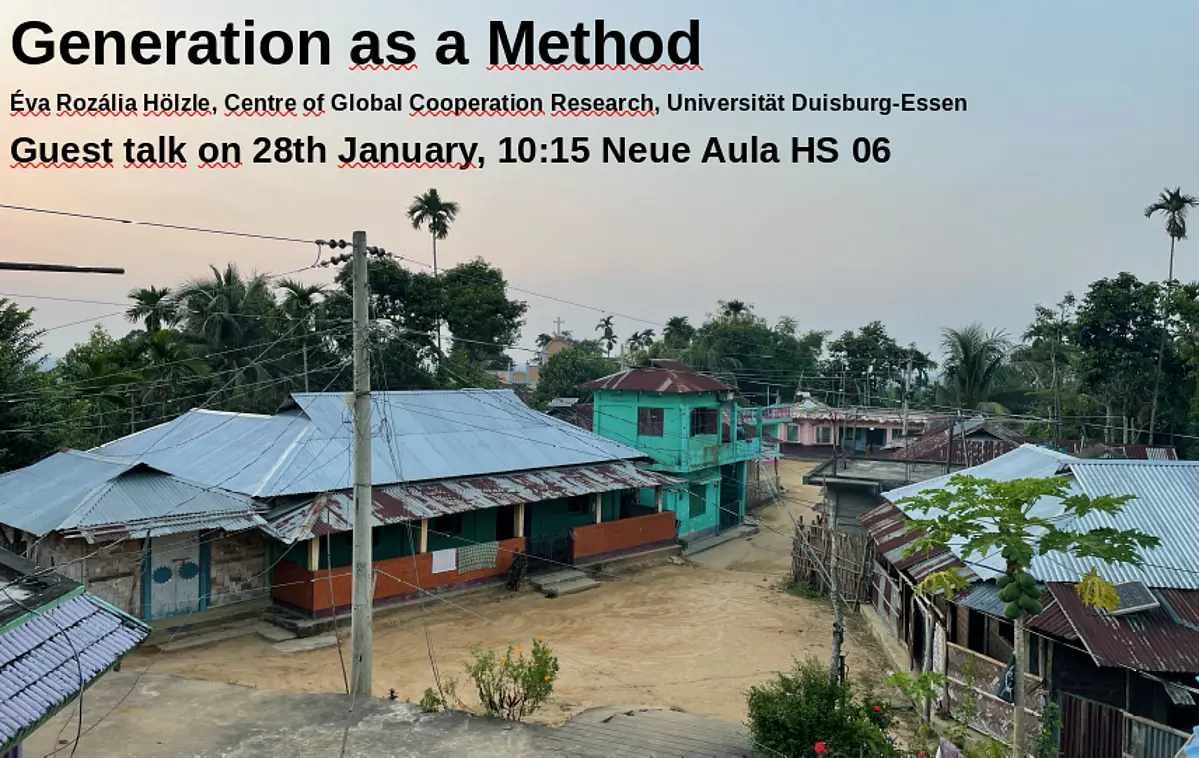
Éva Rozália Hölzle is a social anthropologist affiliated with the Centre of Global Cooperation Research at Universität Duisburg-Essen since January 2026. She has been conducting ethnographic research in the borderlands of Bangladesh and Northeast India exploring the nexus of land dispossession and nation state formation, violence and agency, as well as indigenous life politics since 2010. Her first monograph Land, Life, and Emotional Landscapes at the Margins Bangladesh was published by Amsterdam University Press in 2022. In her postdoctoral research project, Cultivating Ethics across Generation, she examines the interplay and transformation of ethics and kinship through the history of an extended family. She is currently co-leading, together with Dr Magdalena Suerbaum, the DFG-funded research network Kinship Generations, which brings together over 40 researchers focusing on questions of relatedness in Africa, Asia, and the Middle East. To prepare for her talk, please read the article titled "Generations" by Sahana Ghosh and Megha Sarma Sehdev (Feminist Anthropology, 2022) https://anthrosource.onlinelibrary.wiley.com/doi/epdf/10.1002/fea2.12095
Abstract: The term generation encompasses a range of meanings in social anthropology. It has been used to analyse the transmission of roles and responsibilities across age groups, intergenerational commitments and practices of care, as well as shared historical experiences. Beyond these uses, generation also evokes the act of bringing something forth: humans are not merely generated by their contexts but actively shape the worlds they inhabit. This active dimension is aptly captured by the concept of social generativity, which foregrounds the ongoing making and remaking of the social world across different temporalities. Feminist scholarship (Bear et al. 2015; Ghosh and Shedev 2022), however, cautions against an exclusivly positive interpretation of social generativity. Instead, contradictions and tensions produced by uneven distributions of power play a central role in tracing the “processes of generation” through which “socialities are made” (Bear et al. 2015).
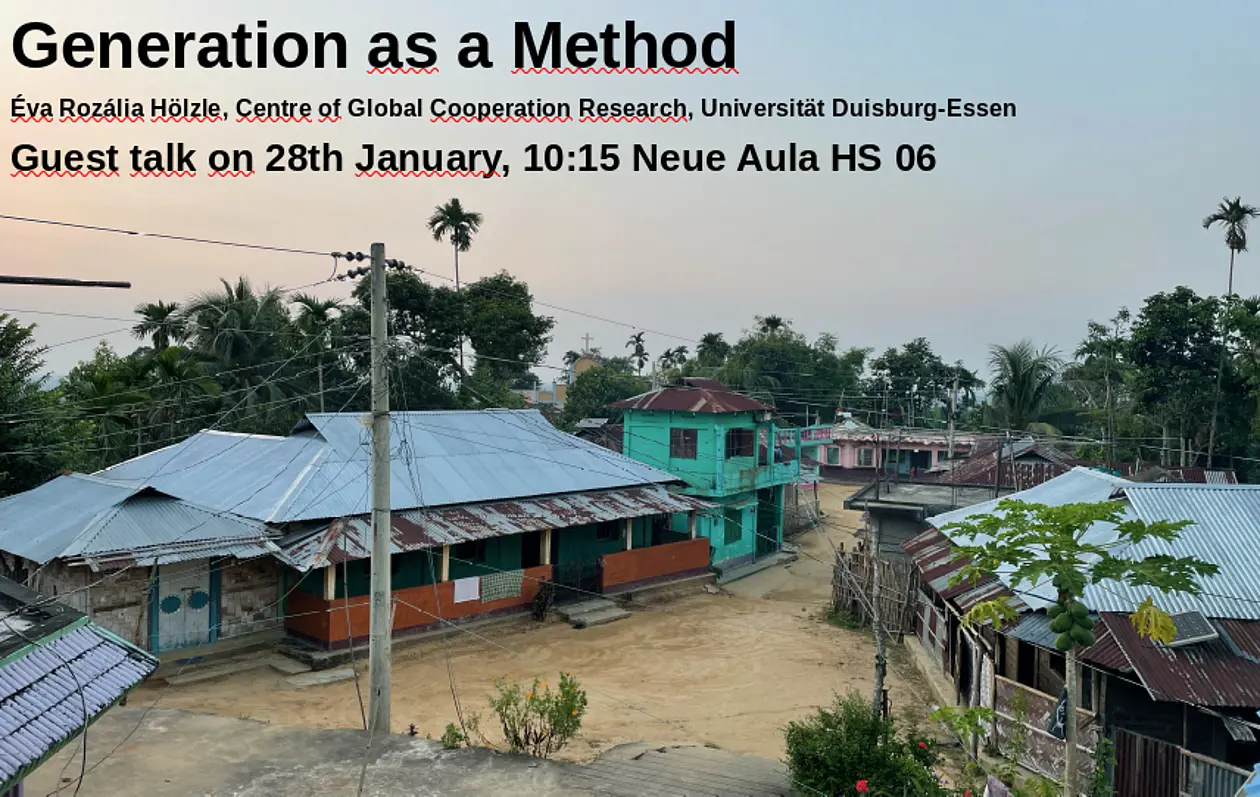
Building on these insights, I propose generation as a methodological lens rather than a purely descriptive category. I argue that a generational lens enables historically grounded ethnographic approach that illuminates differing perspectives on large-scale social events. Drawing on the findings from my ethnographic project, Cultivating Ethics across Generations, which traces the history of an extended family spanning five generations in the Bangladesh–Northeast India borderlands, my talk focuses on the biographical accounts of three siblings from different generations. This methodological approach (i.e. recording and comparing the biographies of people belonging to different generations within the same family), allows me to explore the shifting significance of political events in everyday life over time. Events that appear pivotal for one generation may recede in importance when viewed through the life histories of another within the same family. By juxtaposing these generational perspectives, it enables the accentuation of events that in a narration of family and regional histories tend to fade or submerge due to the requirement of a cohesive storytelling. Generation thus emerges as a key methodological and analytical instrument, enabling the documentation of personal, familial, and regional histories with ethnographic depth while attending to nuanced, generationally differentiated perspectives on large-scale social transformations as they are lived and experienced.