
News aus der Fakultät
23.11.2026
Cosmic firework in the night sky
Supernova in NGC 7331 captured by the 80 cm telescope in Tübingen
Authors: T. Dorhout, V. Kulkarni, P. Singh
The Institute for Astronomy and Astrophysics Tübingen (IAAT) hosts an 80 cm optical reflector telescope at its site at Sand. The telescope can be used for specialized scientific applications, but its most frequent use these days is student training at various stages. Students doing their degree at the IAAT frequently spend their free time (actually nights) at the telescope to observe celestial objects of their choice, such as Solar System planets and their moons, star clusters, planetary nebulae and galaxies. Recently, a group of Master students realized that they had made an incidental observation of a rare celestial event. They captured images of a rare supernova event, which occurred on September 1st in the galaxy NGC 7331, 45 million light years away from Earth. The distance implies that the light has travelled for roughly 45 million years, and the images display the event as it appeared in the distant past.
NGC 7331 was first discovered by William Hershel in 1784 and belongs to a larger group of galaxies called the Deer Lick Group. A total of five supernovae have been observed from this galaxy since 1959, four of which occurred since 2013. This is a relatively high rate compared to other galaxies of its kind. The most recent of which is named sn2026aaiv and was discovered on September 1st 2026 by the ground-based Asteroid Terrestrial-impact Last Alert System (ATLAS) in the USA. This is the event the students captured now.
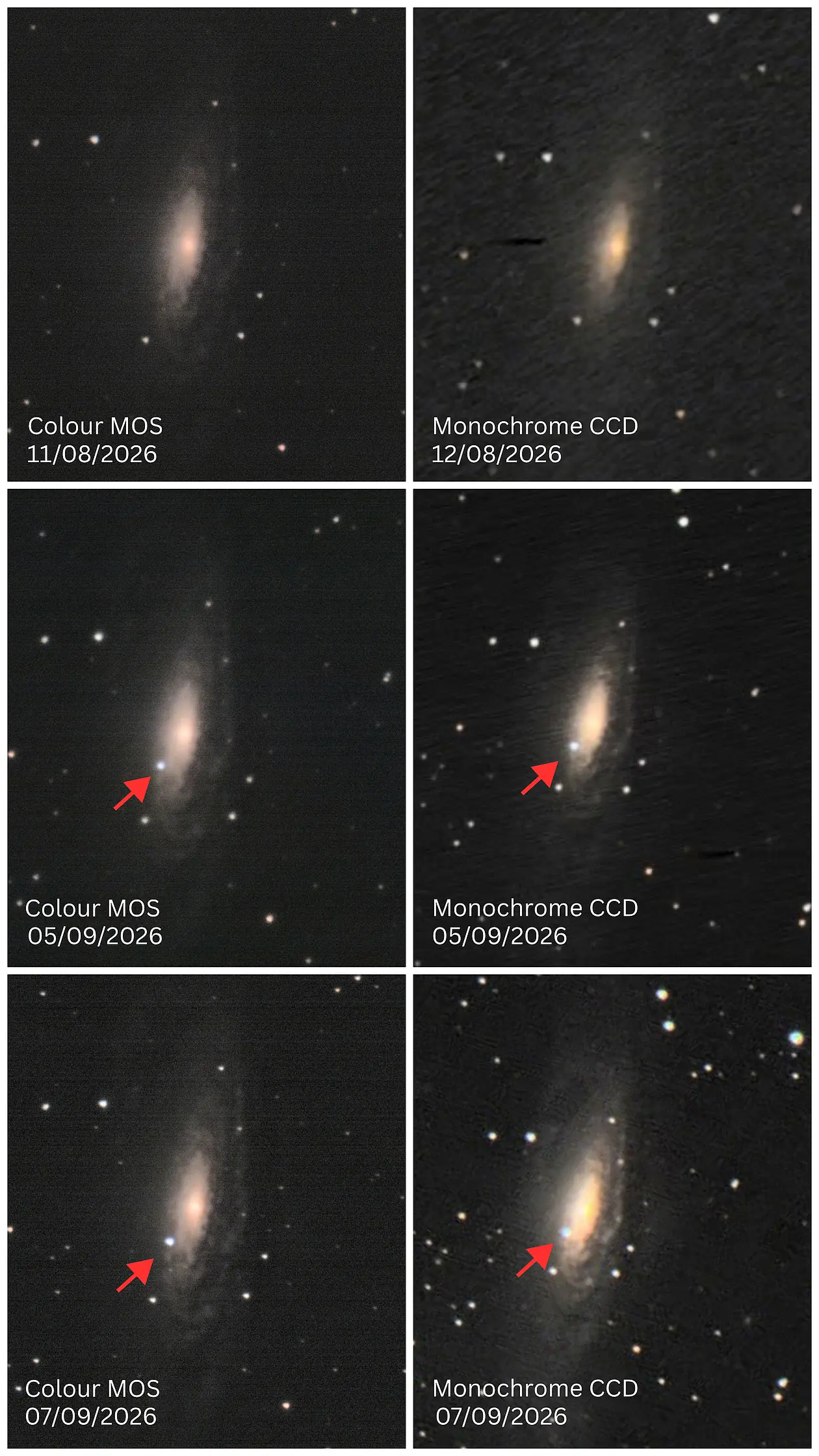
The figure shows images of NGC 7331 on different dates, taken using the 80 cm telescope of IAAT. Visible on all images is the galaxy itself, its dense bright core, background galaxies and foreground stars. Other galactic features include the spiral arms and dust clouds.
Fortunately, this galaxy had been observed with the telescope a month before light from the supernova reached Earth. The top images, taken on August 12th, show NGC 7331 before the supernova event. The middle panel shows the images that were taken by the students on September 5th, not knowing at the time of the observations that the image would reveal a drastic change in the picture. Additional observations were then taken on the night of September 7th (bottom panel). The red arrows mark the bright supernova, as seen a few days after the start of the event. An analysis of the supernova brightness in these images yields a magnitude of just below 14. This means that it is roughly a million times fainter than the brightest stars we see in the night sky. We also note that the brightness of the supernova has slightly increased between the two images. These measurements are consistent with reports of other observers who used telescopes around the globe to observe this event.
Supernovae are rare explosive events that mark the end of the life-cycle of stars. There are different types of supernovae, primarily dependent on the mass of the progenitor star and the system’s configuration. The explosion recently observed in NGC 7331 is a type Ia supernova. Here, a white dwarf (the core of a dead star, around the size of Earth but with a mass of around the Sun’s mass) lives in a binary configuration, where it either merges with another white dwarf or accretes mass from a donor star. Once the white dwarf has accumulated enough mass, a catastrophic thermonuclear explosion of the whole star is triggered. This supernova explosion completely destroys the white dwarf, leaving no central core behind, and blasts gas from its outer layers into space to form a structure called a supernova remnant. In this entire process, a tremendous amount of visible light is emitted, powerful enough to, for a brief moment, outshine its entire host galaxy (consisting of billions or trillions of stars). While the supernova event itself takes place in mere seconds, its effects can remain visible for several months. On average, only a couple of supernovae occur in a galaxy every century, of which roughly 20% are type Ia. Since the process of forming a type Ia supernova is specific, all type Ia supernovae have approximately the same intrinsic brightness. Hence, they are referred to as ‘standard candles’ and are a useful tool to determine distances to other galaxies. This helped scientists to prove that the Universe’s expansion is accelerating.
Considering supernovae are such powerful events, what would happen if one were to occur in the Milky Way? Indeed, a number of such events were recorded in (ancient) literature. The most recent example is SN 1604 (also known as Kepler's Supernova), which first appeared in 1604. The event occurred roughly 20,000 light years away from Earth, and at its peak brightness outshined Jupiter in the night sky. In fact, it was so bright that it remained visible even throughout the daytime for up to 3 weeks, before it started fading. Another notable event is SN 1054, which transpired on July 4th, 1054. Civilizations across the globe described it as a new star that appeared in the sky, showing itself during bright daylight for 23 days. The remnant of this supernova is now known as the Crab Nebula, which is located roughly 6,500 light years away from Earth, and can still be observed by both ground- and space-based telescopes, today.
Apart from being spectacular cosmic fireworks, supernovae also have significant impact on their surroundings. If a supernova were to take place within the solar neighbourhood today (~60 light years from Earth), it would destroy a large chunk of the Earth’s ozone layer, leading to a mass extinction event. In fact, the late Devonian mass extinction event, which wiped out roughly 70% of all life on Earth 372 million years ago, is suspected to be caused by a nearby supernova. However, the chances of such an event occurring (within ~65 lightyears from Earth) is only once per 100 million years.
Shock waves caused by supernova explosions exert intense forces that can compress molecular clouds within their proximity, which can, in the long run, trigger the process of star formation. On shorter timescales, particles in those shockwaves are accelerated to very high speeds (with energies much greater than what can be achieved in man-made accelerators such as CERN). When those particles reach Earth, we recognize them as cosmic rays, contributing to the natural ambient radiation all humans are exposed to. Supernovae also enrich their surroundings with ‘metals’. In astronomy, anything heavier than hydrogen or helium is referred to as ‘metal’. This includes elements such as carbon and oxygen, which are essential for life as we know it. Past supernovae have played a major role in determining the chemical composition of all planetary systems that followed them, including the Sun and the Earth.
To summarize, supernovae are one of the most powerful events in the Universe that play a major role in shaping their surroundings. From arousing curiosity in civilizations of the past to becoming essential tools to estimate extreme distances in recent times, studying supernovae have played an essential role in astronomy and understanding the world around us.
Information on the observations
Images were taken using both monochrome CCD and colour MOS cameras, attached to the 80cm telescope. Several exposures of 30 seconds (colour MOS camera) and 20 seconds (monochrome CCD camera) were taken. The exposed frames included light frames (normal images) as well as dark frames (to remove thermal noise from the data), bias frames (to remove electronic readout noise) and flat frames (to remove noise due to dust/aberrations on the sensor). It is important to note that noise from turbulence in Earth’s atmosphere (called the “seeing effect”) and from thin clouds cannot be removed.
For the monochrome CCD camera, frames (lights and flats) were recorded using red, blue and green filters. Both cameras were cooled to a temperature of roughly -17 °C to - 20 °C to reduce thermal noise. The light frames are calibrated with respect to the dark, flat and bias frames and then stacked to get a composite image. Further processing is done to get rid of any gradients and bring out as much detail as possible.
Acknowledgements
We are grateful for useful comments on the text by Dr. V. Suleimanov and Dr. G. Pühlhofer. The 80 cm telescope of IAAT is maintained by institute staff. We particularly thank T. Schanz for his assistance with the telescope operations and for support with the processing of the images taken with the telescope. We also thank A. Thakar for initiating the observations and for his help conducting them.