

Aktuell
16.07.2025
New Publication: The Future of African-European Relations – Towards an Equitable Global Society
With contributions by Dr. Donnet Rose Adhiambo Odhiambo from IfP
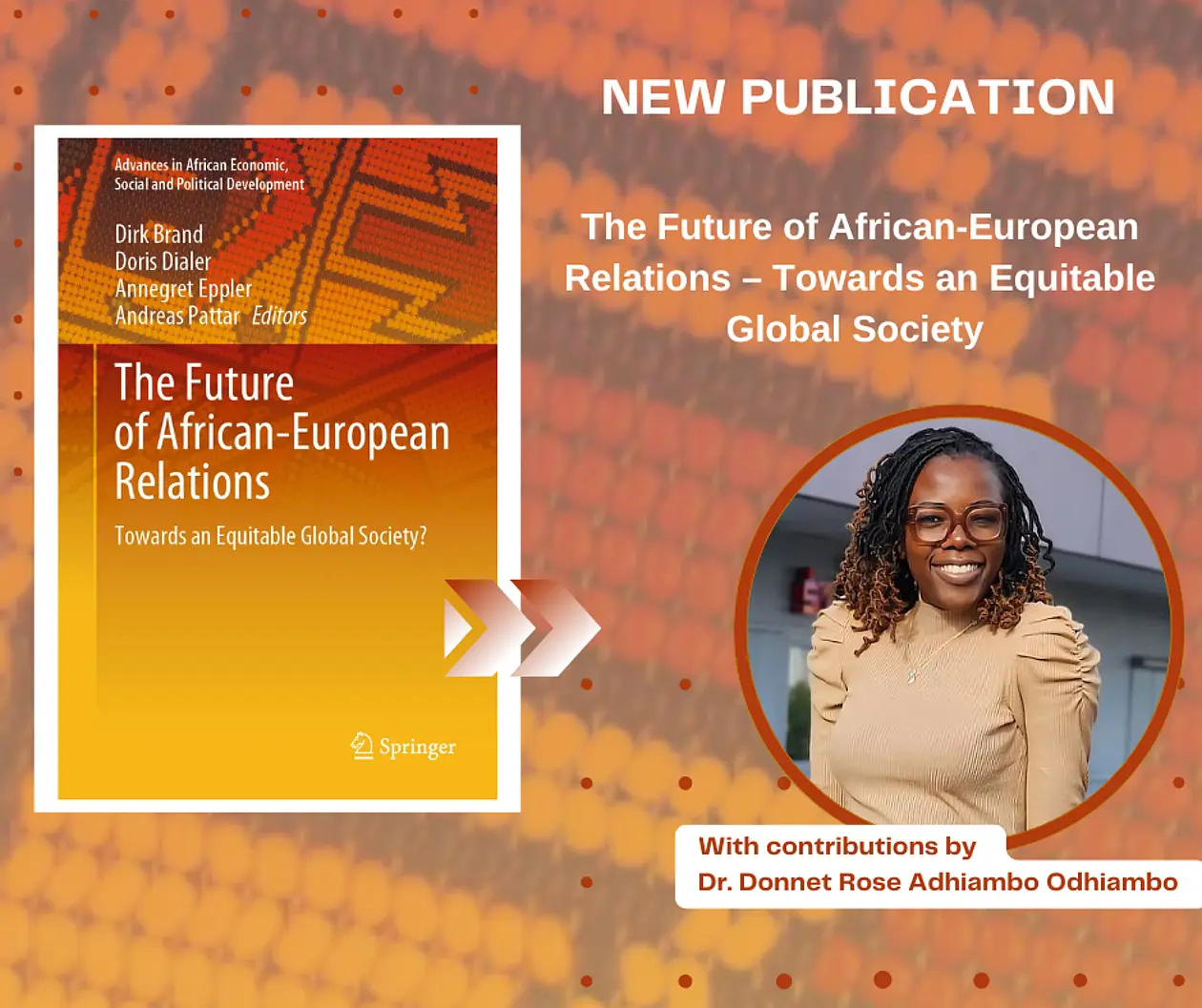
We are pleased to announce the recent publication of the edited volume The Future of African-European Relations – Towards an Equitable Global Society (Springer, 2025), featuring two contributions by Dr. Donnet Rose Adhiambo Odhiambo, a researcher in the team of Prof. Dr. Gabriele Abels, Chair of Comparative Politics and European Integration at the Institute of Political Science (IfP), University of Tübingen.
This interdisciplinary volume brings together academic and policy perspectives to explore pathways toward fairer and more sustainable African-European relations. It engages with current debates on global justice and governance in a multipolar world.
Dr. Odhiambo authored the chapter "Regional Parliaments in Africa", which examines the role and challenges of regional parliaments as political actors within Africa's multi-level governance systems. She is also co-authored the chapter "Introduction: Multi-Level Systems " with Prof. Dr. Annegret Eppler.
Her contributions reflect a strong commitment to comparative political analysis and interregional perspectives—key themes in the research agenda of the IfP.
More information about the book is available here!
Chapter abstract:
Regional Parliaments in Africa
Donnet Rose Adhiambo Odhiambo
This chapter examines the emergence of regional parliaments in Africa, emphasizing their connection to regional integration and external influences. It argues that the African Union (AU) played a pivotal role through its normative commitment to democracy and good governance, as enshrined in its Constitutive Act. Furthermore, economic partnership agreements, notably with the European Union (EU), facilitated institutional development by embedding democratic principles and fostering parliamentary engagement. The EU's influence is highlighted through mechanisms like the ACP-EU Joint Parliamentary Assembly and capacity-building initiatives. Comparisons between the European Parliament and African regional parliaments reveal shared trajectories, including gradual empowerment and integration within regional governance frameworks. This chapter underscores the EU's exemplary role as a model for African parliamentary institutions, while also acknowledging internal and external factors that shaped their establishment. Ultimately, it portrays regional parliaments as integral to Africa's democratic evolution and regional cooperation.
Chapter abstract:
Introduction: Multi-Level Systems
Annegret Eppler and Donnet Rose Adhiambo Odhiambo
This introductory text provides a very brief overview of comparative research on multi-level systems. It includes national (federations, but also decentralized and regionalized states) and supranational (such as the European Union) multi-level systems. The text shows how multi-level systems can be categorized and discusses indices with which research tries to measure the degree of diversity. Some focal points of multi-level systems, as the distribution of competences, the decision-making processes, questions of legitimacy as well as reasons for dynamics in multi-level systems are discussed. At the end, the text gives a short overview of the texts on the topic of secession, which are included in the following chapter.