Rolf Schlichenmaier, Leibniz-Institut für Sonnenphysik (KIS), Freiburg, Germany — November 24, 2025
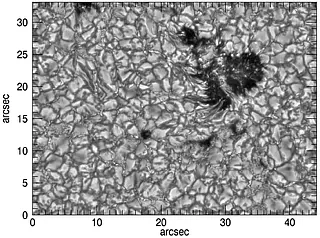
The Sun is a dynamic system shaped by highly complex magnetic processes. Magnetic fields originate deep within its interior and emerge at the surface as sunspots, evolving as part of a 22-year cycle. These fields extend outward into the solar atmosphere, creating a strong magnetic coupling between the photosphere, chromosphere, and corona. In these interconnected layers, magnetic energy can build up and ultimately be released in spectacular events such as solar flares and coronal mass ejections — powerful outbursts that drive space weather and can significantly impact modern civilisation.
This lecture offers an up-to-date overview of the Sun’s magnetic activity, with particular emphasis on the structure and evolution of sunspots. Radiative magneto-convective processes within sunspots are observed in both the photosphere and chromosphere using spectropolarimetric instruments, and these observations are interpreted alongside numerical simulations capable of modelling entire sunspots, including their otherwise invisible subsurface structure.