A Direct In Vivo RNAi Screen Identifies MKK4 as a Key Regulator of Liver Regeneration
The liver harbors a distinct capacity for endogenous regeneration; however, liver regeneration is often impaired in disease and therefore insufficient to compensate for the loss of hepatocytes and organ function. Here we describe a functional genetic approach for the identification of gene targets that can be exploited to increase the regenerative capacity of hepatocytes. Pools of small hairpin RNAs (shRNAs) were directly and stably delivered into mouse livers to screen for genes modulating liver regeneration. Our studies identify the dual-specific kinase MKK4 as a master regulator of liver regeneration. MKK4 silencing robustly increased the regenerative capacity of hepatocytes in mouse models of liver regeneration and acute and chronic liver failure. Mechanistically, induction of MKK7 and a JNK1-dependent activation of the AP1 transcription factor ATF2 and the Ets factor ELK1 are crucial for increased regeneration of hepatocytes with MKK4 silencing.
Based on this target identification and validation, a spin-off was founded and has successfully completed a first round of investment.
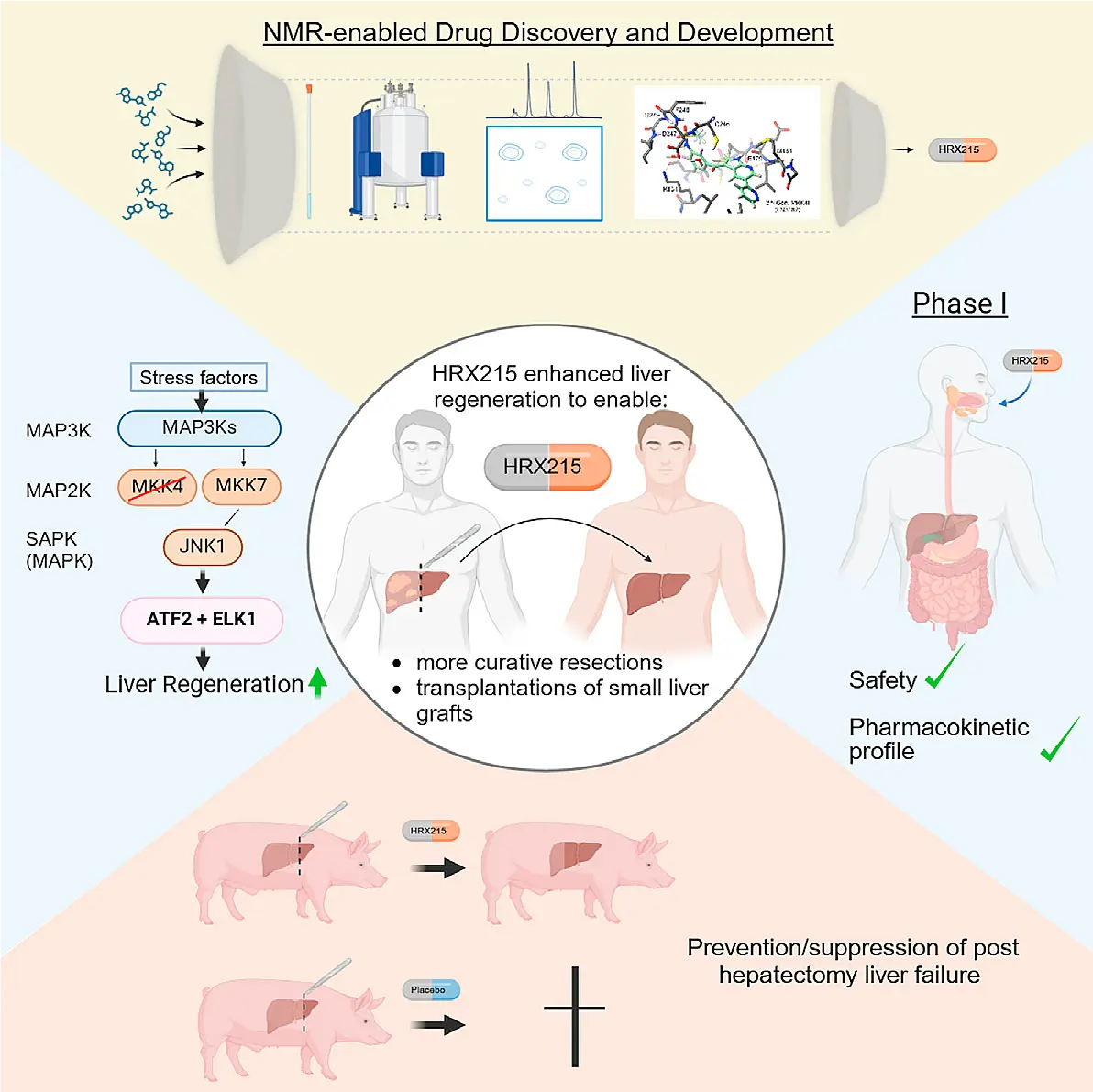
First-in-class MKK4 Inhibitors enhance Liver Regeneration and prevent Liver Failure
Diminished hepatocyte regeneration is a key feature of acute and chronic liver diseases and after extended liver resections, resulting in the inability to maintain or restore a sufficient functional liver mass. Therapies to restore hepatocyte regeneration are lacking, making liver transplantation the only curative option for end stage liver disease. We here report on the structure-based development and characterization (NMR-spectroscopy) of first-in-class small molecule inhibitors of the dual specific kinase MKK4 (MKK4i). MKK4i increased liver regeneration upon hepatectomy in murine and porcine models, allowed for survival of pigs in a lethal 85% hepatectomy model and showed antisteatotic and antifibrotic effects in liver disease mouse models. A first-in-human phase I trial (EudraCT 2021-000193-28) with the clinical candidate HRX215 was conducted and revealed excellent safety and pharmacokinetics. Clinical trials to probe HRX215 for prevention/treatment of liver failure after extensive oncological liver resections or after transplantation of small grafts are warranted.
References: