

News
06.08.2026
Successful PhD Defense of Mathias Bellat/Platz
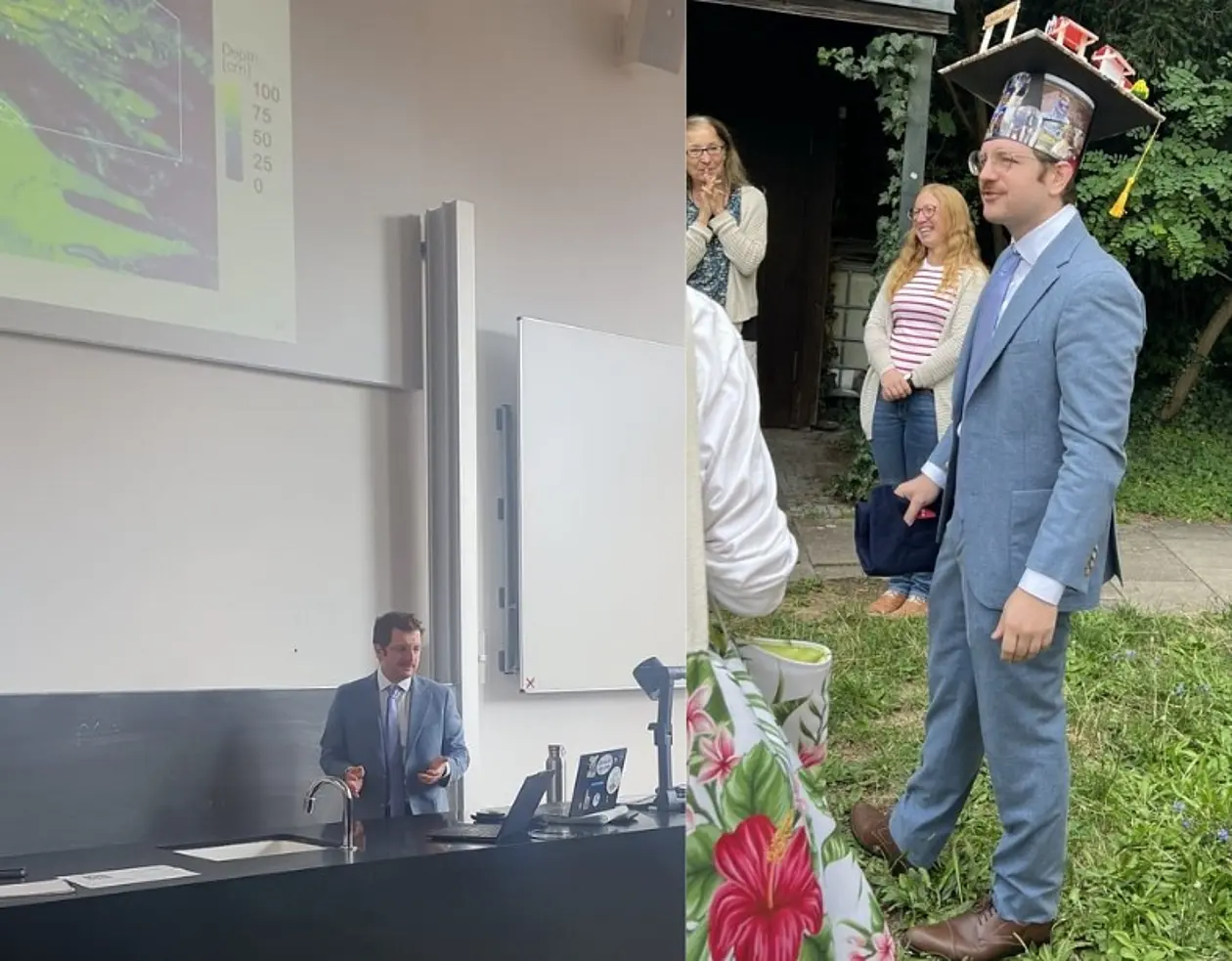
On July 23rd, Mathias Bellat/Platz successfully defended his PhD, giving new insights into methodological and theoretical developments in geoscientific approaches for archaeological research.
Using machine learning modeling and statistics, an innovative framework was developed to understand complex past human-environment interactions. Developed within the CRC 1070 “ResourceCultures,” this new methodology used a case study focusing on the influence of soil as a resource for past human settlements in Northern Mesopotamia (Iraqi Kurdistan) from 2,500 to 330 BCE. After two field campaigns in 2022 and 2023 to collect soil information, this work included both quantitative and newly developed quantitative soil information (paleosol maps). The multimethod approach produced contrasting results on the influence of soil on settlement information, highlighting the potential of long-term dynamic soil factors as a valuable proxy for attesting settlement presence. Internal spatial dichotomy in the site distribution for the studied region was also discussed as a multi-factor reason, social and environmental, but also reflecting an unexplored taphonomic bias.
Results of the thesis are both methodological and proper to the case study. These newly developed methodologies open new doors and offer substantial possibilities for future complex human-environment system analysis.
Teilen


