Institut für Politikwissenschaft

The Programme

MAPIR combines the study of peace strategies, conflict resolution and international politics in a two-year state-of-the-art study programme. It addresses the complexities of conflict management and transformation in the context of international and national societies. Lectures and seminars combine the critical analysis of international institutions, global governance and security debates with cutting-edge research on the prevention, onset, mediation and settlement of armed conflicts. Core ethical questions of international politics as well as the normative foundations of peace are similarly covered.
MAPIR familiarizes students with major theoretical and empirical debates in International Relations and Peace Research. At the same time, students acquire the necessary methodological and critical tools to analyse the interdependencies of contemporary political processes within as well as between states. In particular, theory-guided case studies will help students to develop their analytical skills and to discuss solutions for global challenges such as sustainable multilateral cooperation, effective conflict mediation, human security and inclusive post-conflict peacebuilding. In addition to classroom teaching, MAPIR offers study trips, conflict simulations, lecture series as well as workshops with experts working for international organizations, NGOs, or think tanks.
MAPIR is open to university graduates with a first degree in Political Science or International Relations or related fields. Teaching language is English and English language proficiency at the B2/C1 level is a necessary requirement.
MAPIR is designed for students who are either preparing for an academic career in International Relations and Peace Research or for a professional career in governmental departments, the (I)NGO world, or the media. MAPIR Graduates found their way into leading positions in party organizations, the diplomatic service, research institutions or news corporations.

Structure

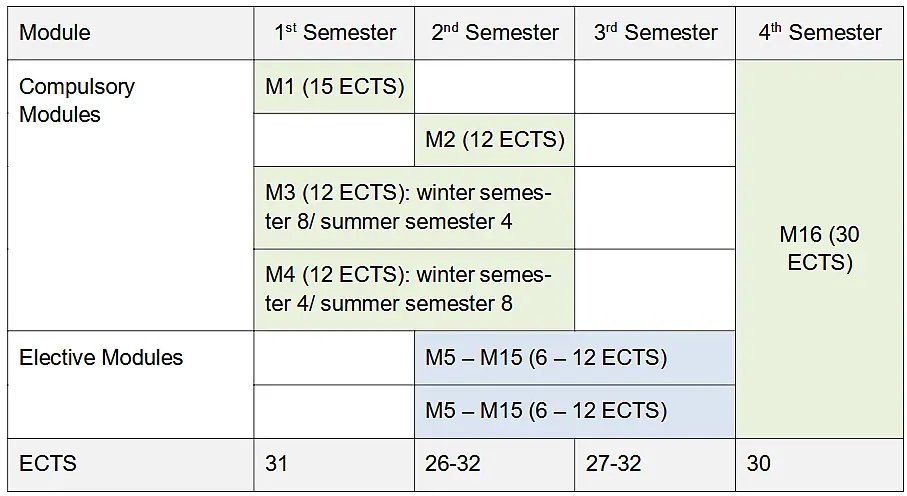
The standard duration of the MA programme Peace Research and International Relations is four semesters or two years with a total of 120 ECTS. Of these, 81 ECTS are acquired in compulsory modules (M1-M4 and the final exam module M16) and 39 ECTS in elective modules (M5-M15). At least two of the elective modules M5 to M14 must be completed in full. Each module is completed by a final exam, which may take the form of a written or oral examination or seminar paper. The module M15 is generally ungraded and students can be credited a maximum of 12 ECTS.

Compulsory Modules

Module 1:

Theoretical and Methodological Perspectives

The module introduces students to the normative, theoretical and methodological foundations of analysing questions related to peace and conflict/ international politics. For this purpose, students discuss central concepts and theories and finally draft a research designas module exam.

15 ECTS

Module 2:

Normative and
Critical Perspectives

The module introduces students to the different conceptualisations of security and their historical and academic evolution. It introduces students to critical debates on security and its policies and politics as well as to the normative and ethical challenges of international relations. Students finalize the module with either a written exam after the lecture or a term paper after the seminar.12 ECTS

Module 3:

Global
Governance I

The module introduces students to the analysis of international institutions theoretically as well as empirically. It provides students with an overview of the evolution of international governance.12 ECTS

Module 4:

Analyzing Armed Conflicts

The module provides an overview of approaches to analyzing armed conflicts at the international and national level. The lecture focuses on the presentation and discussion of key theoretical approaches that address the causes, dynamics, and resolution of armed conflicts. The seminar focuses on the merits of different analytical models based on case-study evaluation.12 ECTS

Module 16:

Final Exam

The module consists of a colloquium, an oral exam, and the Master’s thesis.30 ECTS


Elective Modules


It is possible to choose from the following modules:


  • Conflict Analysis and Conflict Management
  • Global Governance II
  • European Union
  • International Organisations, Security and Conflict
  • Negotiation and Mediation


  • International Political Economy
  • Development and Transformation
  • International Law and World Politics
  • Peace Education
  • Perspectives on Methods and Methodologies
  • Professional Practice

You can find further information regarding the modules in the degree manual.


Semester abroad and internships

Study Abroad

The University of Tübingen as well as the Institute of Political Science maintain worldwide cooperation agreements with other academic institutions. Students are therefore offered a variety of opportunities to study abroad  for one or two semesters. They are advised to do so during the 3rd semester. As the compulsory modules are completed during the 2nd semester, students can concentrate on the elective modules from the third semester onward, which increases the possibility of attending relevant courses at the host university. After their return to the University of Tübingen, students can continue with their final exam module M16 in the last semester.

Study achievements completed abroad which meet the requirements of the present curriculum will be recognised upon request. It is advisable to discuss the plans for studying abroad and the question of the recognition of credits earned abroad with the Study Programme Convenor.

Please find further information on the institute's exchange opportunities here

Internships

Students are recommended to attend a study programme-related internship in Germany or abroad. They are advised to plan internships either for the semester break or/and after completion of the first academic year. It is possible to apply for a semester of leave.

Certificates of eligibility for interships can be obtained from the Study Programme Convenor. Information on internships is available at the Institute's Internship Coordinator.

Important Documents

Documents for the Study Programme MAPIR version 2024/25 

Studien- und Prüfungsordnung 2024 (Study and Examination Regulations - GERMAN)

Study and Examination Regulations 2024 (ENGLISH - Please note that only the German version is legally binding)

Degree Manual 2024/25

Declaration of Academic Integrity (Selbstständigkeitserklärung) (plagiarism and AI)


Documents for the Study Programme MAPIR version 2020/21

Studien- und Prüfungsordnung 2020/21 (Study and Examination Regulations - GERMAN)
Study and Examination Regulations 2020/21  (ENGLISH - Please note that only the German version is legally binding.)
Degree Manual 2020/21


Documents for older versions of the Study Programme - Friedensforschung und Internationale Politik

Documents for the Study Programme MAFIP version 2018/19 (German only)

Studien- und Prüfungsordnung 2018/19
Modulhandbuch 2018/19


Documents for the Study Programme MAFIP version 2013/14 (German only)

Studien- und Prüfungsordnung 2013/14
Modulhandbuch 2013/14


In case you are stuying an older version of MAFIP, please write an e-mail to gabi.schlag@uni-tuebingen.de and we will provide you with the respective document and version.