June 2026
Christian J. Krüger and Sebastian H. Völkel
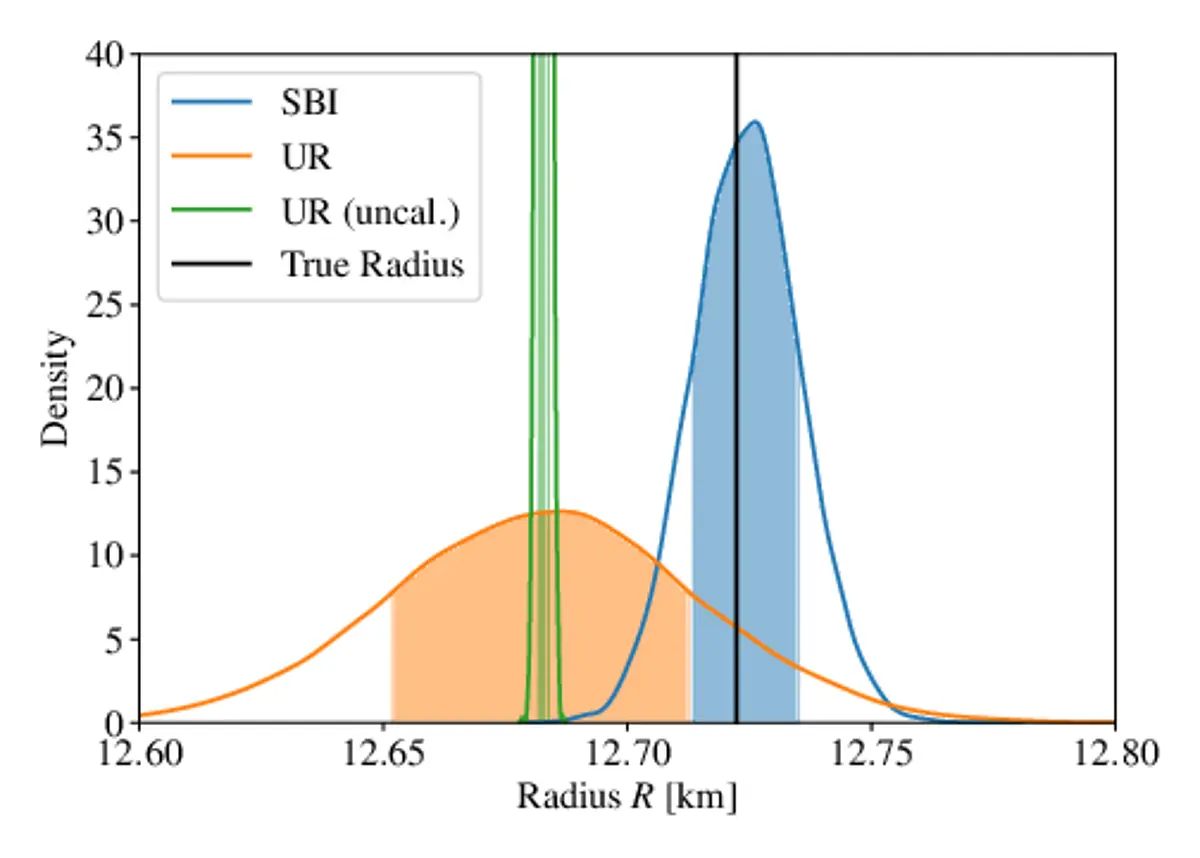
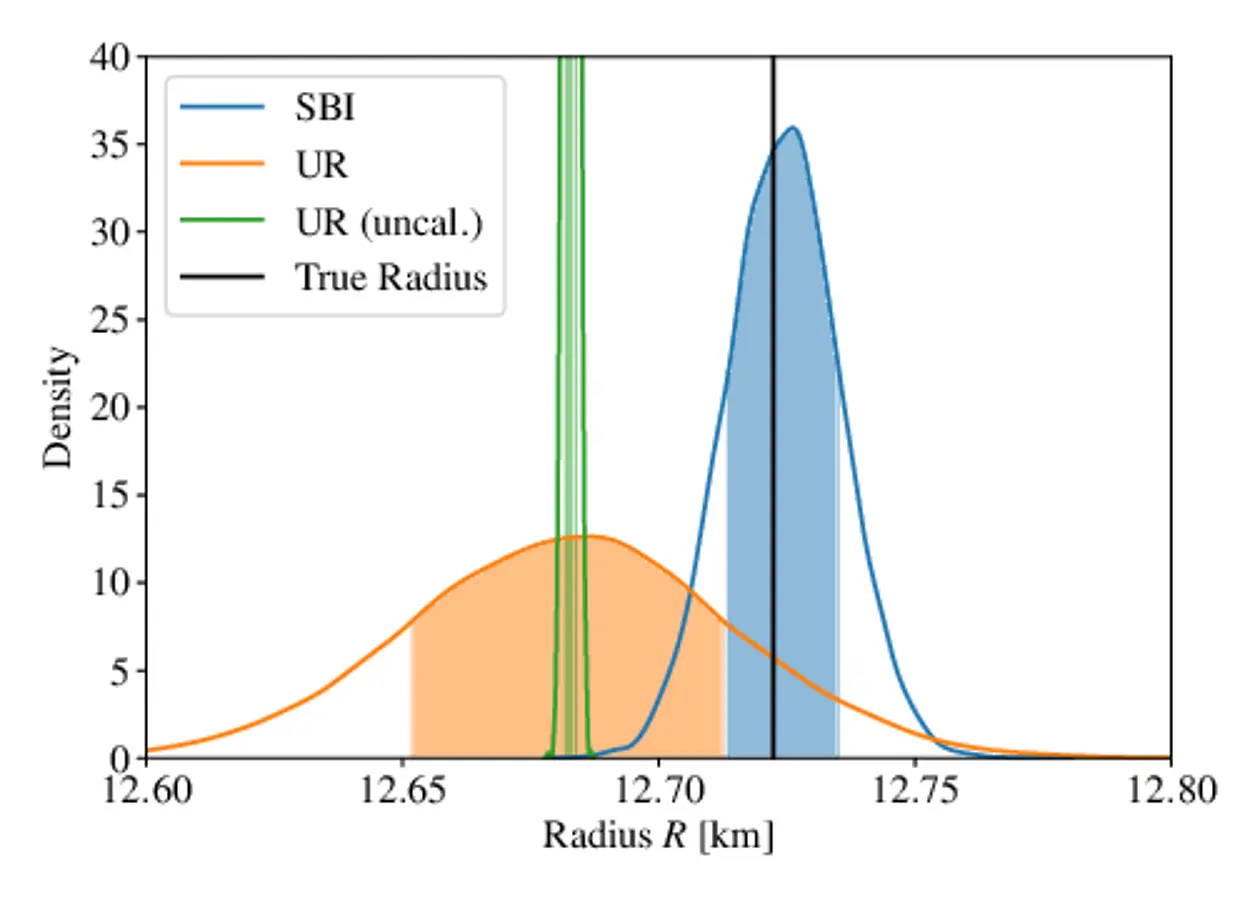
If one were to describe neutron star properties in terms of simple rules, universal relations act as shortcuts linking quantities like mass, radius, oscillation frequencies or others almost independently of the uncertain nuclear equation of state (EOS). However, their predictive power is limited by the difficulty of identifying optimal parameter combinations and, in particular, by reliably quantifying systematic uncertainties, an issue that is especially relevant for gravitational-wave observations. In this study, researchers from the University of Tübingen and the AEI introduce a new approach based on simulation-based inference (SBI), a machine-learning method that learns directly from simulated data and treats variations across EOS models as intrinsic “EOS noise.” This allows for a systematic exploration of correlations, recovers known universal relations, and reveals a new relation linking the neutron star radius to its mass and two oscillation frequencies. The study shows that SBI can capture universal relations, and often, given a sufficiently large data sample, even outperform them while providing reliable uncertainty estimates out of the box. In contrast, standard universal relations do not come with a measure of their systematic uncertainty and a naive approach tends to considerably underestimate it. The work demonstrates that SBI offers a powerful complementary perspective, turning universal relations into part of a broader probabilistic framework for precision neutron star physics.
Link to publication: Krüger, C.J. & Völkel, S.H. (2026). Phys. Rev. D, 113, L121506. DOI: https://doi.org/10.1103/62ly-gtjg