Urgeschichte und Naturwissenschaftliche Archäologie

News

Awards

Early-Stage Scientist Award of the European Chemical Society

We warmly congratulate Dr. Barbara Huber, who has just been awarded the European Chemical Society's Early-Stage Scientist Award 2026 in the field of Cultural Heritage!
The price is awarded to young researchers who "distinguished themselves through remarkable scientific achievements at an early career stage, and a compelling vision for advancing the field".
She received this prestigious and highly competitive award in recognition of her cutting-edge achievements in identifying the chemical signatures of aromatic compounds to shed light on the influence of scents in our past.
The award will be formally presented during the ChemCH 2026 Conference, where Dr. Huber will deliver the Early-Stage Scientist Award Lecture. 
Section ‘Chemistry for Cultural Heritage’ of the European Chemical Society's website.


Coming Events

Archaeometry Colloquium

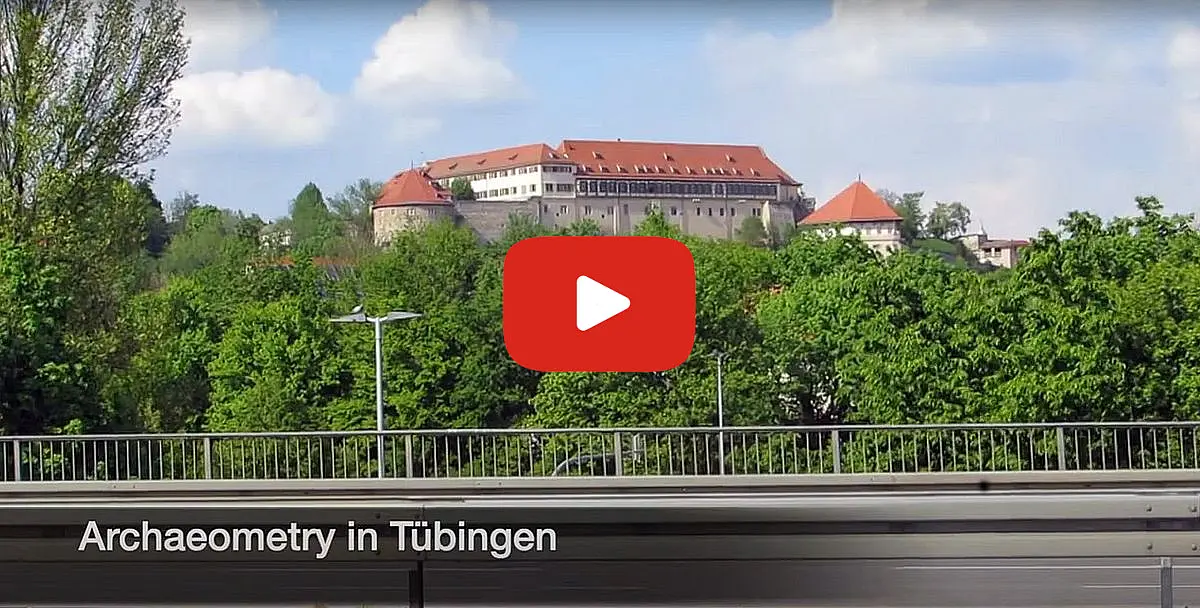
This semester, the Archaeometry colloquium is taking place biweekly on Wednesdays, at 16.00 c.t., in room 212, Schloss Hohentübingen, starting at 16:00 c.t.

Link to the full program of the Archaeometry Colloquium.


Latest Publications

An archaeo-metabolomics approach for identifying cedar tar in archaeological samples: differentiating plant products and production processes

We are happy to share a new research article led by Barbara Huber.

In this paper, the interdisciplinary team of researchers show how an archaeometabolomics approach can distinguish between different cedar-derived products – such as tar, resin, and essential oil – in archaeological samples. By identifying diagnostic chemical markers, the study moves beyond simply detecting plant presence and instead reconstructs ancient production processes and material use. Applied to Egyptian mummification balms, the method provides direct evidence for cedar tar use and offers new insights into ancient technologies, craft knowledge, and cultural practices.

Link to the open access article "An archaeo-metabolomics approach for identifying cedar tar in archaeological samples".


Ritual and Connectivity in Nuragic Sardinia: An Interdisciplinary Study of Ceramics and Metalwork from Nuraghe Barru

We are delighted to share a new research paper led by group member Silvia Amicone.
In this study, an interdisciplinary team examines ritual practices in late Nuragic Sardinia through ceramic and metal artefacts from Nuraghe Barru. By combining ceramic petrography and portable X-ray fluorescence (pXRF), the researchers identify patterns of production, exchange, and material selection. Their results point to strong inter-community connectivity, with mostly non-local ceramics and copper-rich alloys likely carrying symbolic meaning. The study shows how certain Nuragic monuments were reused for ritual purposes during the transition from the Final Bronze Age to the Early Iron Age.
Link to the open access article "Ritual and Connectivity in Nuragic Sardinia".


From biomolecular traces to multisensory experiences: bringing scent reproductions to museums and cultural heritage

We are happy to share a new research paper co-authored by our newest group member Barbara Huber.
In this study, an interdisciplinary research team demonstrates how museums can use molecular evidence to engage audiences with the sensory worlds of the past. By combining expertise across disciplines, the team developed a new workflow that transforms biomolecular data into accessible, visitor-ready olfactory reconstructions for museums and cultural heritage contexts.
Link to the open access article "From biomolecular traces to multisensory experiences".


Assembling the puzzle pieces: integrating pottery and kiln analysis to reconstruct pyrotechnology at the Dinka Settlement Complex (Iraqi Kurdistan)

We are pleased to share our new open-access study led by Silvia Amicone.
This paper analyses the ceramic workshop area at Gird-i Bazar (ca. 1200–800 BCE), where kilns, vessels, and production debris allow reconstruction of the full pottery production sequence. Integrated analyses reveal a shared technological tradition, coordinated kiln use, and standardized firing practices, indicating that pottery production was organised beyond the household level and embedded within the urban fabric, pointing to craft specialisation and central coordination in early Iron Age Dinka.
Link to the open access article "Assembling the puzzle pieces".