
Hector Research Institute of Education Sciences and Psychology

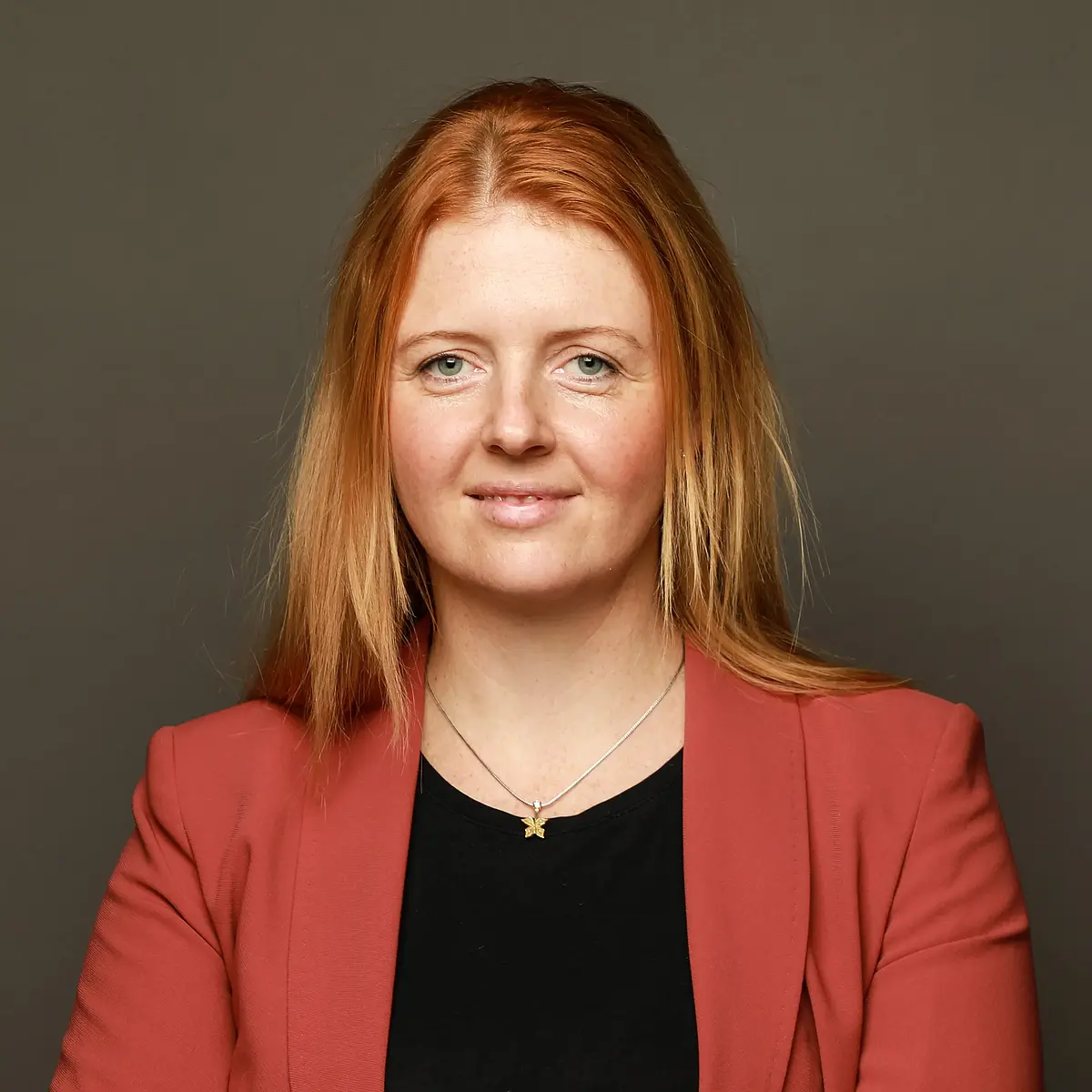
Dr. Stephanie Rösch

Building foundations, connecting disciplines.

Stephanie Rösch is a postdoctoral researcher at the Hector Research Institute of Education Sciences and Psychology and is responsible for the Directorate of Teaching and Studies. 

Her research interests focus on the development and promotion of basic mathematical skills. In particular, she is interested in how these skills develop and how they interact with fundamental cognitive and (fine) motor abilities to either support successful development or lead to later difficulties in mathematics. She also investigates how targeted interventions can effectively support mathematical development. 

Stephanie Rösch has received funding from several sources, including the German Research Foundation (DFG). In the project „Finger und Zahlen – Förderung basaler numerischer Fähigkeiten mit Hilfe der Finger“ she examined the effectiveness of promoting fine motor skills and finger-based strategies (e.g., counting and representing quantities using fingers) in conveying mathematical skills in early childhood education (i.e., embodied learning and cognition). In addition, she is involved in the project Aqua-D (funded by the Ministry of Science, Research and the Arts Baden-Württemberg) as part of the subproject "Interactive Tasks for Building a Part-Whole Concept." The goal of this subproject is to develop and evaluate an app that supports structured quantity perception and structure-based number determination, with a focus on the gradual development of a part-whole concept.

From 2021 to 2025, Stephanie Rösch also served as a board member of the Fachverband für integrative Lerntherapie (FiL). Since 2025, she has been a member of the Scientific Advisory Board of the Professional Association for Integrative Learning Therapy (FiL). In addition, together with Lisa Zachrich, she is responsible for the Directorate of Teaching and Studies at the Hector Research Institute of Education Sciences and Psychology, which oversees the coordination and strategic development of all teaching- and study-related topics.
 

Contact

Dr. Stephanie Rösch
University of Tübingen, Hector Research Institute of Education Sciences and Psychology, Europastraße 6, 72072 Tübingen, Room 201
07071/29-74130
stephanie.roeschspam prevention@uni-tuebingen.de

Follow me on

Publications

Journal Articles

  • Roesch, S., Conze, M., & Moeller, K. (2025). Design and Evaluation of a Systematic Finger-based Intervention for Early Mathematical Skills in 5-to 6-Year-Olds. PsyArXiv: https://osf.io/preprints/psyarxiv/zdb73_v1
  • Marx, C., Roesch, S., Moeller, K., & Benz, C. (2025). From the whole to its parts – A systematic analysis of affordances for learning part-whole-relations in digital apps. International Electronic Journal of Mathematics Education, 20(1), em0802. https://doi.org/10.29333/iejme/15677
  • Roesch, S., Moeller, K., & Bahnmueller, J. (2024). Finger counting, finger number gesturing, and basic numerical skills: A cross-sectional study in 3- to 5-year-olds. Journal of Experimental Child Psychology, 242, 105892. https://doi.org/https://doi.org/10.1016/j.jecp.2024.105892
  • Bahnmueller, J., Barrocas, R., Moeller, K. & Roesch, S. (in revision). The emerging association of canonical finger patterns and quantity-number linkage in early childhood. Acta Psychologica.
  • Roesch, S., Fischer, U., Suggate, S., Moeller, K. & Stoeger, H. (in revision). Raising a finger for arithmetic: A selective contribution of fine motor skills to basic arithmetic development in early childhood. Perceptual and motor skills.
  • Roesch, S., Bahnmueller, J., Barrocas, R., Fischer, U., & Moeller, K. (2022). Feinmotorik, Fingergnosie und frühe mathematische Fähigkeiten: Ein Überblick. Lernen und Lernstörungen, 11, 139-157
  • Barrocas, R., Bahnmueller, J., Roesch, S., Lachmair, M., & Moeller, K. (2023). Design and empirical evaluation of a multitouch interaction game-like app for fostering early embodied math learning. International Journal of Human-Computer Studies, 175, 103030. https://doi.org/10.1016/j.ijhcs.2023.103030
  • Roesch, S., Bahnmueller, J., Barrocas, R., Fischer, U., & Moeller, K. (2021). Die Bedeutung von Fingergnosie und Fingerbeweglichkeit für die Rechenfähigkeit im Kindergartenalter. Empirische Pädagogik, 35(3), 250-268.
  • Kreilinger, I. L., Roesch, S., Moeller, K., & Pixner, S. (2021). Mastery of structured quantities like finger or dice patterns predict arithmetic performance. Cognitive Processing, 22(1), 93-104. https://doi.org/10.1007/s10339-020-00994-4
  • Barrocas, R., Roesch, S., Gawrilow, C., & Moeller, K. (2020). Putting a Finger on Numerical Development – Reviewing the Contributions of Kindergarten Finger Gnosis and Fine Motor Skills to Numerical Abilities. Frontiers in Psychology, 11, Article 1012. https://dx.doi.org/10.3389/fpsyg.2020.01012
  • Jung, S., Meinhardt, A., Braeuning, D., Roesch, S., Cornu, V., Pazouki, T., Schiltz, C., Lonnemann, J., & Moeller, K. (2020). Hierarchical Development of Early Visual-Spatial Abilities – A Taxonomy Based Assessment Using the MaGrid App. Frontiers in Psychology, 11, Article 871. https://dx.doi.org/10.3389/fpsyg.2020.00871
  • Barrocas, R., Roesch, S., Dresen, V., Moeller, K., & Pixner, S. (2020). Embodied numerical representations and their association with multi-digit arithmetic performance. Cognitive Processing, 21(1), 95-103. https://dx.doi.org/10.1007/s10339-019-00940-z
  • Jung, S., Roesch, S., Klein, E., Dackermann, T., Heller, J., & Moeller, K. (2020). The strategy matters: Bounded and unbounded number line estimation in secondary school children. Cognitive Development, 53, Article 100839. https://dx.doi.org/10.1016/j.cogdev.2019.100839
  • Fischer, U., Roesch, S. & Moeller, K. (2017). Diagnostik und Förderung bei Rechenschwäche: Messen wir, was wir fördern wollen? [Dyscalculia diagnosis and treatment: Are we measuring what we want to improve?] Lernen und Lernstörungen, 6, 25-38.
  • Roesch, S., Jung, S., Huber, S. Artemenko, C., Bahnmueller, J., Heller, J., Grust, T., Nuerk, H.-C. & Moeller, K. (2016). Training arithmetic and Orthography on a web-based and socially-interactive learning platform. International Journal of Education and Information Technologies10, 204-217.
  • Wasner, M., Nuerk, H.-C., Martignon, L., Roesch, S. & Moeller, K. (2016). Finger gnosis predicts a unique but small part of variance in initial arithmetic performance. Journal of Experimental Child Psychology146, 1-16.
  • Fischer, U., Roesch, S., Nuerk, H.-C. & Moeller, K. (2015). Erkennen von Rechenschwäche durch LehrerInnen und Testungen im Klassenverband [Detecting Mathematical Learning Difficulties through Teacher and Classroom Test Assessment]. Lernen und Lernstörungen4, 269-282.
  • Roesch, S. & Moeller, K. (2015). Considering digits in a current model of numerical development. Frontiers in Human Neuroscience8, 1-5. 

Monographs

  • Roesch, S. (2016). Förderung früher numerischer Kompetenz im Vorschulalter unter Berücksichtigung des Einflusses der Finger. Dissertation, Eberhard Karls Universität Tübingen. 

Book Contributions

  • Roesch, S., Barrocas, R., Ladel, S., & Moeller, K. (2020). Zahlen begreifen - wie Finger das Verständnis von Zahlen fördern können. In C. Andrä & M. Macedonia (Eds.), Bewegtes Lernen - Handbuch für Forschung und Praxis (pp. 83-99). Berlin: Lehmanns Media.
  • Soltanlou, M., Jung, S., Roesch, S., Ninaus, M., Brandelik, B., Heller, J., Grust, T., Nuerk, H.-C., & Moeller, K. (2017). Behavioral and Neurocognitive Evaluation of a Web-Platform for Game-Based Learning of Orthography and Numeracy. In J. Buder & F.W. Hesse (Eds.), Informational Environments: Effects of Use, Effective Designs (pp. 149-176). Cham, Switzerland: Springer International Publishing. 

Contributions to Conference Proceedings

  • Teuscher, S., Roesch, S. & Benz, C. (2025). Observing and Documenting Early Mathematical Skills: Beliefs and Reported Practices of Early Years Professionals. In: S. Nic Mhuirí, L. Harbison & M. Ryan (Eds.). Proceedings of the Tenth Conference on Research in Mathematics Education in Ireland (MEI 10) (p. 293-294). https://doi.org/10.5281/zenodo.17398480
  • Roesch, S. & Hartmann, J. (2025). Finger use for addition and subtraction in preschoolers. In M. Bosch, G. Bolondi, S. Carreira, C. Spagnolo, & M. Gaidoschik (Eds.), Proceedings of the Fourteenth Congress of European Research in Mathematics Education (CERME14), (pp. 2162-2163). Free University of Bozen-Bolzano and ERME.
  • Marx, C., Moeller, K. Roesch, S., Rudzewitz, B. & Benz, C. (2024). From concept to implementation: Lessons learnt from developing a mathematical learning app. Accepted Conference paper: A Mathematics Education Perspective on early Mathematics Learning (POEM 2024). Bari, Italy.
  • Barrocas, R., Ninaus, M., Tsarava, K., Gawrilow, C., Lachmair, M., Roesch, S., & Moeller, K. (2019). Digits grasp digits: Numbers on your fingertips. Proceedings of the 11th International Conference on Education and New Learning Technologies (EDULEARN19) (pp. 7165-7174). Barcelona, Valencia: IATED Academy.
  • Roesch, S., Moeller, K., Ohl, F. W. & Scheich, H. (2016). Förderung früher numerischer Kompetenz im Kindergartenalter: Mit Hilfe der Finger? In A. Schmitt, A. Schwentesius & E. Sterdt (Hrsg.), Berichte aus dem KFB (pp. 44-51). Stendal: Kompetenzzentrum frühe Bildung.
  • Jung, S., Roesch, S., Huber, S., Heller, J., Grust, T., Nuerk, H.-C., & Moeller, K. (2015). An interactive Web-Based Learning Platform for Arithmetic and Orthography. In N. E. Mastorakis, A. L. Brooks, & I. J. Rudas (Eds.), Advances in Computers and Technology for Education – Proceedings of the 11th International Conference on Educational Technologies (pp. 13-22). Dubai: WSEAS. 

Contributions for the practice

  • Karcher, C. (Text) & Marquardt, V. (Fotos)(2024). Zahlen begreifen [Grasping numbers]. Universität Tübingen: Attempto! S. Roesch in Zusammenarbeit mit dem Wissenschaftsjournalisten C. Karcher und dem Fotographen V. Marquardt.
  • Karcher, C. (2024). Fingerfertig zum Zahlenverstand. Herder: kindergarten heute, S. Roesch in Zusammenarbeit mit dem Wissenschaftsjournalisten C. Karcher.
  • Roesch, S. (2025). Interview: Mit den Fingern rechnen: Warum und wie lange es sinnvoll ist – und wann nicht mehr. Online-Magazin Schulmanagement. https://www.campus-schulmanagement.de/magazin/mit-den-fingern-rechnen-warum-und-wie-lange-es-sinnvoll-ist-und-wann-nicht-mehr-stephanie-roesch
  • Fischer, U., Roesch, S., & Stoeger, H. (2018). Mit geschickten Händen besser rechnen - Die Relevanz der Feinmotorik für die Entwicklung mathematischer Fertigkeiten. begabt & exzellent - Zeitschrift für Begabtenförderung und Begabungsforschung, 46(2), 8-12.
  • Roesch, S., Klein, E., Kaufmann, L., & Moeller, K. (2017). Zahlen, Rechnen und das Gehirn: Können neurokognitive Befunde zu einem besseren Verständnis des Rechnens und der Rechenstörung beitragen? Landesverband Legasthenie und Dyskalkulie NRW e.V., ldl-nrw.de
  • Roesch, S., Ladel, S., & Moeller, K. (2015). Finger begreifen Zahlen: Einsatz von Tablets im mathematischen Erstunterricht. Magazin Digitale Schulemagazin.digitale.schule/p-dagogik/finger-begreifen-zahlen-einsatz-von-tablets-im-mathematischen-erstunterricht 

Conference Contributions

  • Teuscher, S., Roesch, S., Benz, C. (2025, Oktober). Observing and Documenting Early Mathematical Skills: Beliefs and Reported Practices of Early Years Professionals. 10th conference of the Mathematics Education in Ireland (MEI), Dublin. [Poster]
  • Teuscher, S., Roesch, S., Moeller, K., Benz, C. (2025, Juni). Development of questionnaire for the observation of mathematical skills in early Years educational settings. 8th conference of the Mathematical Cognition and Learning Society (MCLS), Hongkong. [Poster]
  • Marx, C., Roesch, S., Moeller, K., Benz, C. (2025, Juni). Assessing children‘s part-whole understanding. 8th conference of the Mathematical Cognition and Learning Society (MCLS), Hongkong. [Vortrag]
  • Marx, C., Roesch, S., Moeller, K., Benz, C. (2025, Juni). Development and evaluation of a Digital Learning Resource to promote part-whole understanding. 11th Conference for Research in Early Childhood Education (CRECE 2025), Hongkong. [Poster]
  • Roesch, S. & Hartmann, J. (2025, Februar). Finger use for addition and subtraction in preschoolers. Congress of the European Society for Research in Mathematics Education (CERME14 2025). Bolzano, Italy. [Poster und Kurzvortrag]
  • Roesch, S. (2024, September). Effects of a finger-based early maths intervention for 5- to 6-year-olds. 53. Kongress der Deutschen Gesellschaft für Psychologie (DGPs) und 15. Konferenz der Österreichischen Gesellschaft für Psychologie (ÖGP), Wien. [Vortrag]
  • Marx, C., Roesch, S., Moeller, K. & Benz, C. (2024, August). ICT related competences, attitudes, and experiences in primary school mathematics teachers. Earli Sig 6&7 Conference, Tübingen. [Vortrag]
  • Roesch, S., Bahnmueller, J. & Moeller, K. (2024, Mai). Promoting basic mathematical skills in early education: The potential of embodied learning. Jahrestagung des Forschungsnetzwerkes Bildungspotenziale (LERN), Tübingen. [Vortrag]
  • Marx, C., Roesch, S., Moeller, K. & Benz, C. (2024, Mai). Digitale Kompetenzen von Mathematiklehrkräften in der Grundschule als Chance und Herausforderung für das Bildungssystem. Jahrestagung des Forschungsnetzwerkes Bildungspotenziale (LERN), Tübingen. [Poster]
  • Benz. C. & Roesch, S. (2024, April). Early maths research workshop, Gothenburg.
  • Roesch, S., Bahnmueller, J., Barrocas, R., & Moeller, K. (2023, Juni). Finger Counting, Finger Montring, and Early Mathematical Skills. 6th conference of the Mathematical Cognition and Learning Society (MCLS), Loughborough. [Poster]
  • Fischer, U., Roesch, S., Bahnmueller, J., Barroca, R., Bollmann, N. & Moeller, K. (2023, Juni). Spatial working memory capacity moderates the association between fine motor skills and mathematics in preschoolers. 6th conference of the Mathematical Cognition and Learning Society (MCLS), Loughborough. [Poster]
  • Roesch, S., Fischer, U., Suggate, S., Moeller, K. & Stoeger, H. (2022, Juni). Fingers and arithmetic: The selective relation of different components of fine motor skills and basic arithmetic in early childhood, Conference of the Mathematical Cognition and Learning Society 2022 (MCLS). Antwerpen, Belgium [Vortrag]
  • Roesch, S., Bahnmueller, J., Barrocas, R., & Moeller, K. (2022, Mai). Die Finger zählen: Fingerzähl- und Rechenstrategien im Kindergartenalter und deren Einfluss auf die frühe mathematische Entwicklung, 3. Internationales Bodenseesymposium Frühe Kindheit. Kreuzlingen, Swiss [Vortrag]
  • Barrocas, R., Bahnmueller, J., Roesch, S. & Moeller, K. (2021, August), The association of cardinal finger patterns and quantity-number concepts in early childhood,19th Biennial Conference of the European Association for Research on Learning and Instruction (EARLI). Online [Vortrag]
  • Roesch, S., Bahnmueller, J., Barrocas, R., & Moeller, K. (2021, März), Raising a Finger for Numbers, 63. Tagung experimentell arbeitender Psychologen (TEAP). Online [Symposium]
  • Roesch, S., Bahnmueller, J., Barrocas, R., Fischer, U., & Moeller, K. (2021, März). The impact of finger gnosia and finger agility on preschoolers’ arithmetical abilities. 63. Tagung experimentell arbeitender Psychologen (TeaP), Online [Vortrag]
  • Barrocas, R., Ninaus, M., Tsarava, K., Gawrilow, C., Lachmair, M., Roesch, S., & Moeller, K. (2019, Juli). Digits grasp digits: Numbers on your fingertips. 11th International Conference on Education and New Learning Technologies (EDULEARN19). Palma, Spain. [Vortrag]
  • Barrocas, R., Roesch, S., & Moeller, K. (2019, Juni). Fingers come in handy: does finger use support learning a pseudo-number-word sequence? 2nd Conference of the Mathematical Cognition and Learning Society. Ottawa, Canada. [Poster]
  • Barrocas, R., Roesch, S., Dresen, V., Kreilinger, I., Moeller, K., & Pixner, S. (2018, Juni). The longitudinal influence of fingers on the acquisition of discrete cardinal number knowledge. 3rd Jean Piaget Conference: The origins of number. Geneva, Switzerland. [Poster]
  • Moeller, K., Jung, S., Roesch, S., Lonnemann, J., Hasselhorn, M., & Heinze, A. (2018, September). Muster, Form und Raum: Geometrische Fähigkeiten im Kindergarten. Bildungspolitisches Forum des Leibniz-Forschungsverbundes Bildungspotenziale (LERN). Berlin. [Poster]
  • Barrocas, R., Roesch, S., Dresen, V., Kreilinger, I., Moeller, K., & Pixner, S. (2018, September). Finger-based numerical representations predict preschoolers' cardinal number knowledge longitudinally. Workshop Integrating Educational and Cognitive Perspectives on Mathematics. Tübingen. [Poster]
  • Jung, S., Roesch, S., Klein, E., Dackermann, T., Heller, J., & Moeller, K. (2018, September). Solution strategies in bounded and unbounded number line estimation: A comparison of contour analysis and data modelling. Workshop Integrating Educational and Cognitive Perspectives on Mathematics. Tübingen. [Poster]
  • Barrocas, R., Roesch, S., Dresen, V., Moeller, K., & Pixner, S. (2018, January). Different aspects of non-canonical finger patterns and their association with arithmetic performance. 36th European Workshop of Cognitive Neuropsychology. Bressanone, Italy. [Vortrag]
  • Jung, S., Roesch, S., Klein, E., Nuerk, H.-C., Heller, J. & Moeller, K. (2017, September). Impact of phonology and rule knowledge beyond domains? Workshop on Linguistic and Cognitive Influences on Numerical Cognition. Tübingen. [Vortrag]
  • Rebholz, F., Golle, J., Roesch, S., Trautwein, U., & Moeller, K. (2017, März). Förderung prozessbezogener Kompetenzen – Evaluation eines Mathematik-Trainings für Grundschulkinder. 5. Tagung der Gesellschaft für Empirische Bildungsforschung (GEBF). Heidelberg.
  • Rebholz, F., Golle, J., Roesch, S., Trautwein, U., & Moeller, K. (2016, September). Mathematics Training to Foster Process-Based Competencies. Workshop on Domain-General and Domain-Specific Foundation of Numerical and Arithmetic Processing. Tübingen. [Poster]
  • Roesch, S., Moeller, K., & Scheich, H. (2016, März). Zahlen begreifen - Förderung numerischer Fähigkeiten im Vorschulalter mit Hilfe der Finger.  4. Tagung der Gesellschaft für Empirische Bildungsforschung (GEBF). Berlin. [Vortrag]
  • Roesch, S., Moeller, K., Pontual Falcão, T., Dackermann, T., & Scheich, H. (2016, January). Finger dexterity and finger gnosis: Unique predictors of preschoolers numerical abilities.  34th European Workshop on Cognitive Neuropsychology. Bressanone, Italy. [Poster]
  • Bahnmueller, J., Bloechle, J., Huber, S., Dackermann, T., Roesch, S., Moeller, K., & Klein, E. (2015, June). Time matters – Temporal dynamics of number magnitude processing and arithmetic fact retrieval. 21st Annual Meeting of the Organization for Human Brain Mapping. Honolulu, HI, USA. [Poster]
  • Roesch, S., Jung, S., Huber, S., Heller, J., Grust, T., Nuerk, H.-C. & Moeller, K. (2015, February). An Interactive Web-Based Learning Platform for Arithmetic and Orthography. 11th International Conference on Educational Technologies. Dubai. [Vortrag]

Presentations

  • Roesch, S. (2025, May). Effects of a finger-based early mathematical intervention for 5- to 6-year-olds. Potsdam Embodied Cognition Group, Online. [Vortrag]
  • Roesch, S. (2024, November). Chancen und Möglichkeiten von fingerbasierter Anschauung für das Erlernen basaler math. Fähigkeiten. Netzwerk für Lerntherapeut*innen Baden-Württemberg. [Vortrag]
  • Roesch, S. (2024, September). Finger begreifen Zahlen: Verkörperte numerische Kognition oder wie die Finger sinnvoll zur Vermittlung von Zahlbegriff und Rechenverständnis eingesetzt werden können? Workshop für Lerntherapeut*innen im Fachverband für integrative Lerntherapie FiL e.V.
  • Roesch, S. (2024, Januar bis Juli). Mathematische Förderung mit Hilfe der Finger. Workshops für ErzieherInnen zur Studie „Finger und Zahlen“. [Workshop]
  • Roesch, S. (2024, Januar/Februar). Mathematische Förderung ohne Finger nach dem Konzept „Mengen, zählen, Zahlen“. Workshops für ErzieherInnen zur Studie „Finger und Zahlen“. [Workshop]
  • Roesch, S. (2023, Juli). Mathematische Förderung im Vorschulalter mit Hilfe der Finger. Workshops für ErzieherInnen im LK Tübingen und Böblingen.
  • Roesch, S. (2022, November). Fingerzähl- und Rechenstrategien im Kindergartenalter und deren Zusammenhang mit mathematischen Basiskompetenzen. Mathematikdidaktisches Kolloquium der PH Schwäbisch Gmünd.
  • Roesch, S. (2021, September). Fingerturnen mit Ed und Ted: Eine Studie zum Einfluss der Feinmotorik auf die Entwicklung mathematischer Fähigkeiten und Strategien. Workshops für ErzieherInnen im LK Tübingen und Böblingen.
  • Roesch, S. (2014, Juni). Förderung numerischer Kompetenz in der frühen Bildung: Mit Hilfe der Finger? 1. Fachtagung des Forschungsnetzes Frühe Bildung, Stendal. [Vortrag]
  • Roesch, S. (2013, November). Förderung mathematischer Basiskompetenzen in der frühkindlichen Bildung mit Hilfe der Finger. Kolloquium der Stiftung „Haus der kleinen Forscher“, Berlin. [Vortrag]
  • Roesch, S. (2013, November). Förderung mathematischer und schriftsprachlicher Basiskompetenzen im Kindergarten: Wie effektiv ist die Kybernetische Methode? Caritas für Kinder und Jugendliche Oberösterreich, Linz. [Vortrag]

Guest Editor Works

  • Acta Psychologica: Gasteditorin für das Themenheft „Numbers in action: The embodied nature of numerical representations” (2021/2022) gemeinsam mit Korbinian Moeller, Julia Bahnmueller und Roberta Barrocas.

Curriculum Vitae

Since May 2025
Director of Teaching and Studies

University of Tübingen, Hector Research Institute of Education Sciences and Psychology

Since June 2020
Postdoctoral Researcher

University of Tübingen, Hector Research Institute of Education Sciences and Psychology

2018 – 2020
Parental leave
2017 – 2018
Postdoctoral Researcher

Leibniz-Institut für Wissensmedien, Tübingen

2017
Research Associate

University of Regensburg, Lehrstuhl Schulpädagogik

2016 – 2017
Parental leave
2016
Doctorate (Dr. rer. nat.)

University of Tübingen, Department of Psychology

2015 – 2016
Research Associate

Leibniz-Institut für Wissensmedien, Tübingen
University of Tübingen, Department of Psychology

2011 – 2014
Research Associate

Leibniz Institute for Neurobiology, Magdeburg

2011
Second State Examination (Primary School Teaching/School Psychology)
2008
First State Examination (Primary School Teaching/School Psychology)

* Position has been or will be used part-time due to child care