Faculty of Humanities

Funding measures

1. Promoting the compatibility of science and family life

“Mehr Zeit” (More Time) Support staff to assist postdoctoral researchers with children

The aim of the ‘More Time’ programme is to increase the amount of time habilitation candidates with children can devote to research by funding an academic assistant. Applications for this can be submitted either by 10 January or 01 July. Funding begins on 1 April or 1 October and lasts for six months.

Application form; most recent Application details 

Family-friendly conditions at faculty conferences

Childcare at conferences enables or facilitates participation for some parents, and thus makes an important contribution to the compatibility of academic careers and family life. For conferences held at the faculty, the children's room in the Brechtbau building can be used free of charge. A subsidy for the costs of childcare can be applied for. Qualified childcare and the necessary insurance cover must be provided by the applicants themselves.

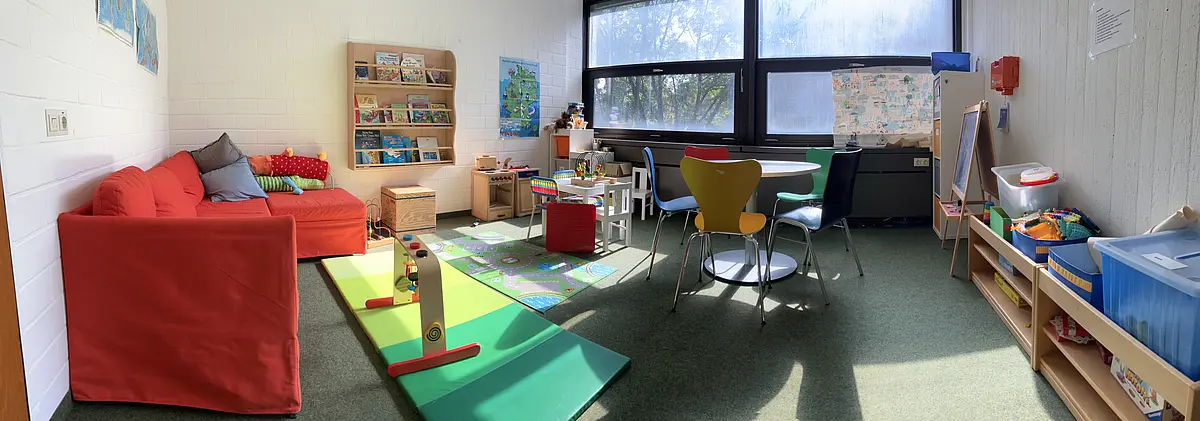
Family Room in the Brechtbau

The family room in the Brechtbau building is available to students and staff for short-term childcare. You may need to arrange for a caregiver yourself. If necessary, the room can also be used as a relaxation room during pregnancy. The room was furnished with funds from the Equal Opportunities Commission and offers a changing table, a recliner, a work area with a desk and space for small children to play.

If you would like to use the room, please fill out the application form for use of the family room or relaxation room and send it signed by post or email to gleichstellungspam prevention@philosophie.uni-tuebingen.de. You will then be added to the list of authorised users. The list is kept by the Brecht Library, which will give you the key upon presentation of your student or staff ID card if required. Authorisation to use the room is initially valid for three years (children's room) or one year (rest room) and can be extended afterwards; to do so, please send us the completed form again with your current user data.

You can find more family rooms at the University of Tübingen and further information on family life on campus on the homepage of the Team Equity.

2. Support for young female scientists

Subsidies for participation in conferences and meetings, conducting field research, extended stays in specialist libraries and visits to archives

Young female scientists should be motivated to participate in conferences and meetings, to network and to pursue their scientific careers. Proportionate funding is available for participation/usage/entry fees, travel and accommodation costs (excluding meal costs) for attending specialist conferences and meetings at which they give their own presentation (not guest presentations by invitation), for conducting field research, for longer stays in specialist libraries, for visits to archives and for active participation in fee-based courses offered by the Graduate Academy. When submitting an application, the relevance to the dissertation or habilitation project should be clearly stated.
If the trip incurs childcare costs for a minor child, a higher reimbursement may be granted in individual cases (decision by the commission on a case-by-case basis; if applicable, please enclose proof of the child's travel and a birth certificate with the application; please note: for formal reasons, only childcare costs can be claimed, not travel costs for a child or a caregiver!
Travel by private car can only be funded in justified, exceptional cases.

Applications can be submitted at any time by email to gleichstellungspam prevention@philosophie.uni-tuebingen.de. The commission usually meets in mid-July, late October and mid-January. To be considered, applications must be received by 1 July, 20 October or 10 January.

Application form 

Subsidies for continuing education seminars for young female scientists

Funding is available for participation in interdisciplinary continuing education seminars for young female scientists or their organisation on topics related to career development in science (e.g. third-party funding, balancing family and science, university didactics, negotiation strategies, intercultural competence, etc.). Applications can be submitted at any time by young female scientists who wish to organise or participate in such a continuing education seminar. Funding may be subsidised by the Equal Opportunities Commission.

Application form

3. Teaching Equality Programm (TEA)

Teaching assignments

The Equal Opportunities Commission promotes the integration of topics that reflect the role of gender and gender relations in research and teaching by awarding teaching assignments. The Teaching Equality Programme (TEA) funds teaching assignments in all departments that focus on this area. Applications can be submitted by interested young academics who wish to lead a seminar at the faculty, as well as by institutes and subjects in which gender-related topics are underrepresented.

Most recent call for applications

Conferences and lecture series

The Equal Opportunities Commission welcomes the organisation of conferences or lecture series with a clear focus on gender-related topics. Travel expenses and if applicable, lecture fees are subsidised on a pro rata basis.

Practical lectures

In order to not only study successfully, but also to strategically plan their own careers, female students need insights into career prospects. Practical lectures by women from various fields of work are intended to highlight the career opportunities available and what different individual career paths for women can look like. They are designed to encourage female students to plan their professional lives in a meaningful way. The practical lectures are funded by Teaching Equality funds. Applications can be submitted by students and all members of the university.

4. Printing cost subsidies

Printing subsidies for dissertations

Since summer 2016, the Equal Opportunities Commission of the Faculty of Arts has been granting printing subsidies for dissertations that focus on gender issues and are preferably published in open access. Subsidies for proofreading and editing in foreign languages can also be applied for in the case of non-German-language theses or other publications. The application deadlines are 10 January and 1 July of each year. Please submit an informal application, a short summary of your work, the reviews, the table of contents and a cost estimate from the publisher.