Hector Research Institute of Education Sciences and Psychology

Day of Eyewitnesses 2025

1st and 2nd October 2025

“Remembrance and Democracy – Day of Eyewitnesses in Tübingen”  

This page contains the following information:

  • Project Report on the Day of Eyewitnesses
  • Contact & Organization
  • Program
  • Project Participants

Project Report on the Day of Eyewitnesses – Funded by the University Association of Tübingen

Thirty-five years after German reunification, the “Day of Eyewitnesses” focused on German-German history under the theme “Remembrance and Democracy.” Over the course of the two days, the 100 to 130 participants from academia and the field of historical and political education engaged in lively, sometimes controversial, and at times emotional discussions of the theses raised in the lectures and panel discussions. In tandem presentations, both historical and sociological perspectives (Prof. Dr. Detlef Pollack and Prof. Dr. Christina Morina), as well as emotional and communicative perspectives on the era of division and the period of transformation (Prof. Dr. Dirk Oschmann and Dr. Anna Lux), and—on the second day—perspectives from the fields of history didactics and memory culture (PD Dr. Heinrich Ammerer and Prof. Dr. Aleida Assmann). The panel discussions and tandem presentations were moderated by the sponsors and cooperation partners (Federal Foundation for the Reappraisal of the SED Dictatorship, Berlin Wall Foundation, Archive „Deutsches Gedächtnis“) of the integenrational projects. Nine-Christine Müller, who reports on East German identity in her podcasts, moderated the entire event with great professionalism; the program is available here.

A central focus of the event was the interview studies with the “Generation 1975” and the “Generation Wall Construction”, in which people from East and West Germany were interviewed. In the intergenerational projects—led by Dr. Christiane Bertram of the University of Tübingen—the interviews are utilized in a variety of ways for research, education, and knowledge transfer. For instance, the Hector Institute for Empirical Educational Research is investigating the impact that eyewitnesses have on their audiences. Key findings on this topic were presented by Prof. Dr. Ulrich Trautwein, Dr. Lisa Zachrich, and Katharina Totter. The Center for School Quality and Teacher Education (ZSL) in Baden-Württemberg, on the other hand, presented how the videos available on the  Generationenportal are used in history classes. In the evening, the premiere of the video installation “A Matter for the Germans” took place, part of the traveling exhibition “Connecting Generations,” which will tour East and West Germany from 2025 to 2027. The well-attended public evening event was opened by Prof. Dr. Monique Scheer, from the Department of Empirical Cultural Studies at the University of Tübingen, with a highly illuminating lecture on the difficult concept of the “people” as demos and ethnos.

“Democracy needs memory—not as a burden, but as a resource.” Thanks to funding from the University of Tübingen and other sponsors, this vision of Aleida Assmann’s became a reality over the course of these two days. The conference provided a space for a respectful exchange among people of diverse backgrounds, disciplines, and professions regarding the “shared” memories of Germany’s common history.


Contact

Dr. Christiane Bertram
07071/29-74135
christiane.bertram@uni-tuebingen.de 


Organization

Location: 
Alte Aula, University of Tübingen

Target groups: 

  • Part 1: Teachers, researchers, and advocates of historical and political education
  • Part 2: The general public
  • Part 3: Teachers, researchers, and advocates of historical and political education
     

Program

Memories of Germany’s division and reunification vary greatly among people who grew up in East or West Germany. Historians, social scientists, and cultural studies scholars are researching the period of division, the course of the transition, and its impact on society. History education and educational research, on the other hand, are examining how eyewitness accounts can be meaningfully integrated into educational contexts. The conference facilitates and promotes exchange and networking among various stakeholders in historical-political education and research.

Renowned experts on the German-German discourse, such as Prof. Dr. Detlef Pollack (sociologist of religion), Prof. Dr. Monika Oberle (political didactics), Prof. Dr. Christina Morina (contemporary history), Prof. Dr. Dirk Oschmann (literary studies), and Dr. Anna Lux (history and sociology) will engage in discussions with teachers and multipliers in historical-political education.


Overview:

To the program

Part 1: Remembering German-German History as a Means of Democratic Education
Symposium
1st October, 9:00 a.m.–5:00 p.m.
Symposium
1st October, 9:00 a.m.–5:00 p.m.

Program: October 1, 2025

Part 1: October 1, 9:00 a.m.–5:00 p.m.

Remembering German-German History as a Means of Democratic Education

Symposium | Registration required | Target audience: Researchers, educators in historical and political education, teachers | Moderator: Nine-Christine Müller

9:00–9:45 a.m. | Welcome and introduction to the topic

  • Rectorate of the University of Tübingen (Prof. Dr. Samuel Wagner, Vice Rector)
  • Hector Research Institute of Education Sciences and Psychology (Prof. Dr. Ulrich Trautwein, Director)
  • Federal Foundation for the Reappraisal of the SED Dictatorship (Dr. Robert Grünbaum)
  • Berlin Wall Foundation on behalf of the cooperation partners (Dr. Sarah Bornhorst)

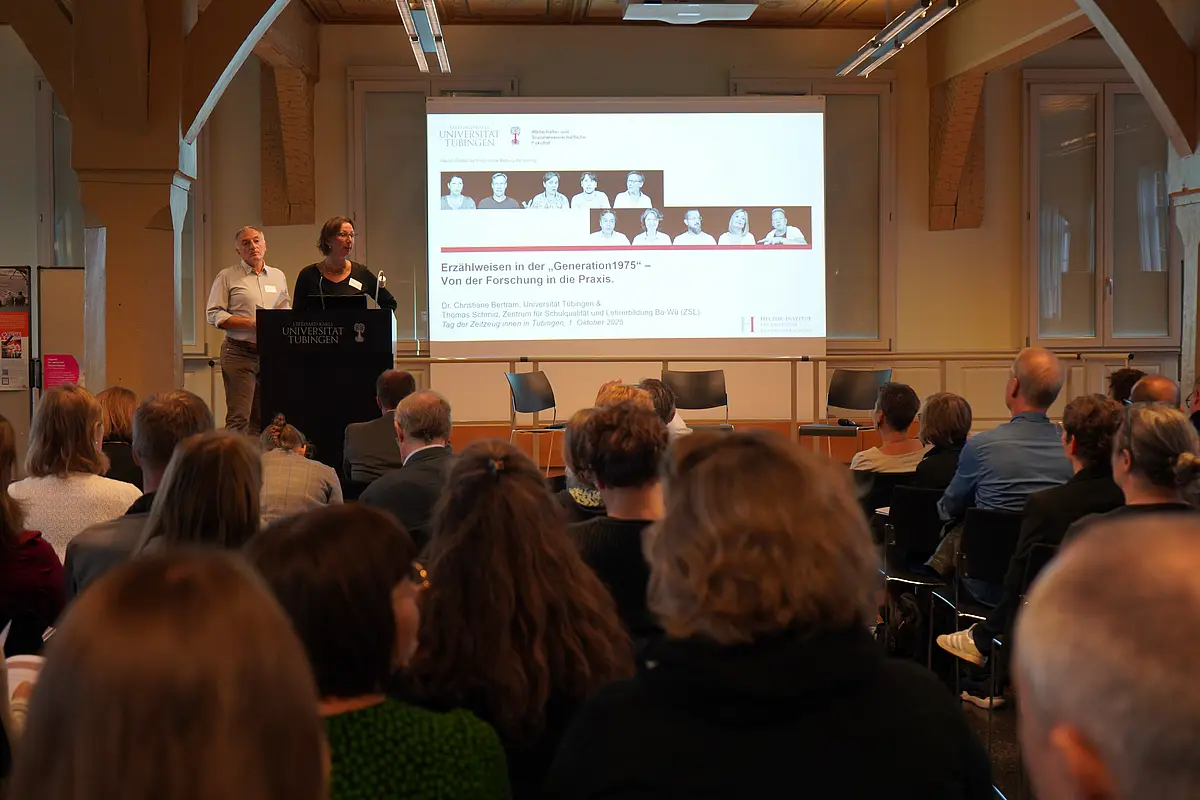
09:45–10:30 a.m. | Narratives in “Generation 1975”: From Research to Practice

Moderator: Dr. Almut Leh, FernUniversität in Hagen

  • Dr. Christiane Bertram, University of Tübingen: Stereotypes and Narratives in the “Generation 1975.” How German-German history is told.
  • Thomas Schmid, Center for School Quality and Teacher Education: How the narratives of the “Generation 1975” are used to teach historical thinking.

10:30–11:00 a.m. | Coffee Break & Posters & Book Tables

11:00–12:00 | The Era of Transformation in East and West Germany

Moderator: Dr. Markus Bultmann, Center for School Quality and Teacher Education, Baden-Württemberg

  • Prof. Dr. Detlef Pollack, University of Münster: “The People” in East Germany: Victims or Agents of German Unification?
  • Prof. Dr. Christina Morina (University of Bielefeld): “A Thousand New Beginnings”: German-German Experiences of Democracy since the 1980s.

12:00–12:30 | Historical-Political Education Programs on “Remembrance and Democracy”

Moderator: Nine-Christine Müller

  • Pitches by cooperation partners and multipliers (2 minutes each)
  • Poster presentation in the event room throughout the event

12:30–1:30 p.m. | Lunch & Posters & Book Tables

1:30–2:30 p.m. | Emotions in the East and West regarding German-German history

Moderator: Katharina Hochmuth, Federal Foundation for the Reappraisal of the SED Dictatorship

  • Prof. Dr. Dirk Oschmann, University of Leipzig: “The East – a West German Invention”
  • Dr. Anna Lux, University of Freiburg: “East Meets West. Upheavals and Popular Culture”

2:30–3:30 p.m. | Perspectives from Empirical Educational Research

Moderator: Dr. Christiane Bertram

  • Prof. Dr. Ulrich Trautwein (University of Tübingen): Education and Democracy – What Can Empirical Educational Research Contribute – and What Can It Not Contribute?
  • Katharina Totter & Dr. Lisa Zachrich (University of Tübingen). Learning History with Eyewitnesses and the Role of the Perceived “Aura.” A randomized and controlled field study (funded by the DFG).

3:30–4:00 p.m. | Coffee break & posters & book tables

4:00–5:00 p.m. | Panel discussion: Eyewitness accounts today. Why are life stories told in the 21st century, and why are people listening?

Moderator: Dr. Sarah Bornhorst, Berlin Wall Foundation

  • Markus Achtélik, “Generation 1975,” East Berlin
  • Nimet Leone, “Generation Wall Construction,” Baden-Württemberg
  • Nora Oehmichen, Teachers For Future Germany e.V.
  • Katharina Hochmuth, Federal Foundation for the Reappraisal of the SED Dictatorship

5:00–6:30 p.m. | End of the symposium

Free time, e.g., “Market of Opportunities” or “Walk to Talk” (city walk)

 

Part 2: Public Evening Event
Opening of the Video Installation
1st October, 6:30–8:30 p.m.

Opening of the video installation “’A German Affair’—Who Is Affected by the History of Reunification?”

Target audience: Interested members of the public; registration required

Moderator: Nine-Christine Müller

6:30–7:00 p.m. | Introduction

  • Prof. Dr. Monique Scheer, University of Tübingen: “The People—a Difficult Concept. Different Origins—Shared Memories?”

7:00–8:00 p.m. | Opening of the video installation “‘A German Affair’—Who Is Affected by the History of Reunification?”

  • With video artists Ina Rommee and Stefan Krauss

8:00–8:30 p.m. | Panel discussion on the video installation

  • Ibraimo Alberto, East Berlin/Mozambique, “Generation Wall Construction”
  • Katharina Franke, Baden-Württemberg/Brandenburg, “Generation 1975”
  • Stefan Krauss (KRRO Film)

Starting at 8:30 p.m. | Reception and buffet

Part 3: Remembrance and Civic Education – How Can We Make It Work?
2nd October, 9:00 a.m.–5:00 p.m.

Program: 2nd October
 

Networking Day for Multipliers, Researchers, Educators, and Eyewitnesses

Overall Moderators: Dr. Christiane Bertram & Dr. Lisa Zachrich

9:00 a.m. | Arrival and Getting the Conversation Started

Moderators: Dr. Christiane Bertram & Dr. Lisa Zachrich

  • Opportunities and risks of eyewitnesses, experiences with eyewitnesses

9:30 a.m.: Remembrance as an opportunity for historical and political learning

Moderator: Dr. Gerhard Sälter, Federal Archives – Stasi Records Archive

  • Prof. Dr. Aleida Assmann, University of Konstanz: “The Power of Memory”
  • PD Dr. Heinrich Ammerer, University of Salzburg: “The Power of Historical Consciousness”

10:30–11:00 a.m.: Coffee break & posters & book tables

11:00 a.m.–12:00 p.m. “Generationenportal” – Resources on the State Education Server

Moderators: Dr. Stefan Schipperges, ZSL Baden-Württemberg

  • Florian Hellberg, ZSL Baden-Württemberg: Introduction to the “Generationenportal”
  • Nora Mussler, ZSL Baden-Württemberg: Overview of the lesson plans and materials

12:00–1:00 p.m.: Panel discussion (theses for the World Café)
Gaps and Challenges in Addressing German-German History

Moderator: Prof. Dr. Heike Radvan, University of Tübingen

  • Silvana Hilliger, Education Officer for the State of Brandenburg’s Commissioner for Coming to Terms with the Consequences of the Communist Dictatorship
  • Dr. Konstantin Broese, State Agency for Civic Education, Baden-Württemberg
  • Dr. Juliette Brungs, AMCHA Deutschland e.V.

1:00–2:00 p.m.: Lunch & Posters & Book Tables

2:00–3:30 p.m.: World Café (Follow-up to the panel discussion)

Gaps and Challenges in Addressing German-German History

Moderator: Dr. Rolf Frankenberger, University of Tübingen

  • Anti-Semitism Yesterday and Today in East and West Germany (with Dr. Juliette Brungs)
  • Working with Eyewitnesses in Coming to Terms with the SED Dictatorship (with Silvana Hilliger)
  • Political Education and Right-Wing Extremism in Baden-Württemberg (with Konstantin Broese)

3:30–4:00 p.m.: Coffee break, posters, and book tables

4:00–5:00 p.m.: Closing plenary session

Moderators: Dr. Christiane Bertram & Dr. Stefan Schipperges

  • What takeaways do you have? What did you feel was missing? How can we move forward?


“The life stories of eyewitnesses are emotionally moving; they challenge us, they forge connections, and they can provide guidance. Above all, however, sharing different memories of a time we all experienced together fosters an understanding of other perspectives—a key skill for living together in a democracy.”

Christiane Bertram


Project partners

Initiated and organizes by the Hector Research Institute of Educational Sciences and Psychology, University of Tübingen, by Christiane Bertram and Lisa Zachrich.

Partner of cooperation:

  • Zentrum für Schulqualität und Lehrerbildung (ZSL) Baden-Württemberg
  • Stiftung Berliner Mauer
  • IRex
  • Archiv Deutsches Gedächtnis


This project is funded by the “Bundesstiftung zur Aufarbeitung der SED-Diktatur”

Further financial support:

  • Universitätsbund Tübingen
  • Stiftung Berliner Mauer
  • Institut für Rechtsextremismus (IRex), Universität Tübingen
  • Zentrum für Schulqualität und Lehrerbildung (ZSL) Baden-Württemberg
  • Gegen Vergessen für Demokratie e.V.