Hector Research Institute of Education Sciences and Psychology

Empirical research on Eyewitness Interviews

Our goal

Using quantitative methods, we examine the effectiveness of interviews with eyewitnesses in the classroom and in historical and political education. To this end, we employ methods from empirical educational research, including randomized and controlled field studies.

Eyewitness interviews in history lessons

Interviews with eyewitnesses are a popular method in history classes for helping students connect with the past. However, students sometimes believe eyewitnesses more than they do textbooks or written sources, because eyewitnesses “were there.” Eyewitnesses are therefore both engaging and risky for history classes.

In several studies, we are examining the effectiveness of eyewitness interviews in history classes. Dr. Christiane Bertram’s BMBF-funded dissertation project on the opportunities and risks of eyewitness interviews in history classes served as the starting point for two follow-up projects: In her dissertation within the context of LEAD, Dr. Lisa Zachrich researched the unique learning experience with eyewitnesses and developed a tool to standardize the measurement of students’ engagement during encounters with eyewitnesses. This tool was used in Katharina Totter’s dissertation project, a DFG-funded randomized field study in which trained teachers worked with live and video eyewitnesses from the “Generation 1975.” We expect these studies to provide important insights into the mechanisms underlying the work with eyewitnesses. 

Opportunities and Risks of Using Eyewitnesses in History Classes

What opportunities and risks does interviewing eyewitnesses present?

Design: In the first randomized controlled intervention study in German-language history education, a total of 30 experimental classes were taught by an expert teacher. Ten classes each worked with eyewitnesses in person in the classroom, with a video, or with a written interview transcript. The main study took place during the 2011–2012 school year with 962 ninth-grade high school students.

Intervention: The topic “Peaceful Revolution in the GDR” was treated as a historical case study. Like Sherlock Holmes, the students not only examined sources but also interviewed eyewitnesses who had been active in the opposition movement. The lesson unit spanned 6 ½ class periods and differed only in the double period, during which students worked with eyewitnesses live in the classroom or with a video or transcript of an interview.

Objective: The students were to recognize that history is a reconstruction of the past, so that historical narratives must be deconstructed and the necessary perspective and contextual connection of eyewitnesses must be taken into account.

Results: Students in the live group performed statistically significantly worse on the post-test than students in the video/text group, but they rated the potential of working with eyewitnesses much higher in terms of their progress in content and methodology and their interest in the topic.

Publications:

Bertram, C., Wagner, W., & Trautwein, U. (2017). Learning historical thinking with oral history interviews. A cluster randomized controlled intervention study of oral history interviews in history lessons. American Educational Research Journal 54(3), 444–484. https://journals.sagepub.com/doi/10.3102/0002831217694833

Bertram, C. (2017). Zeitzeugen im Geschichtsunterricht. Chance oder Risiko für historisches Lernen? Eine randomisierte Interventionsstudie (Reihe Geschichtsunterricht erforschen). Schwalbach/Ts.: Wochenschau-Verlag. https://www.wochenschau-verlag.de/Zeitzeugen-im-Geschichtsunterricht/40431

Unique Learning Experience with Eyewitnesses

Are learners overwhelmed by the “aura of authenticity” (Martin Sabrow) of the live eyewitness? How can the subjective experience of encountering eyewitnesses be recorded in a standardized manner?

Substudy 1: To make the “aura” of eyewitnesses empirically measurable, a theory-based framework model was developed that operationalizes the experience of complex historical sources (such as historical sites and eyewitness interviews).

Zachrich, L., Baron, C., Weller, A., & Bertram, C. (2020). Historical Experiences: A Framework for Encountering Complex Historical Sources. History Education Research Journal 17(2), 243–275. https://journals.uclpress.co.uk/herj/article/id/316/

Substudy 2: The testing instrument developed based on the framework model was used in several samples and validated with over 800 students. The instrument psychometrically captures the cognitive and emotional engagement of learners who encounter eyewitnesses.

Zachrich, L., Bertram, C., Wagner, W. & Trautwein, U. (2023). Das «Aura­Erlebnis» in der Begegnung mit Zeitzeug*innen. Eine komplexe Lernerfahrung verstehen und standardisiert erfassen. In M. Waldis & M. Nitsche, Geschichtsdidaktisch intervenieren. (S. 375-397). https://www.hep-verlag.ch/geschichtsdiaktisch-intervenieren-doi

Substudy 3: In the experimental study on the authenticity of eyewitness videos, the information regarding whether the person in the video clip was recounting their own experiences, acting out an eyewitness account, or presenting a reconstructed narrative was manipulated. Simply framing the video as an authentic, acted, or reconstructed eyewitness account had an effect on the participants’ emotional engagement.

Zachrich, L., Wagner, W., Bertram, C., & Trautwein, U. (2024). Really? It depends! How authentic learning material affects involvement and learning with personal stories of the past. Learning & Instruction 92. https://doi.org/10.1016/j.learninstruc.2024.101921

Zachrich, L. (2023). Empirische Bildungsforschung trifft Geschichtsdidaktik. Eine Untersuchung der Lernprozesse im Lernarrangement mit Zeitzeug:innenberichten. https://publikationen.uni-tuebingen.de/xmlui/handle/10900/133894

Authentic Learning with Eyewitnesses

What effect does the individual processing of the encounter with eyewitnesses have on student learning?

Development: Unlike the first intervention study, we made two adjustments. Working with two eyewitnesses was intended to highlight the necessary perspective they bring to their view of the past. Accounts of “everyday life” were intended to reduce the risk of students feeling overwhelmed.

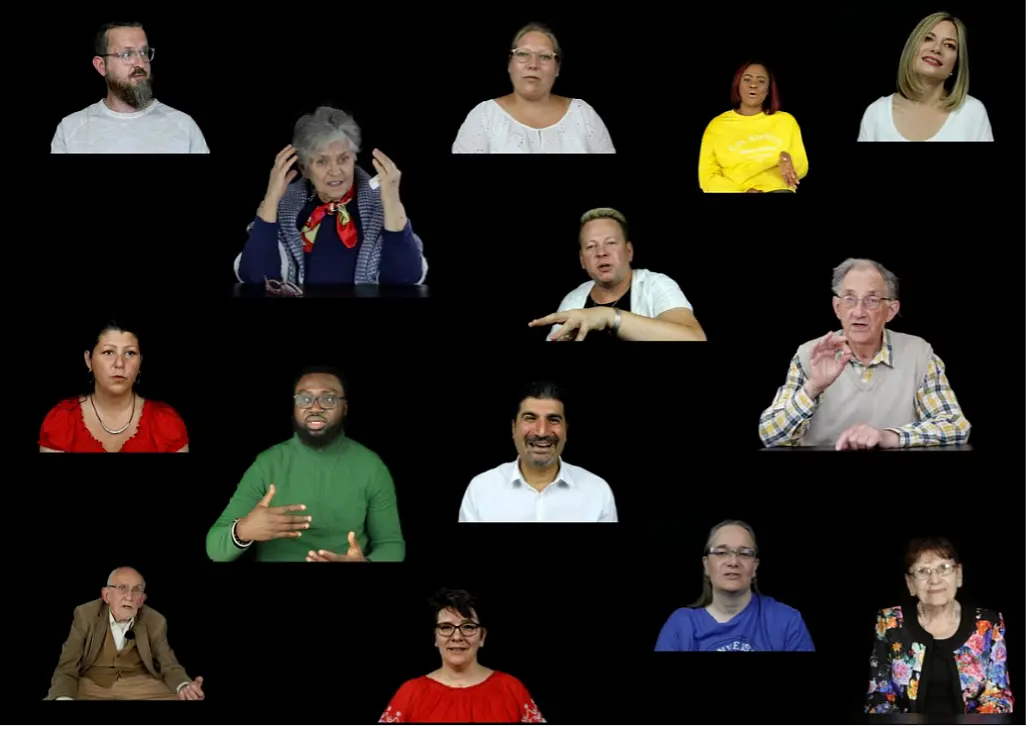
Intervention: Together with the Center for School Quality and Teacher Education in Baden-Württemberg (ZSL), we developed a lesson unit on the topic of “The Transformation Period after 1989,” which involved working with two eyewitnesses from the “Generation 1975”—one from East Germany and one from West Germany. The lesson unit, including the videos, can be found on the “Generationenportal”.

Design: To assess the effects of the intervention under conditions as realistic as possible, a total of 50 teachers participated with their own classes (a total of 1,301 students) and, assigned at random, either taught the lesson unit (with a live visit or a video compilation) or, in the control group, followed the curriculum without eyewitnesses.

Substudy 1: To measure the effects of the intervention, assessment tools were developed and validated.

Totter, K., Wagner, W., & Bertram, C. (2024). Standardized Assessment of Historical Thinking Competencies in an Intervention Study Using Perspectives on German History. Historical Thinking, Culture, and Education 1(1). DOI 10.12685/htce.1382

Substudy 2: This study examined the effects of working with the two eyewitnesses from East and West Germany on the learners’ competencies, knowledge, and motivation.

Totter, K., Wagner, W., Bertram, C., & Trautwein, U. (2025). Effects of Working With Multiple Eyewitnesses in History Lessons on Competencies, Knowledge, and Motivation: A Cluster Randomized Controlled Field Trial. Journal of Educational Psychology. Advance online publication. https://doi.org/10.1037/edu0000996

Substudy 3: This study examined the role that learners’ subjective experiences play in their learning process when they encounter eyewitnesses in person or through media. The analyses were pre-registered.

Totter, K. (2028). Effects of Working With Eyewitnesses: A Randomized Controlled Field Trial on Authentic Learning in History Lessons [Doctoral dissertation]. University of Tübingen. https://doi.org/10.15496/publikation-75247
Team

  • Dr. Christiane Bertram (Head of the “Historical Learning” Division)
  • Prof. Dr. Ulrich Trautwein
  • Dr. Wolfgang Wagner
  • Dr. Lisa Zachrich
  • Katharina Totter