Hector Research Institute of Education Sciences and Psychology

Hector-Seminar

TALENT Study
TALENT development in secondary education: Scientific support for the Hector Seminar

The Hector Seminar provides voluntary, supplementary support for highly gifted high school students in the North Baden region. The program focuses on in-depth courses in the STEM subjects (science, technology, engineering, and mathematics), beginning in grade 6 and continuing through upper secondary school.

Since the 2022/2023 school year, the Hector Institute for Empirical Educational Research has been providing scientific support for the Hector Seminar and conducting a longitudinal evaluation of the program.

This scientific support is carried out on behalf of the Hector Foundation II.

Our Goal

The aim of the study is to examine the talent development of (highly) gifted students in secondary school and to identify the beneficial impacts of the Hector Seminar. The main research questions are:

  • What characteristics help to identify particularly gifted secondary school students in the STEM field?
  • How do (highly) gifted students develop during secondary school, and which factors most strongly support their growth/development?
  • What effects does participation in the Hector Seminar have on talent development, e.g., in the areas of technical, cognitive, and socio-emotional skills?
  • Which didactic measures are most effective for promoting (highly) gifted students?
The Challenge

Despite the high educational policy relevance of gifted education, little is known about how talent develops and which conditions lead to excellent performance in the long term. Talent is not determined by cognitive ability alone. Rather, it emerges from the dynamic interaction of motivation, creativity, personality characteristics, and social influences. At the same time, it is unclear which forms of support are effective in the long term. Many Existing programs vary greatly in their conceptual foundations and quality, and they are seldom systematically documented or rigorously evaluated. This leaves open the question of which approaches genuinely promote the development of (highly) gifted students.


Our Solution

With the TALENT study, the Hector Institute for Empirical Educational Research is investigating these questions within the Hector Seminar, a long-term STEM enrichment program for highly gifted students. The study relies on a comprehensive, multi-cohort longitudinal design that scientifically monitors systematically tracks and evaluates the participants’ developmental trajectories and the support they receive. By regularly assessing cognitive, creative, and socio-emotional skills, key success factors can be identified and the quality of the support program continuously improved. In this way, the study provides valuable insights for the further development of gifted education in STEM subjects.


Study Procedure

Students who are considered particularly gifted in STEM subjects by their teachers are invited to take a central selection test for the Hector Seminar in 5th grade. This takes place annually at the beginning of the 6th school year. Of the approximately 1,000 students who take the selection test, around 80 students per school year are accepted into the Hector Seminar.

To draw conclusions about the general developmental pattern of (highly) gifted students and the effectiveness of the Hector Seminar, the aim is to include all students nominated for the Hector Seminar in the sample each year.

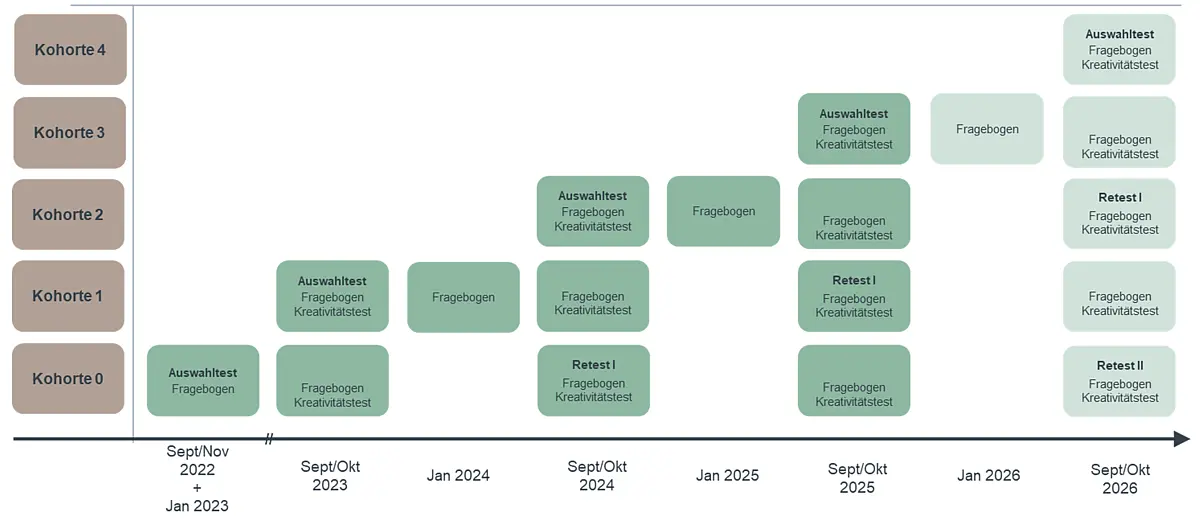
As part of the study, the selection test is repeated every two years. A shorter creativity test is conducted annually in digital form. Once a year, the students and their parents also complete an online questionnaire that records socio-emotional and motivational variables, among other things variables. Additionally, a one-time online questionnaire is conducted in January of each student’s first year of participation (see Figure 1).