Welcome to our FAQs on copyright and licensing in the field of open access!
Here you will find clear answers to key questions about intellectual property, rights of use, and legal principles, particularly in the field of open access publishing. The content is up to date and is continuously supplemented and updated so that you always have access to reliable information.
What are Creative Commons (CC) licences and why do I need them?
Creative Commons (CC) licenses are standardized "some rights reserved" usage licenses that authors grant to the general public. These licenses allow certain usage rights, such as reproduction, distribution, and editing, without the need for complex individual contracts.
CC licenses enable open access to your research. Research funding agencies (such as the DFG) and many universities recommend or require open licenses such as CC BY.
CC BY (Attribution) is the most open Creative Commons license and is considered open access compliant. It allows any use, including commercial use, as long as the author is credited. Further information on CC licenses is available here.
The licenses are based on four modules: BY (Attribution), NC (No Commercial Use), ND (No Derivatives), and SA (Share Alike). These modules are combined into six predefined licenses, such as CC BY-NC-ND, and they vary greatly. Further information on CC licenses is available here.
You can only do so if you are the copyright holder of the work and the legal status of any third-party works used in your work has been clarified. If you have assigned the exclusive rights to third parties (e.g., through a publishing contract), you cannot grant a CC license. The same applies if you have not obtained permission to use third-party works or cannot invoke the right to quote for their use.
Select the license and clearly mark your work with it. This marking should include the license abbreviation and version number (e.g., CC BY 4.0), a link to the license text, and your name. In printed works, links must be written out in full so they can be typed. It is advisable to include a page with the necessary licensing information at the beginning of the dissertation, similar to an imprint.
What is the significance of the various CC license versions?
Over the years, Creative Commons has continuously improved the licenses it offers. Each step has been incorporated into a new version. The latest version, 4.0 International, differs from previous versions because it is applicable worldwide and has not been adapted to specific national liability laws.
What is the process for licensing my work when I want to incorporate third-party material, especially images, that is licensed under Creative Commons?
Individual, clearly definable parts can be excluded from the overall licensing of a work. It is important to clearly indicate which content is covered by which Creative Commons (CC) license on the specific part of the work and in a copyright notice. However, there is no formal requirement as to what a copyright notice must look like. The important thing is that people reusing the work are made aware of the distribution of rights in a prominent place, so it's clear which parts of the work are covered by which license. Of course, the rules for properly granting CC licenses must be followed.
Why does the DFG or third-party funding bodies require the CC-BY license to be granted?
Non-commercial license types often exclude many desirable uses without offering significant advantages. They are not truly open licenses. Consequently, the CC BY license has become the global standard for open access. It enables equal and open use for all, in accordance with the basic principles of open access. In accordance with the Budapest and Berlin declarations, the Alliance of German Research Institutions' representatives endorse this recommendation. For more information, see: https://deal-konsortium.de/warum-ccby.
Is it possible to relicense my own work from a CC license version 3.0 to version 4.0?
Yes. Licensing under the newer version 4.0 is possible. However, it is not possible to change the license itself. For instance, a CC-BY 3.0 license can be updated to a CC-BY 4.0 license. It is not possible, however, to update from a CC-BY 3.0 to a CC-BY-SA 4.0.
What about unlicensed parts, and what are the implications of using them?
Unlicensed parts are considered to be under standard copyright ("All rights reserved"). Provided that you are the author and have not already assigned the rights elsewhere, you can publish these parts under a CC licence at any time.
I would like to know if I am allowed to make use of the articles?
This depends on the publishing agreement for the articles. Check whether you have transferred exclusive or simple rights of use to the publisher, which version you are permitted to use for your dissertation (if applicable) and how you must cite the original publication. You can often find this information in the publisher's policies. The SHERPA/RoMEO list also provides an overview of various publisher policies. For open access publications (often CC-licensed), you usually retain simple rights of use, so including them in your dissertation is generally unproblematic. However, you should always check the exact terms of the publication agreement, even in this case.
What about articles that have been submitted but not yet accepted or published? Or those for which no publication agreement has been reached with the publisher yet?
Until a transfer of rights takes place through a publication agreement, the author retains the rights of use. Therefore, it is possible to transfer the simple rights of use to the university library. However, the publisher should still be consulted to ascertain their agreement to inclusion in the dissertation. Otherwise, the publisher may lose interest in the submitted article because it has already been published as a manuscript in the dissertation. In such cases, a temporary embargo should particularly be considered before the dissertation is published. (For more information on embargoes, see the section on general publication information.)
What should be done with articles that have different licences?
It is only possible to publish the dissertation as a complete work under a single licence if the different licences are compatible. Not all Creative Commons licences are compatible with each other and can be combined. If the licences contradict each other, uniform overall licensing is not possible. Articles that have already been licensed cannot be republished under a different licence; they must always adhere to the licence originally assigned to the original publication. However, it is possible to license parts of the dissertation that are not yet licensed. The freely accessible CC License Mixer can help you determine whether material licensed under different CC licences can be published under a common CC licence: https://ccmixer.edu-sharing.org/.
Which license under Section 6 of the TOBIAS-lib publication agreement is the best choice in the case of a cumulative dissertation with conflicting CC licenses?
If you do not wish to licence the unlicensed part of your dissertation, the standard contract is the best option. Alternatively, if you would like to place the unlicensed part under one of the CC licences offered, this is also possible. Please note, however, that currently, only the licence selected in the contract can be displayed in the repository's metadata. CC licences for articles cannot be listed separately.
Labeling is particularly important in the case of a cumulative dissertation, which is the publication of several papers. In most cases, the framework chapter explicitly indicates which parts originate from which publications. It is essential to observe the specific doctoral regulations of your faculty. Typically, each article must contain the complete bibliographic source (including the DOI) and the copyright notice of the original publication (e.g., "Reproduced with kind permission of [publisher] / This article is published under CC BY-NC-ND 4.0"). At the beginning of the dissertation, include a detailed list of articles and applicable licenses.
If the publisher does not allow secondary publication of the dissertation, especially online, you should consult your doctoral office or the examination committee. Another option is to remove the article and include a detailed bibliographic source with a DOI in its place.
Choosing the right publishing agreement and license in the TOBIAS-lib publishing agreement
Which contract do I need to submit? With or without research data?
The publication agreement (including research data) only applies if the research data is uploaded and published alongside the dissertation. If only the dissertation is to be published, select the publication agreement without research data. Please refer to the information sheet for more details.
Which license should I select in §6 of the publication agreement?
The standard contract is the most restrictive licensing option for your work. By signing it, you grant the University Library of Tübingen the permanent, non-exclusive right to publish your work. You retain all rights. If third parties wish to reuse your work and it is not covered by a legal exception, you must give your consent. You may also transfer rights to your work to third parties without asking the University Library for permission. In contrast, by choosing a Creative Commons (CC) license, you regulate the reuse of your work by default. Here, too, all rights remain with you. With a CC license, you can specify what potential reusers can do with your work beyond granting them access to it, without having to ask for permission. Reusers must continue to ask your permission for all other uses not permitted by the selected CC license.
Is it possible to publish my dissertation with an embargo, making the content available at a later date?
It is possible to set up an embargo. However, the faculty must agree to impose such an embargo. Please note that the metadata will be freely accessible from the date of publication. If the content has not yet been published elsewhere, publication with an embargo is considered a first publication, even if the text is not yet available for viewing.
If I have a conflict with a publisher, can I impose an embargo retroactively?
Unfortunately, due to organizational and technical reasons, we at the University Library are unable to impose a retrospective embargo. A retrospective embargo would be ineffective for the following reasons: First, we cannot rule out the possibility that the dissertation has been accessed or cited by other parties. Furthermore, establishing a retrospective embargo would lead to ineffective references, which would contradict the integrity of the University of Tübingen's publication system. Copies of the publication may already exist on other servers, and downloads may already be in circulation—this cannot be controlled or reversed. For these reasons, we have long adhered to the principle that publications already published will not be deleted or withdrawn. This in no way precludes further publication via other channels, as we have obtained the simple rights for permanent publication from the rights holders.
Can I make changes to the dissertation after it has been approved by the faculty for printing? Can I also make changes to the online version before uploading it due to publishers' licensing requirements?
No! In the declaration of conformity, you confirm that the print and digital versions of your dissertation are identical. If a licensing issue with a publisher requires changes to the digital version, the print version must be updated as well. If this occurs after the faculty has approved the dissertation for printing, consult the faculty. In case of doubt, obtain a new approval. Please note that it is not possible to change the digital version once it has been uploaded and published in the university repository.
Who signs the publication agreement in the case of multiple authors?
Before signing the contract, please contact the University Library's Publication Services for more information and the contract addendum. Select someone to act as the contact person for the University Library, who will sign the contract on behalf of all authors.
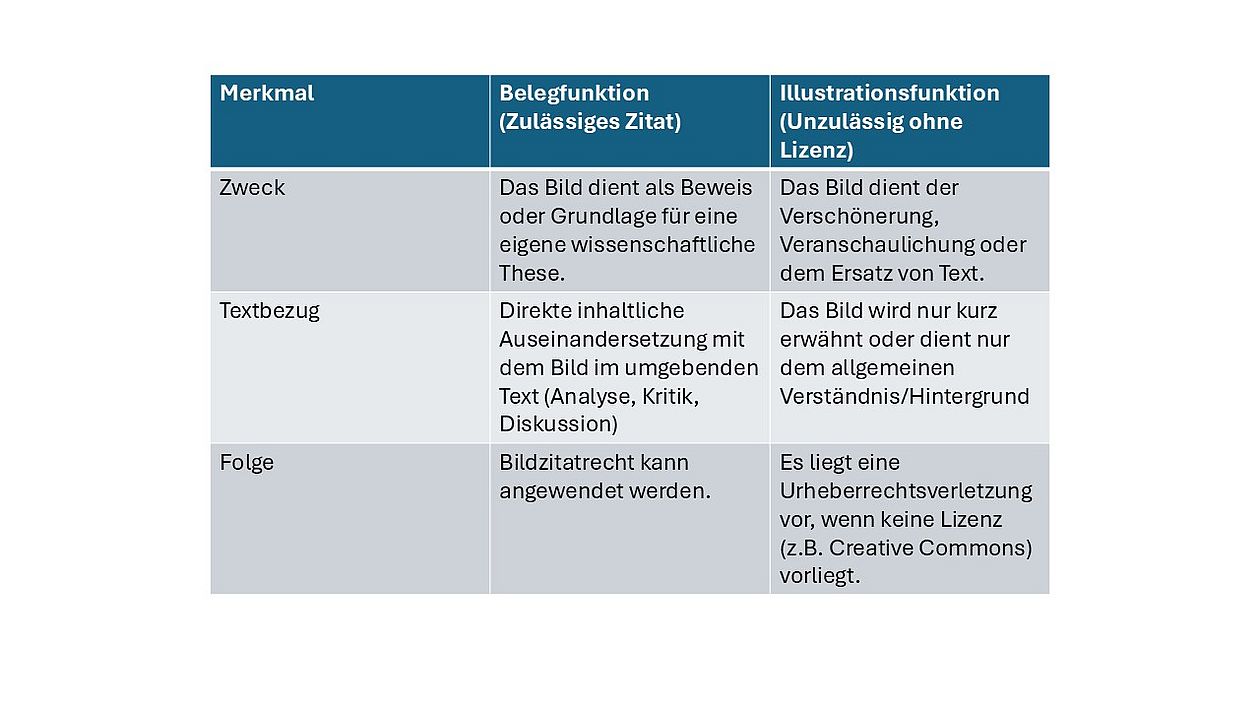
The right to quote images is a special exception to copyright law that permits the use of published works (including images, graphics, tables, photos, etc.) without the author's explicit consent if doing so serves to explain, document, or substantiate the content of one's own scientific work. In Germany, this exception is regulated by Section 51 of the Copyright Act (UrhG).
Note: The use must be closely linked to the content of your scientific statement. The image may not be used solely for decorative purposes!
What requirements must I meet for an image citation to be legally permissible?
An image citation must meet a number of strict criteria (cumulatively) to be permissible.
The necessity of the citation (purpose limitation): The image must be necessary to substantiate, explain, or critique the author's intellectual discussion. Without the citation, the scientific statement would be incomprehensible or unsubstantiated.
Scientific discussion: There must be a substantive discussion of the quoted image or its content. Simply inserting it as a decorative accessory is not permitted.
Publication of the original: The quoted work must already have been published in a book, magazine, or publicly accessible website.
Scope: A meaningful and comprehensible selection must be made that does not exceed what is necessary. No "chain of citations" or an excessive number of citations are permitted.
Source reference (mandatory!): The source and author must be clearly and correctly indicated (§63 UrhG). This usually includes:
Author (photographer, illustrator, artist, etc.)
Title of the original work
Reference (publication, year, URL/DOI)
Exact location of the image in your work (e.g., "Fig. 1: Title of the Image. Source: Last Name, Year, Page").
As a general rule: Only the original is permitted! Changes are only permitted if they are technically necessary, such as adjusting the size or resolution, or if the change itself is the subject of scientific debate, such as circling a specific area to discuss it. Not allowed: Any change that is arbitrary or distorts the original, thereby violating the author's intellectual and personal connection to the work (§14 UrhG), is prohibited. Excerpts: Using an excerpt may be permitted if it better supports the scientific statement than the entire image. However, it must be clear that it is an excerpt (e.g., add the word "excerpt").
What do I need to bear in mind when using images from the internet?
The same rules that apply to printed works also apply to the internet. Publication: An image on a publicly accessible website (e.g., a blog or museum website) is considered published. Please note that just because an image is accessible (e.g., via Google) does not mean that it can be cited or used without permission. Private images or images on closed platforms are often not "published" in the sense of copyright law. Check licenses: Actively search for references to Creative Commons (CC) licenses or public domain (PD) licenses. If an image has a CC license, you must comply with the license terms, which often extend beyond the right to quote (e.g., you must name the author and the license type).
Does the right to quote images also apply to presentations (e.g., PowerPoints) and lectures?
Yes, the right to quote images also applies to academic presentations, provided that they serve an academic purpose, such as internal colloquia or conference presentations. However, since text references to images are often shorter in presentations than in theses, the risk of mere illustration is higher. Make sure you discuss the content of each cited image in your presentation. Online publication of presentations: If the presentation is published online (e.g., on the institute's website or in a repository), exercise caution. Online publication has a wide reach and may impose stricter requirements on the permissibility of quotations. If you have any doubts, use licenses (CC0, CC BY, etc.) or your own work.
Scientific integrity and legal certainty are of the utmost importance. Create your own work. Use your own photos, graphics, or diagrams whenever possible. This makes you the copyright holder, solving the problem. Use license-free sources. Access databases with Creative Commons licenses, such as Wikimedia Commons or Pixabay, or public domain sources. In these cases, you only need to comply with the respective license conditions (usually a source citation). Obtain permission. If an image is necessary but the requirements for citation are unclear, ask the author for permission. Written permission provides the highest level of security.
What do I need to keep in mind when taking the picture myself?
Creating your own images is one alternative. In this case, it is particularly important to consider the personal rights of the people depicted, property rights, and copyright of the desired motifs. More information on this topic can be found here.
Self-citation occurs when one's earlier texts, data, or illustrations are reused in a new scientific work and correctly identified as preliminary work. Self-plagiarism, on the other hand, occurs when this is done without referencing the original work, creating the false impression that it is a new scientific achievement. Self-citation generally follows the principle of being “transparent, economical, and correctly marked.”
Scientific progress depends on transparency. Readers must be able to distinguish between new and existing findings. Failing to label findings properly is considered self-plagiarism, or text recycling, and is considered scientific misconduct.
It violates scientific integrity and transparency. It may also infringe on copyright or license agreements. Ultimately, it misleads readers, reviewers, and institutions regarding the novelty of the work.
Yes. Excessive self-citation for the purpose of artificially inflating one's citation index (also known as "citation stuffing") is frowned upon. Only cite yourself if doing so is necessary for understanding the current work.
Do I also need to cite unpublished works, such as a master's thesis?
Yes. Even if a piece of work has not been published, it is still considered preliminary. To avoid accusations of deception, refer to the relevant qualifications.