
11.03.2026
“The Human Right to Science” – Lecture by Dr Monika Plozza
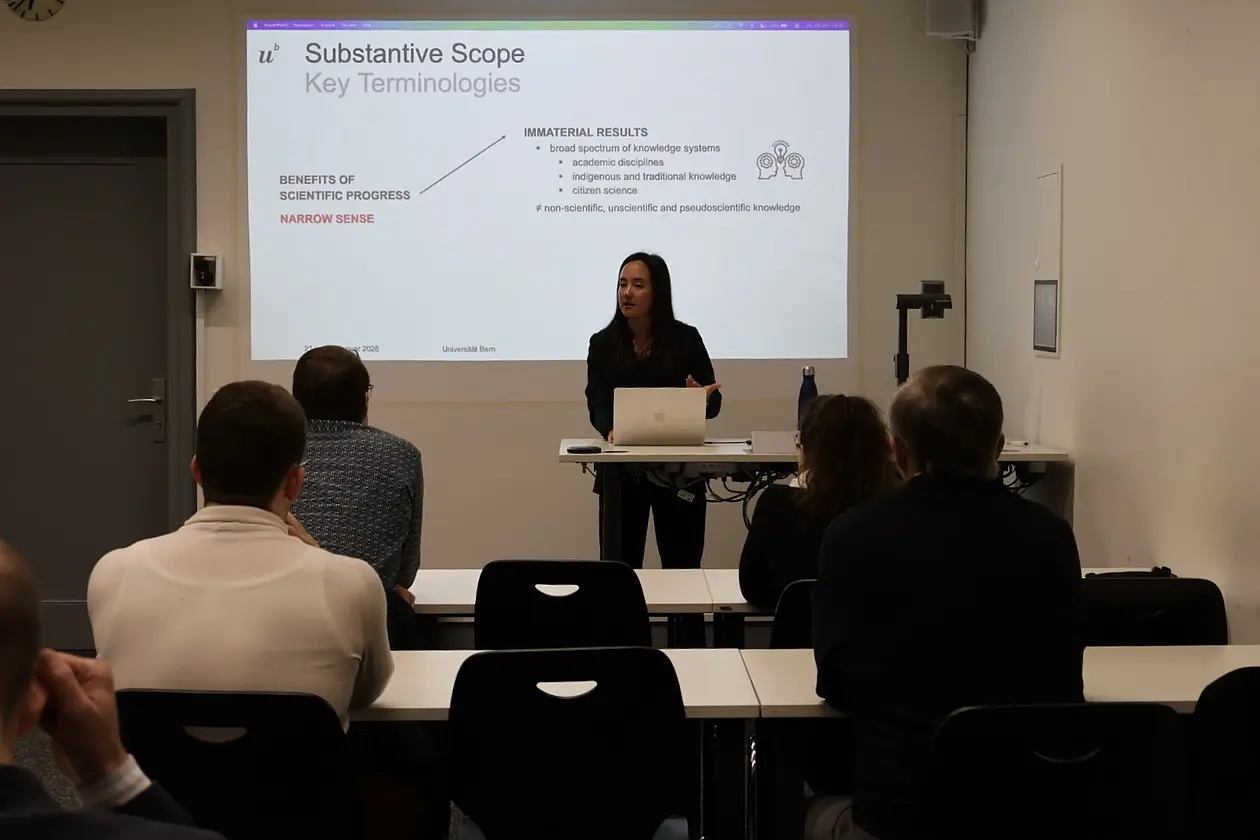
On 29 January, the Forum Junge Rechtswissenschaft invited Dr iur. Monika Plozza to deliver a lecture on “The Human Right to Science – A Framework for Justiciability”. The lecture drew on her doctoral thesis, The Human Right to Science – Down to the Core: Promoting its Justiciability in International Law. She completed this thesis at the University of Lucerne and was awarded the Lucerne Dissertation Prize and the Prize of the Swiss Association for International Law. In her lecture, Dr Plozza explored the contours, challenges, and legal potential of the human right to science, with particular emphasis on its justiciability under international human rights law.
Dr Plozza began by describing the right to science as the “sleeping beauty” of international human rights law — a right long enshrined in international instruments but only rarely invoked and insufficiently developed in practice. The right is codified in Article 27 of the Universal Declaration of Human Rights (UDHR) and, in legally binding form, in Article 15 of the International Covenant on Economic, Social and Cultural Rights (ICESCR). Despite its binding character, its wording remains broad and open-textured, raising important interpretative questions. According to Dr Plozza, the right to science should be understood as “umbrella” term, encompassing a bundle of different human rights concerning science. These include the right to enjoy the benefits of scientific progress and its applications, the conservation, development and diffusion of science, the freedom indispensable for scientific research, and international cooperation in the scientific field. She emphasised the contemporary relevance of the right considering global challenges such as pandemics, climate change, and technological transformation. Properly understood, the right to science may provide a normative framework for debates on open science, academic freedom, open science (i.e. open access), and the governance of emerging technologies.
A central part of the lecture addressed the question of justiciability. Dr Plozza revisited the traditional distinction in human rights law between civil and political rights, on the one hand, and economic, social and cultural rights, on the other. The former are often regarded as immediately applicable and primarily involving negative obligations, whereas the latter are frequently characterised as programmatic, resource-dependent, and subject to progressive realisation. This framework allows states with fewer resources additional time to implement these rights. However, she challenged this simplified dichotomy. Justiciability, she argued, has both a formal and a material dimension. Formally, mechanisms for adjudication already exist, including the Optional Protocol to the ICESCR, which allows for individual communications. Materially, the decisive issue is whether the right possesses sufficiently concrete normative content to guide judicial reasoning and decision-making.
The overarching aim of Dr Plozza’s research was to develop a structured framework that renders the human right to science operational, i.e., justiciable. The goal is twofold: to empower rights holders to invoke the right effectively before competent authorities and to provide duty bearers with clear normative guidance. In this way, the right to science can move from abstract recognition to practical applicability.
Dr Plozza then turned to the normative substance of the right, addressing both rights holders and duty bearers. Article 15 ICESCR guarantees the right to enjoy the benefits of scientific progress and its applications as well as the freedom indispensable for scientific research (Article 15(3)). Science, she argued, can be understood in both a broad and a narrow sense, encompassing not only technological advancements but the broader social and epistemic benefits of scientific advancement. The right to science is closely interconnected with other rights protected under the ICESCR, inter alia the right to education (Art. 13), the right to health (Art. 12), and the right to an adequate standard of living (Art. 11). This interdependence, according to Dr Plozza reinforces its systemic relevance within international human rights law.
Particular attention was given to the concept of “core content.” The core content of human rights must be implemented immediately and irrespective of a state’s available resources. Dr Plozza highlighted that the UN Committee on Economic, Social and Cultural Rights first articulated core obligations and subsequently derived corresponding core rights — a methodological move she described as a form of “reverse engineering.” Core elements of the right to science include, inter alia, the freedom of scientific opinion and inquiry (Art. 15(3) ICESCR), the right to scientific progress (Art. 15(1)(b) ICESCR), as well as the rights of non-discriminatory access and participation in science.
The right to science is guaranteed to “everyone.” This includes individuals and communities. Dr Plozza also addressed the position of future generations, particularly in the context of climate change and long-term scientific risks. While future generations may not qualify as rights holders in a strict doctrinal sense, she argued that such generations ought to be regarded as beneficiaries of the right’s protective dimension. On the side of addressees, states and state actors — such as universities and schools — bear primary responsibility. International organisations, including the World Trade Organization, and other non-state actors, also play an important role within the broader scientific ecosystem, even though the nature and scope of their obligations may differ.
The lecture also addressed possible limitations of the right to science. Restrictions may arise under Article 4 ICESCR, under the International Covenant on Civil and Political Rights (ICCPR), or through mechanisms of scientific and ethical self-regulation. Any limitation, however, requires careful balancing. The benefits and risks of scientific progress, according to the speaker, must be weighed against other human rights interests in accordance with principles of proportionality and legality.
In her concluding remarks, Dr Plozza argued that the material dimension of the human right to science is sufficiently developed to allow for judicial engagement. Existing formal mechanisms within international human rights law provide avenues for enforcement. The right to science, she concluded, is not merely symbolic. Properly interpreted and operationalised, it constitutes a potentially justiciable human right with significant contemporary relevance.
The lecture was followed by an engaging discussion with the audience.
Text und Bild: Emelie Trinkner