

"Gundert Chair" agreement for Malayalam and Kerala Studies
Call for Papers
International Workshop On Languages and Traditions of Challenge and Change
Gundert Chair for Malayalam
India endows guest lectureship at the University of Tübingen
Lecturers from southwest India have been teaching the language Malayalam on the "Gundert Chair" since October 2015
| The University of Tübingen has been awarded a guest lectureship, donated by the Indian government and the Indian science organisation "University Grants Commission". Lecturers from Thunchath Ezhuthachan Malayalam University in the state of Kerala have been teaching "Malayalam", a language spoken by approximately 33 million people in south-western India, on a regular basis in Tübingen since October 2015. They thus complement the existing Malayalam teaching at the Department of Indology - a unique focus in Europe which has distinguished the University of Tübingen for about 15 years.
|

Gundert-Portal:
At the University Library of Tübingen (in cooperation with Prof. Heike Oberlin), the digitisation project "The Hermann Gundert Portal: Digitisation and indexing of the estate of Hermann Gundert (manuscripts and prints) and supplementary works from his environment at the University Library of Tübingen" was funded by the DFG 2016-2018. The database can be found HERE.
Current events:
Wintersemester 2026/27
Geetha Kaimathuruthil Wilson (M.A.)
Malayalam: Course for Beginners / Grundstufe 1
Details
- Tuesdays & Fridays, 10:15-11:45 CET
- HYBRID course: In class & via Zoom
- Tübingen students have to enroll via Alma.
- If you seek to join this course as a guest listener, please follow these instructions: https://uni-tuebingen.de/en/951
Malayalam Aufbaustufe 1
- Tuesdays, 4:15-5:15 & Fridays, 4:15-5:30 pm CET
- HYBRID (in person & via Zoom)
- Tübingen students have to enroll via Alma.
- If you seek to join this course as a guest listener, please follow these instructions: https://uni-tuebingen.de/en/951
The language of instruction is English.
Summersemester 2026
Dr. Ophira Gamliel (Sabbatical Prof. Dr. Heike Oberlin)
- Malayalam: Grundstufe 2
- Malayalam Aufbaustufe 2
- Early Modern Malayalam Literature: Guided Readings from the Gundert Portal and Beyond
The language of instruction is English.
All courses are HYBRID courses – in class & via Zoom:
- Tübingen students have to enroll via Alma.
- If you seek to join this course as a guest listener, please follow these instructions: https://uni-tuebingen.de/en/951
Wintersemester 2025/26
Prof. Dr. Heike Oberlin and Vishnupriyaa P S (M.A.)
Malayalam: Course for Beginners / Grundstufe 1
Details
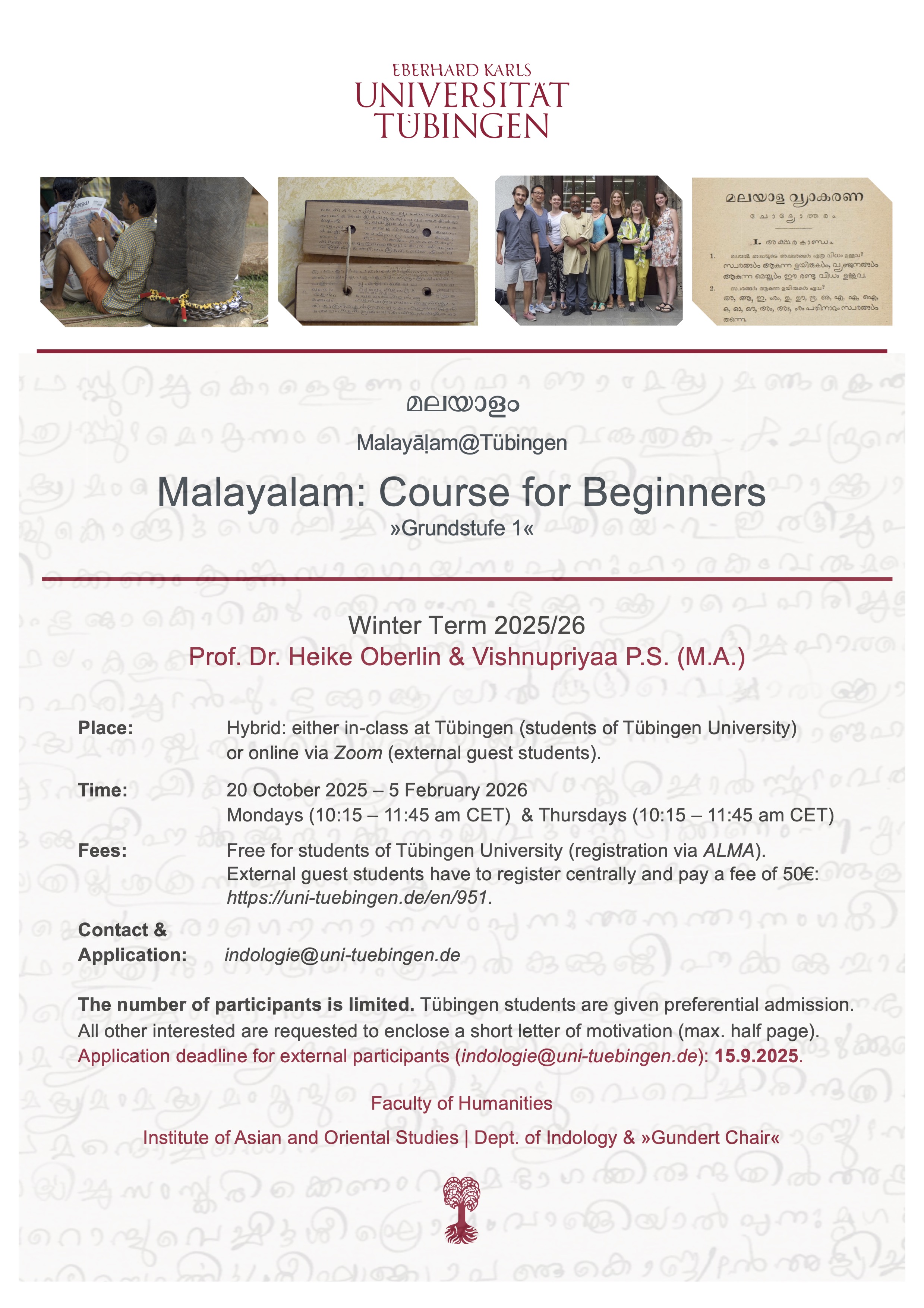
- Mondays & Thursdays, 11:15-12:45 CET
- HYBRID course: In class & via Zoom
- Tübingen students have to enroll via Alma.
- If you seek to join this course as a guest listener, please follow these instructions: https://uni-tuebingen.de/en/951
Malayalam Aufbaustufe 1
- Mondays, 16:00-17:00 & Thursdays, 16:15-17:30 pm CET
- HYBRID (in person & via Zoom)
- Tübingen students have to enroll via Alma.
- If you seek to join this course as a guest listener, please follow these instructions: https://uni-tuebingen.de/en/951
The language of instruction is English.
Summersemester 2025
Prof. Dr. Heike Oberlin and Vishnupriyaa P S (M.A.)
Malayalam: Course for Beginners / Grundstufe 2
- Mondays & Thursdays, 4:15-5:45 pm CET
- HYBRID course: In class & via Zoom
- Tübingen students have to enroll via Alma.
- If you seek to join this course as a guest listener, please follow these instructions: https://uni-tuebingen.de/en/951
Malayalam Aufbaustufe 2
- Tuesdays & Wednesdays, 11:00 am -12:15 pm CET
- HYBRID (in person & via Zoom)
- Tübingen students have to enroll via Alma.
- If you seek to join this course as a guest listener, please follow these instructions: https://uni-tuebingen.de/en/951
The language of instruction is English.
Advanced Malayalam Reading. Songs of Kāṟaḷmān: Reading the Caviṭṭunāṭakam Kāṟaḷmān (Charlemagne)
Geetha Kaimathuruthil Wilson, (M.A.)
- This one-week intensive block seminar, running from April 7 to April 11, offers an in-depth exploration of the Charlemagne/ Kāṟaḷmān songs from the Plōrippīss˘ play of the Charlemagne Chronicle in Caviṭṭunāṭakam.
- The language of instruction is English, and is available in hybrid format (participation via Zoom)
Course will be conducted in Room 1.05, Naulkestr.35.- Tübingen students have to enroll via Alma.
- If you seek to join this course as a guest listener, please follow these instructions: https://uni-tuebingen.de/en/951
Workshop Call
Exploring Malayalam: A two-day intensive Workshop for Malayalam Language Proficiency || 14 – 15 October 2024 | Details
Organised by Geetha Kaimathuruthil Wilson at the University of Tübingen | Nauklerstr. 35 | Room 1.06 and via Zoom (for selected participants)
Winter Term 2024/25
Prof. Dr. Heike Oberlin and Vishnupriyaa P S (M.A.)
Malayalam: Course for Beginners / Grundstufe 1
Details
- Mondays & Thursdays, 4:15-5:45 pm CET
- HYBRID course: In class & via Zoom
- Tübingen students have to enroll via Alma.
- If you seek to join this course as a guest listener, please follow these instructions: https://uni-tuebingen.de/en/951
Malayalam Aufbaustufe 1
- Tuesdays & Wednesdays, 1:00-12:00 pm CET
- HYBRID (in person & via Zoom)
- Tübingen students have to enroll via Alma.
- If you seek to join this course as a guest listener, please follow these instructions: https://uni-tuebingen.de/en/951
The language of instruction is English.
Winter Term 2023/24 & Summer Term 2024
Instructors: Prof. Dr. Heike Oberlin and Geetha K. Wilson (M.A)
- Malayalam Grundstufe 1 and Grundstufe 2
- Malayalam Aufbaustufe 1
- Malayalam: Grammar & Readings
Winter Term 2022/23 & Summer Term 2023
Malayalam 3 & 4
Tuesdays, 4-5:30 pm CET (hybrid: in person & via Zoom)
Summer Term 2022
Summer School "Malayāḷam Literature and Screen Adaptions"
Prof. Dr. T. Anithakumary
When:
Monday, 1 August /2022 – Friday, 5 August 2022 &
Monday, 8 August 2022 – Friday 12 August 2022
Daily 9 am – 5 pm (with breaks)
Where:
„Gundert Chair“ for Malayalam at the Dept. of Indology, University of Tübingen
72074 Tübingen, Keplerstr. 2, Room 002
(Only in exceptional cases, online participation will be made possible.)
The Summer School aims to study the interconnection between Malayalam literature and cinema. Especially between 1960 and 1980 novels, short-stories, poetry and drama became the basis of movies. The examples chosen will focus on cinematic adaptations like Marthandavarma, Newspaper Boy, Bhargaveenilayam and Chemmeen, just to name a few, and film makers like Adoor Gopalakrishnan, who have a place in the history of world cinema.
Requirements: Basic knowledge of Malayalam desirable, suitable for beginners.
Further information & application: Prof. Dr. Heike Oberlin | heike.oberlin@uni-tuebingen.de
Deadline for application: 1 July 2022
– no participation fees –
Further information & application
Winter Term 2021/22
Malayalam 1: Course for Beginners
Prof. Dr. Heike Oberlin
The course is aimed at beginners with no prior knowledge of the language.
The participants acquire knowledge of the Malayalam script (old and new), basic knowledge of the grammar and vocabulary of the Dravidian language Malayalam and can comprehend, identify and explain basic structures of grammar and syntax.
- Place: online participation via Zoom is possible
- Time: classes on Mondays (4:15 – 7:45 pm CET) & Fridays (10:15 – 11:45 am CET); starting 25.10.2021, ending 11.2.2022
- Fees: free for students registered at Tübingen University | 250€ for external participants
- Registration: heike.oberlin@uni-tuebingen.de
ATTENTION: The number of participants is limited. Tübingen students are given preferential admission. All other interested are requested to enclose a short letter of motivation (max. half page).
Application deadline for external participants: 30.9.2021.
Credit points / ECTS:
For students of the University of Tübingen: 6 ECTS.
For students from other universities: The approval must be negotiated with the respective university.
Malayalam Grammar & Readings
Prof. Dr. Heike Oberlin & Prof. Dr. T. Anithakumary
We will read various excerpts of Malayalam literature.
Existing knowledge of grammar will be consolidated.
The course is designed for students with prior knowledge of the language as far as Malayalam 1 and Malayalam 2 (Tübingen model).
- Place: online participation via Zoom is possible
- Time: classes on Tuesdays, 5:00 – 6:30 pm CET; starting 26.10.2021, ending 8.2.2022
- Fees: free (for students registered at Tübingen University and for external participants)
- Registration: heike.oberlin@uni-tuebingen.de
ATTENTION: The number of participants is limited. Tübingen students are given preferential admission.
Application deadline for external participants: 30.9.2021.
Credit points / ECTS:
For students of the University of Tübingen: 3 ECTS.
For students from other universities: The approval must be negotiated with the respective university.
Malayalam Literature and Screen Adaptations
Prof. Dr. T. Anithakumary
It is planned that this seminar will be held by the Gundert-Chair Professor T. Anithakumary (Malayalam University, Tirur) in classrooms over two weeks, starting mid-February 2022 (14.-25.2.2022). Any changes due to Corona regulations will be reflected in this space.
Those interested should get in touch with Prof. Heike Oberlin at heike.oberlin@uni-tuebingen.de.

Summer Term 2021
Prof. Dr. Heike Oberlin
Malayalam 2
Fridays, 11 am CET (via Zoom)
Malayalam: Grammar and Readings
Tuesdays, 5 pm CET (via Zoom)
Further information & registration: heike.oberlin@uni-tuebingen.de
Winter Term 2020/21
Two Guest Lectures on the History of Kerala
Monday, 7.12.20203:30 pm CET (Online via Zoom) :
First Lecture: Kerala’s Development Model: Historical Background (Prof. Rajan Gurukkal)
Friday, 18.12.2020 3:30 pm CET (Online via Zoom) :
Second Lecture: Historical Roots of Kerala: Social, Cultural and Political Antecedents (Prof. Kesavan Veluthat)
Rigistration:
heike.oberlin@uni-tuebingen.de
More Info: PDF
Language Course "Malayāḷam@Tübingen | Online Course for Beginners"
In Tübingen the annual Malayalam intensive course for beginners will be offered this time online via Zoom due to the current situation caused by the corona pandemic. We will meet twice a week during the Tübingen winter term, i.e. we start on November 6th 2020 and end on February 26th 2021. As the number of participants is limited, please apply until 23.10.2020.
A course for intermediate level students is also taking place online via Zoom.
For further information and registration send an email to: heike.oberlin [ at ] uni-tuebingen.de.
Summer Term 2020
Due to the Corona crisis, we have to cancel the Gundert Chair visit of Prof. T. Anithakumary and the associated compact courses, which were planned for July / August 2020.
Prof. Anithakumary will come back to Tübingen in summer 2021 to teach.
A course for intermediate level students is taking place online via "Zoom". If you would like to join this course online please pre-install Zoom on your device (https://zoom.us/download) and send an email to: heike.oberlin[at]uni-tuebingen.de.
In Winter Term 2020/21 a beginners' course will be offered.
Winter Term 2019/20
Prof. Dr. Heike Oberlin: Malayāḷam – Course for Beginners
10.-14.2. and 17.-21.2.2020
Keplerstr. 2, 72074 Tübingen, room 004
Summer Term 2019
Prof. Dr. Heike Oberlin: Introduction into the Reading of Palm Leaf Manuscripts in Malayalam Script
26 July 2019 - 27 July 2019
daily 10 - 13 Uhr and 15 -17 h
Prof. Dr. Anithakumary Holder of the »Gundert Chair«
Malayalam: Grammar and Readings I
Monday, 29/07 – Friday, 02/08
Malayalam: Grammar and Readings II
Monday, 05/08 – Friday 09/08
Contact:
Prof. Dr. Heike Oberlin
Asien-Orient-Institut (AOI)
Telefon +49 7071 29-74005
heike.oberlin@uni-tuebingen.de
Homepage Hermann-Gundert-Gesellschaft: http://www.gundert.org