Institute of Media Studies

Images in Motion and Moving Images:

Gender, Power & Mobility

19th – 21st November 2025 

Joint conference of the DGPuK Divisions of „Media, Public Sphere, Gender“ and „Visual Communication“

From baby monitors to livestreams, from migrants crossing borders to digital navigation systems in our pockets; from Black Lives Matter demonstrations to COVID-19 tracking apps, and from Woman, Life, Freedom to influencers staging their journeys through social media – these examples demonstrate how people get and are set in motion with and through "their" media.

But who or what is actually mobile? How do people on the move become visible through mobile, networked media technologies, and who or what remains invisible? What role do gender and power relations play in this? How do mobilities and visualities shape each other? To what extent do different social categories and inequalities shape regimes of mobility and visibility from an intersectional perspective? In addition, the discussion of methodological challenges will be given space: How can mobile media use be analysed when both people and media are constantly moving? How can research methods be flexibilised to adequately capture the ephemerality of visual content and the processuality of media practices? This conference invites to engage with the topic of mobility from a media and communication studies perspective, both theoretically and methodologically.

Agenda

Complete schedule as PDF (German)

Detailed agenda on ConfTool: https://www.conftool.net/dgpuk-fm-2025/sessions.php 

Conference Schedule - overview:

PRE-CONFERENCE DAY
Wednesday 19 Nov 2025

14.30-18.30 Early-Career Colloquium
Brechtbau – R215, Wilhelmstr. 50, 72074 Tübingen

18.00 Get-Together
Bistro Boxenstop, Brunnenstraße 18/1, 72074 Tübingen 


CONFERENCE DAY 1
Thursday 20 Nov 2025

09.00–09.30 Welcome
Neue Aula – Großer Senat, Geschwister-Scholl-Platz, 72074 Tübingen

09.30–10.30 Keynote mit Daniela Jaramillo-Dent, Ph.D.
Neue Aula – Großer Senat, Geschwister-Scholl-Platz, 72074 Tübingen

10.30–11.00 Kaffepause/Coffee Break
Neue Aula – Kleiner Senat, Geschwister-Scholl-Platz, 72074 Tübingen

11.00–12.30 Panel 1a+b
Neue Aula – Großer Senat / R236, Geschwister-Scholl-Platz, 72074 Tübingen

12.30–13.30 Mittagspause/Lunch Break
self-organized - see suggestions

13.30–15.00 Panel 2
Neue Aula – Großer Senat / R236, Geschwister-Scholl-Platz, 72074 Tübingen

Parallel: 15.00–15.30 Vernetzungstreffen Queere Forscher:innen
Neue Aula – R236, Geschwister-Scholl-Platz, 72074 Tübingen // 15.00–15.30 Kaffepause/Coffee Break
Neue Aula – Kleiner Senat, Geschwister-Scholl-Platz, 72074 Tübingen

15.30–17.00 Panel 3
Neue Aula – Großer Senat / R236, Geschwister-Scholl-Platz, 72074 Tübingen

17.00–17.30 Fachgruppen-Sitzung Visuelle Kommunikation
Neue Aula – Großer Senat, Geschwister-Scholl-Platz, 72074 Tübingen

19.00 Conference Dinner
Liquid Kelter, Schmiedtorstraße 17, 72070 Tübingen


CONFERENCE DAY 2
Friday 21 Nov 2025

09.00–10.00 Keynote mit Prof. Dr. Kaarina Nikunen
Neue Aula – Großer Senat, Geschwister-Scholl-Platz, 72074 Tübingen

10.00–10.30 Kaffeepause/Coffee Break
Neue Aula – Kleiner Senat, Geschwister-Scholl-Platz, 72074 Tübingen

10.30–12.00 Panel 4
Neue Aula – Großer Senat / R236, Geschwister-Scholl-Platz, 72074 Tübingen

12.00–12.30 Fachgruppensitzung Medien, Öffentlichkeit, Geschlecht
Neue Aula – Großer Senat, Geschwister-Scholl-Platz, 72074 Tübingen

12.30–13.30 Mittagspause/Lunch Break
self-organized - see suggestions

13.30–15.00 Panel 5
Neue Aula – Großer Senat / R236, Geschwister-Scholl-Platz, 72074 Tübingen

15.00–15.30 Best Paper Award & Closing Words
Neue Aula – Großer Senat, Geschwister-Scholl-Platz, 72074 Tübingen

15.30–16.30 Kaffeepause + Snacks/Coffee Break + Snacks

17.00–18.30 Stadtführung/City Tour (German)
Meeting point: Taubenhaus on the Platanenallee: https://maps.app.goo.gl/EceopFXAtFRkuNyQ7

Unfortunately, the English-language city tour had to be cancelled due to insufficient registrations.

Workshop for Early-Career Researchers

As part of the conference, there will be workshops for early career researchers. These are aimed at doctoral and master’s students whose projects touch on issues of media, publicity and gender, and/or visual communication and who would like to discuss their work with experts. Participation is explicitly open to all doctoral and master's students, regardless of their affiliation with the departments. A thematic connection to the conference theme is not required. The workshop will be organized by the pre-doc speakers of the two research groups.

Schedule (in German)
Call for Papers

For the Division “Visual Communication”:
Lisa Plumeier (lisa.plumeierspam prevention@filmuniversitaet.de
Friederike Jage-D’Aprile (f.jage-daprilespam prevention@filmuniversitaet.de

For the Division “Media, Public Sphere and Gender”:
Victoria Kratel (victoria.kratelspam prevention@kristiania.no)
Miriam Siemon (miriam.siemonspam prevention@fu-berlin.de)

Keynotespeaker

Daniela Jaramillo-Dent, Ph.D.: "Platformed Visual (Im)mobilities"

This lecture examines how platform logics shape visual (im)mobilities across digital spaces for traditionally marginalized groups and in contexts of political unrest. Drawing on my research examining influencers (migrant and mainstream) in the US, Spain, and Switzerland, it explores three dimensions of visual (im)mobility within algorithmic media environments.

Literal (im)mobilities emerge as migrants deploy visual content to represent border crossings and journeys while challenging dominant media framings. Yet they remain subject to multiple layers of power —platform governance, political tensions, and anti-immigration sentiment— that render them immobile by pigeonholing them within specific frames through hateful engagement, problematic media coverage, and regulation.

Metaphorical (im)mobilities describe how marginalized groups and mainstream influencers pivot toward rights-based visual content as a survival strategy. These genre-based mobilities represent movement from privileged content creation toward digital politicization and witnessing, demonstrating how media technologies mobilize socio-political communication through visual activism in response to threats to basic rights.

Platformed (im)mobilities interrogate how some visual narratives circulate freely while others become immobilized through deletion, shadowbanning, or self-censorship. Platform moderation, online hate, and commercial interests create differential mobilities —determining what content moves and what remains static— raising epistemological and methodological challenges for studying ephemeral content within platform architectures that shape visibility hierarchies.

More information on Daniela Jaramillo-Dent, Ph.D.

Prof. Dr. Kaarina Nikunen: “Intimate infrastructure and mobility: between voluntary and coerced visibility”

This talk explores the contradictions of visibility in digital and data driven media environment in the context of migrant mobility. While visibility is considered central for struggles of human rights and societal belonging, visibility, for people in marginal position, can also be a trap as famously argued by Peggy Phelan.

This talk takes as its departure the idea of digital technologies as intimate infrastructure (Wilson 2015) that profoundly organise and shape daily life. In current data driven, algorithmic digital environment also visibility takes form infrastructurally. The vulnerability produced by the traces left by data may be difficult to discern, and as Gangadharan (2012) points out the tracking personal data can create “non–transparent, asymmetric power relations between the profilers and profiled, in political, social, and economic contexts”.

I discuss the complications of digital and data driven visibility through two case studies:  a participatory photographic exhibition and workshop with undocumented migrants in Finland and a case of social media videos shared in the context of human smuggling in Europe.

The case studies illustrate affective and haptic dimensions to visibility as well as the tensions between voluntary and coerced visibility with complications that may affect lives long in the future, as data shadows and echoes. 

More information on Prof. Dr. Kaarina Nikunen


Lunch Suggestions

Lunch is organized by each person individually. We have put together a few suggestions for you here, depending on your preferences.

Restaurant
(Link to Google Maps)
Type of foodVegan friendly?Distance
Refectory WilhelmstraßeMenuYes150m (2min)
Restaurants in the area
Die KichererbseFalafel - MenuYes550m (8min)
CollegiumEuropean cuisine - MenuYes600m (8min)
Restaurants in the street “Mühlstraße”
EsszimmerBowls - MenuYes400m (6min)
San BaoChinese restaurant - Menu-600m (7min)
Short StoriesBowls - MenuYes400m (6min)
IssWasKebab & Pizza - Menu-450m (6min)
Salam’s BurgerBurger - Menu-500m (7min)
Asia-Imbiss Wok-InAsian restaurant - MenuYes150m (2min)
Salam BoxLebanese Food - MenuYes450m (6min)
IstanbulKebab & Pizza - Menu-750m (10min), 100m after Mühlstraße
Supermarkets
EdekaStore-WebsiteYes500m (7min)
ReweStore-WebsiteYes650m (9min)
Bakeries
There are plenty of bakeries within walking distance, e. g. Bäckerei GehrCafé Lieb.

Conference Dates and Contact

The conference will take place at the Institute of Media Studies (Chair for Digitalization and Social Responsibility; Prof. Dr. Martina Thiele) at the University of Tübingen.

The event will begin on 19 November 2025 with a get-together to provide an opportunity for initial exchange. The conference itself will last two days and will end in the early afternoon of 21 November 2025.

Local Organization Team:
Dr. Helena Atteneder, Prof. Dr. Martina Thiele, Julia Fischer
Contact: mobilityspam prevention@mewi.uni-tuebingen.de

Division Speakers DGPuK 
Dr. Helena Atteneder, Dr. Yener Bayramoglu 
(Media, Public Sphere and Gender)
Dr. Seraina Tarnutzer, Dr. Maria Schreiber 
(Visual Communication)

Recommendations on Accommodation

We recommend booking accommodation as early as possible, as Tübingen is a small university town and accommodation is often booked up quickly. A list of possible accommodation options can be found here.

Locations

Conference Events:

Main conference venue
Neue Aula, gr. Senat and R236
Geschwister-Scholl-Platz
72074 Tübingen
https://maps.app.goo.gl/wR7kMGYAhQFSe2c56

Early-Career Colloquium
Brechtbau/Neuphilologikum, R215
Wilhelmstraße 50
72074 Tübingen
https://maps.app.goo.gl/Ai4A9NPEDjeuyX6T9

Socials: 

Get-Together
19.11.2025, 18:00 Uhr
Bistro Boxenstop
Brunnenstraße 18/1
72074 Tübingen 
https://maps.app.goo.gl/ZfpCFaEDtQAKtXiV8

Conference-Dinner 
20.11.2025, 19:00 Uhr
Liquid Kelter
Schmiedtorstraße 17 
72070 Tübingen
https://maps.app.goo.gl/vj8n1y5Zkv3xMjk19

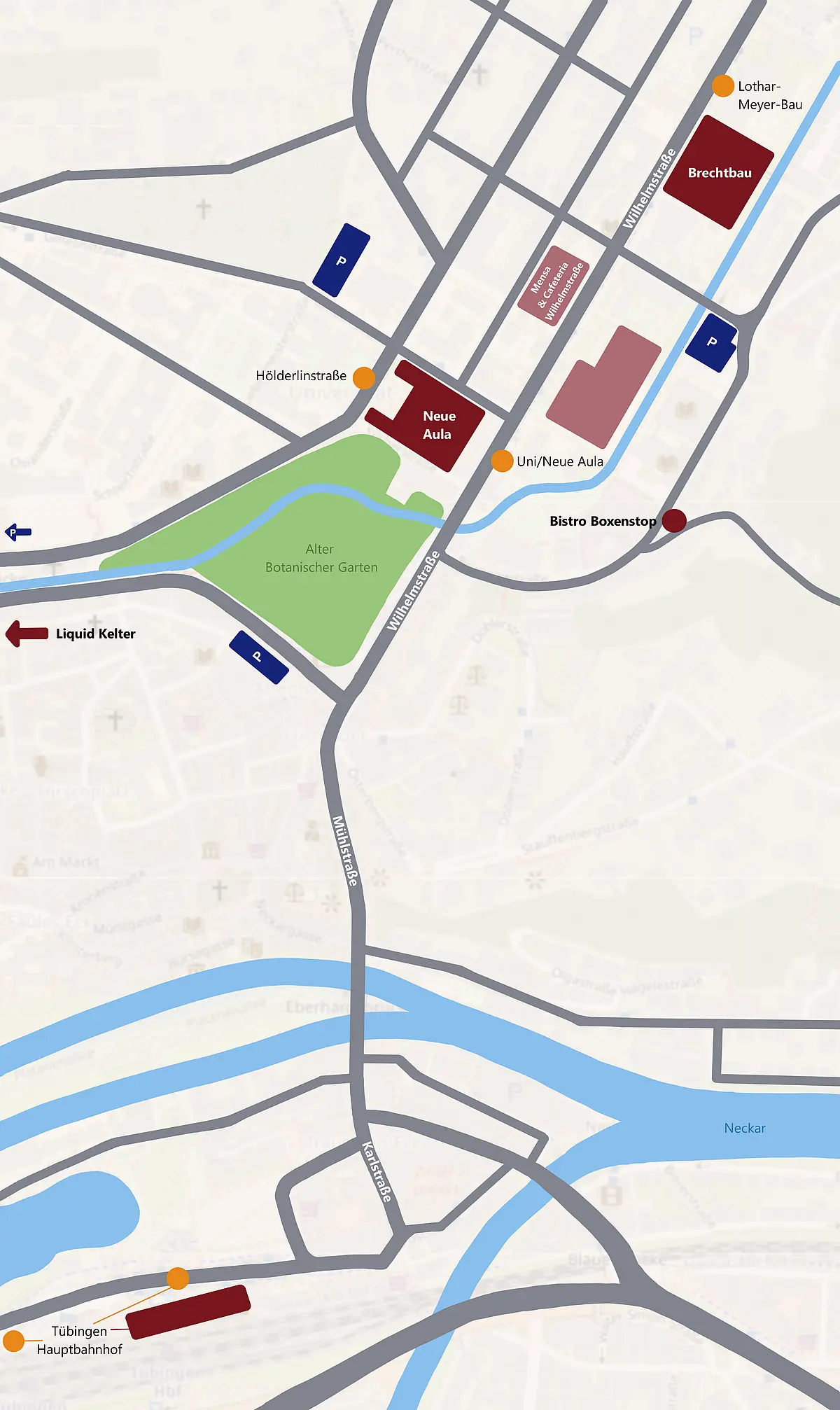
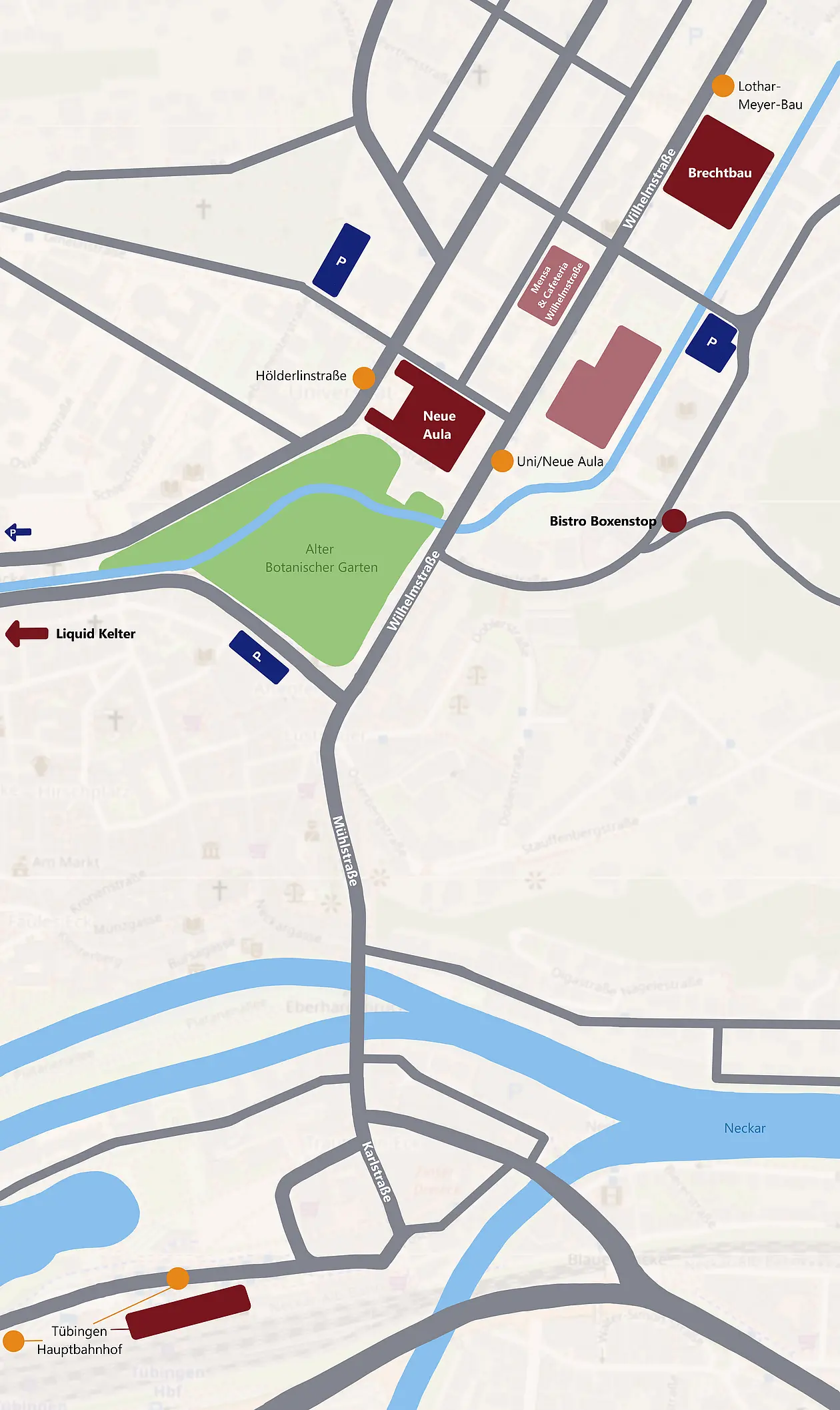
Arriving in Tübingen & Map

Arriving by public transport:

If you plan on traveling by train your destination train station will be “Tübingen Hauptbahnhof” (Tübingen main station). Connections to Tübingen are only available with regional trains, therefore in most cases you will have to transfer at Stuttgart main station. 
It is also possible to arrive at Tübingen main station via coach (e.g. Flixbus).

How to continue your journey: Right in front of the train station’s building you will find the bus station “Tübingen Hauptbahnhof”.  From there multiple bus lines will connect you to the stations “Uni/Neue Aula” and “Lothar-Meyer-Bau”. Due to a vast number of lines passing these stations with short intervals between their departures it will be best to check for the next connection once you arrived there. Multiple information boards as well as the online applications by DB and Naldo will inform you on your options. Alternatively, you can walk to the relevant buildings in approximately 20 minutes.

Arriving by car:

Tübingen is easily accessible by car via various freeways. The Bundesstraße 27 leads directly from the Autobahn 8 at Stuttgart Messe to Tübingen. Road users on the Autobahn 81 take the Herrenberg exit coming from the north and the Rottenburg exit coming from the south. From Herrenberg the Bundesstraße 296 leads to Tübingen. From the Rottenburg exit, take the Bundesstraße 28 a as well as state roads.

Parking: The most convenient car park is: Parkhaus Brunnenstraße 24. Alternatives are Parkplatz Kupferbau (Gmelinstraße 5A), Parkhaus Altstadt-Mitte (Am Stadtgraben 13), as well as Parkhaus Altstadt-König (Herrenberger Str. 2).

Arriving by plane:

The closest airport is in Stuttgart (IATA-Code STR).

How to continue your journey: Once you arrived at the airport the easiest way to get to Tübingen is via bus with the lines X82 and 828. They depart at the bus station “Stuttgart Flughafen/Messe” (sometimes called “Echterdingen Flughafen/Messe”), which is within walking distance of the arrival gates. The busses depart every 30 minutes starting from 04:48 a.m. (after midnight the frequency is reduced to an hourly connection, on the weekends some connections in the early morning are reduced). A digital schedule is available through Naldo or DB (Deutsche Bahn). The drive takes approximately one hour. The lines operate multiple bus stops in Tübingen, from which “Hölderlinstraße” is the closest to relevant buildings. Tickets can be purchased with the driver. 

Alternatively various connection via S-Bahn and trains are possible starting from a station also called “Flughafen/Messe”. However, the connection via direct bus is recommended to avoid complications during changeovers.

Map