Korean Studies

Tübingen Series in Korean Studies


Volume 10

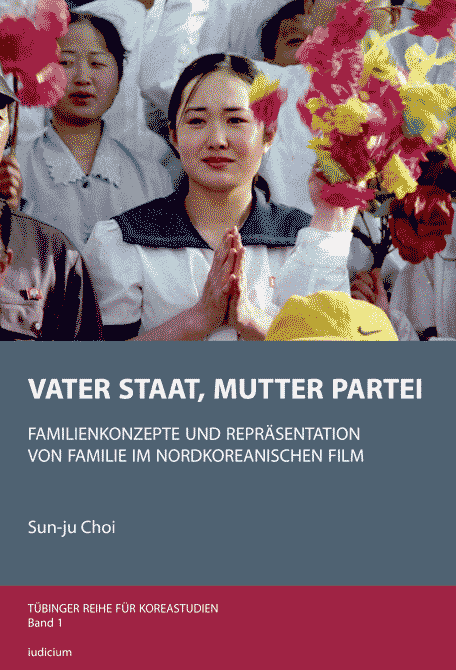
Max Altenhofen: "Ambivalent Relations"

Technical Development Cooperation between the Federal Republic of Germany and South Korea during the Cold War

Max Altenhofen, Ambivalent Relations: Technical Development Cooperation between the Federal Republic of Germany and South Korea during the Cold War, Tübinger Reihe für Koreastudien, Volume 10, Munich: Iudicium Verlag, 2025.

With the agreement on economic and technical cooperation, relations between the Federal Republic of Germany and South Korea deepened. From 1961 to 1993, both countries carried out joint model projects, research collaborations, advisory missions, and training programs. This led to a transfer of materials, knowledge, and practices. South Korea viewed Germany as an alternative to the USA and Japan, while the Federal Republic also sought to access the Korean economic market. As South Korea developed into a newly industrialized country, the asymmetry in bilateral relations gradually diminished and slowly evolved into a partnership. In particular, the German-Korean actors on the ground negotiated the direction of projects, resolved conflicts, and shaped development policy.


Volume 7

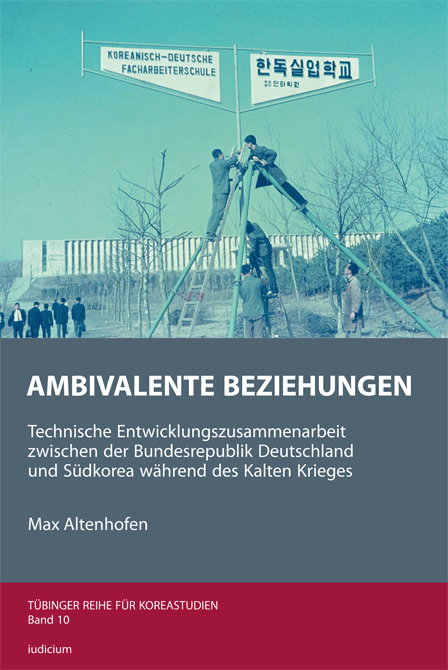
You Jae Lee / Byung Wook Jung (eds.): “Everyday History in Korean Studies”

Spaces of Action for Ordinary People

You Jae Lee / Byung Wook Jung (eds.), Everyday History in Korean Studies: Spaces of Action for Ordinary People, Tübinger Reihe für Koreastudien, Volume 7, Munich: Iudicium Verlag, 2025.

Everyday history is a young historiographical approach in Korean studies, developed in close exchange with German Alltagsgeschichte (history of everyday life). It focuses on ordinary people in history, who actively shape their living conditions. In doing so, they may open up new possibilities, but they can also reinforce existing circumstances. Explicitly distancing itself from master narratives—such as modernization, capitalism, nation-building, colonialism, patriarchy, and the Cold War—from a macrohistorical perspective, the contributions collected in this volume explore the individual shaping of the material reality of ordinary people “from below.”

For example: How do Yangban women secure their inheritance when a supposedly lost husband returns? How do Yangban widows defend ancestral graves when others contest them? What do the acts of lèse-majesté by the colonized reveal about their relationship to the colonial rulers? What behavior among middle school girls in the 1950s and 1960s was considered deviant, disturbing public morals, and how was it regulated? How were weather phenomena and physical violence in rural daily life in the 1960s and 1970s connected to local power relations and social dynamics? Why was the New Village Movement in the 1970s so strongly influenced by Christianity for local leaders? How was it possible even in the 1980s for street children to be forcibly interned in large numbers and systematically abused? Why did the division of Korea lead to the splitting of a congregation in Kyoto?

This volume is very well suited as an introduction to Korean everyday history.

Contributors:
Lee You Jae, Jung Byung Wook, Kwon Nae Hyun, Kim Kyeong Sook, So Hyunsoog, Ahn Seung Taik, Lee Sangrok, Joo Yunjeong, Itagaki Ryuta
VOLUME 6

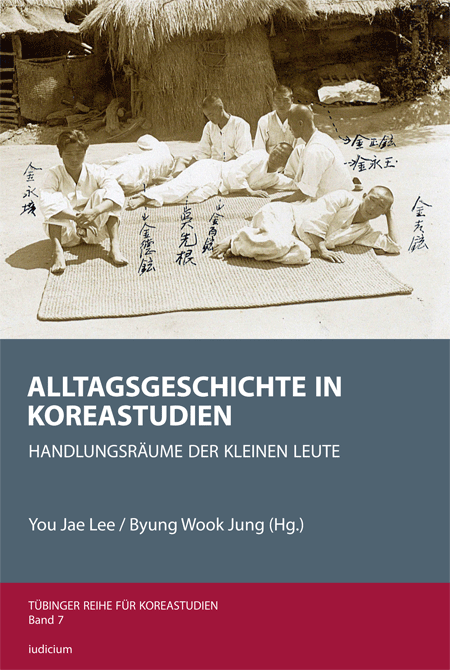
You Jae Lee / Myoung Hoon Shin (eds.): “Mission for Peace and Democracy”

Church Collaboration between Germany and Korea

Lee, You Jae / Shin, Myoung Hoon (eds.). Mission for Peace and Democracy: Church Collaboration between Germany and Korea. Munich: 2025, Iudicium.

The relations between Protestant churches in Germany and Korea were established at the beginning of the 1960s and are therefore of relatively recent origin. This field of research has so far been insufficiently studied. In this volume, (former) actors analyze various aspects of church collaboration based on their own experiences. Several significant particularities can be observed. The German churches moved away from the classical mission approach, which had been primarily focused on the salvation of souls. In the 1960s and 1970s, the emphasis was initially on supporting Christian institutions and theological educational structures in Korea, as well as on pastoral care for Korean labor migrants in West Germany and West Berlin. From the mid-1970s onward, social and societal projects increasingly came into focus, including rural development, urban poverty alleviation, working conditions in industry, women’s movements, the strengthening of civil society, and diaconal initiatives in Korea. During the democracy movement of the 1980s, the churches were actively engaged in human rights issues. After German reunification in the 1990s, the German churches—albeit with limited influence—sought to support peace and reunification processes on the Korean Peninsula. Overall, the church collaboration between Germany and Korea represents a success story that still requires comprehensive scholarly analysis.

CONTENTS
Foreword · Mission-Theological Basis for Ecumenical Cooperation · German-Korean Ecumenism in Congregational Work · Peace Work and Development Aid · Document Appendix

CONTRIBUTORS
Lee You Jae · Kim Won Bae · Henry von Bose · Oh Yong Sik · Lee Young Sook · Paul Oppenheim · Karl Schönberg · Margit Lottje-Schröder · Han Unsuk


VOLUME 5

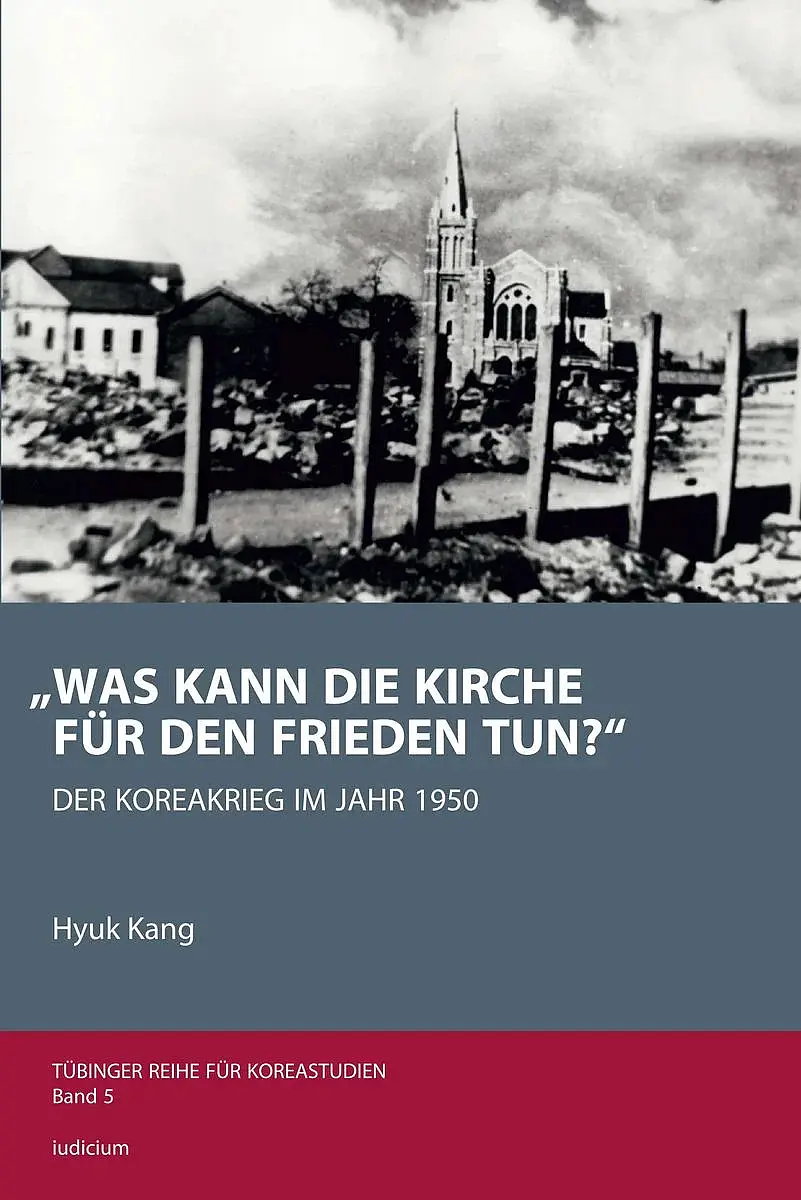
Hyuk Kang: "What Can the Church Do for Peace?"

The Korean War in 1950: Perceptions, Reactions, and Debates in Korea, the WCC, and German Protestantism, with Special Consideration of Publications in the National German Protestant Press

> Kang, Hyuk. What Can the Church Do for Peace? The Korean War in 1950: Perceptions, Reactions, and Debates in Korea, the WCC, and German Protestantism, with Special Consideration of Publications in the National German Protestant Press. Munich: 2022, Iudicium.

The church should speak more about peace and reconciliation through Christ than about war. Throughout history, the church has often assumed the role of guaranteeing the legitimacy of a war, but this has frequently led to consequences with destructive effects. Church proclamation and political action cannot be entirely separated, because all things in this world are connected to political activity, and churches are commissioned to act in the world. However, as churches, they must bear witness to what they believe based on the Word of God and its revealing self-disclosure.

Review by Dr. Sung Kim (Kim, Sung. “Hyuk Kang, What Can the Church Do for Peace? The Korean War in 1950: Perceptions, Reactions, and Debates in Korea, the WCC, and German Protestantism, with Special Consideration of Publications in the National German Protestant Press.” theologie.geschichte [online], 18 [2023]: S. Web. 6 Dec. 2023)


VOLUME 4

You Jae Lee (ed.): "Glück Auf!"

Life Stories of Korean Miners in Germany

Lee, You Jae. Glück Auf! Life Stories of Korean Miners in Germany. Munich: 2021, Iudicium.

The nearly 20,000 miners and nurses who came to West Germany as guest workers in the 1960s and 1970s form the foundation of today’s Korean diaspora in Germany. However, the life stories of the miners who settled in Germany remain largely unknown. In ten multifaceted biographical narratives, former miners recount their reasons for emigrating, the physically demanding work underground, the founding of families and their professional lives, as well as experiences of everyday discrimination and their plans for later life.

In all stages and circumstances of life, these men faced the challenges of a migration society. Often, with varying degrees of success, they asserted their own will and carved out and maintained their place in Germany. Family cohesion was of great importance to them, and they placed high value on their children’s education. None of them regrets the decision to remain in Germany. Yet, in retrospect, their memories blend nostalgia with moments of happiness. They now seek social recognition for their transnational life achievements—both from the Korean community in Germany and from South Korea and Germany alike.


VOLUME 3

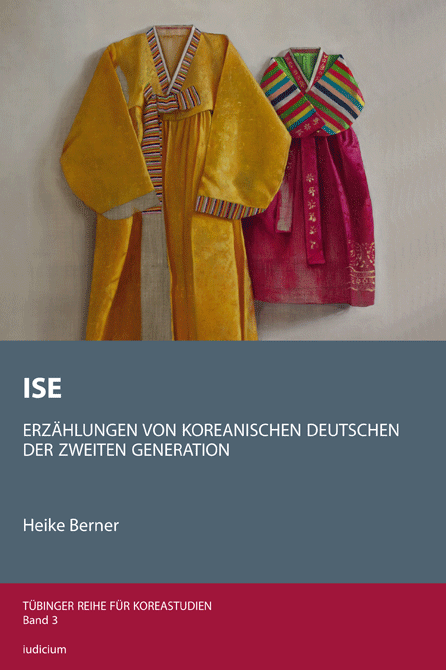
Heike Berner: "ISE"

Narratives of Second-Generation Korean Germans

> Berner, Heike. ISE: Narratives of Second-Generation Korean Germans. Munich: 2018, Iudicium.

How does the second generation of people of Korean descent (“Ise”) situate themselves in Germany?

This question is explored in ten narratives based on oral history interviews with individuals born between 1969 and 1989 as children of Korean immigrants. These are highly individual stories about growing up in Germany from the 1970s to the 1990s. They depict the continuous negotiation between externally imposed and self-determined identities and describe how the now-adult Ise position themselves between exception and normality, between being “foreigners” and being German, between Germany and Korea. The narratives challenge fixed notions of “German” and “Korean” identities and reveal the diversity of experiences within the second generation. At the same time, they document a largely unknown aspect of both Korean and German migration history.

Review by Sebastian Tobginski (Tobginski, Sebastian. “Heike Berner: ISE. Narratives of Second-Generation Korean Germans.” Asien: The German Journal on Contemporary Asia, No. 154/155 [January/April 2020]: 161–162.)


VOLUME 2

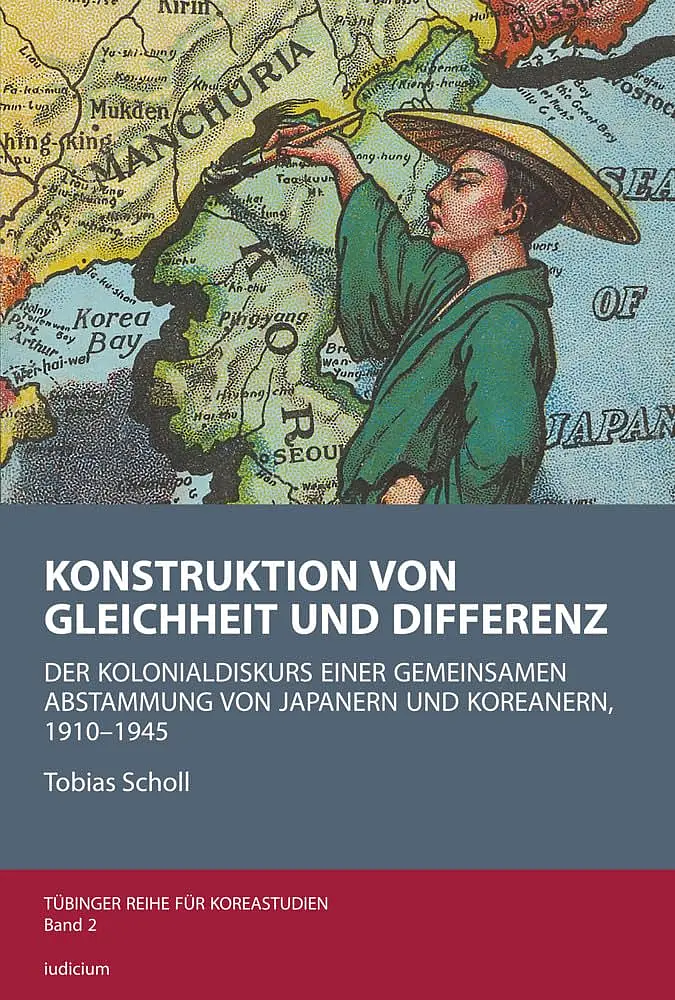
Tobias Scholl: "The Construction of Equality and Difference"

The Colonial Discourse on the Shared Ancestry of Japanese and Koreans, 1910–1945

> Scholl, Tobias. The Construction of Equality and Difference: The Colonial Discourse on the Shared Ancestry of Japanese and Koreans, 1910–1945. Munich: 2018, Iudicium.

During Japan’s colonial rule over Korea, Japanese authorities emphasized the affinities between Japanese and Koreans. This emphasis on commonalities is known in contemporary scholarship as the discourse on the shared ancestry of Japanese and Koreans (Jap.: Nissen dōsoron; Kor.: Il-Sŏn tongjoron). The present book situates this discourse of affinity historically and examines it as both a discursive and a governing practice of the Japanese colonial period. Within and through this discourse, both the colonizers and the colonized constructed notions of equality and difference in relation to one another—either to legitimize or to challenge the colonial order. The discussion also sheds detailed light on the particular position of the West within these processes.

An examination of the Korean resistance to the theory of shared ancestry between Japanese and Koreans, in turn, reveals that the colonized found themselves in the contradictory situation of having to draw upon arguments and discourses that had originally been employed by the Japanese colonial power to justify its domination over Korea.


VOLUME 1

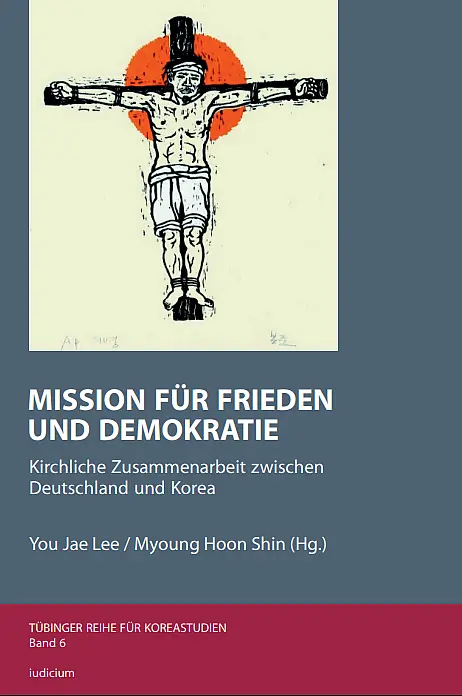
Sun-ju Choi: "Father State, Mother Party"

Family Concepts and the Representation of Family in North Korean Cinema

> Choi, Sun-ju. Father State, Mother Party: Family Concepts and the Representation of Family in North Korean Cinema. Munich: 2017, Iudicium. [Flyer]

The history of North Korean cinema is closely intertwined with the country’s political and ideological development, in which the repeated narration of its historical heritage plays a crucial role in shaping national identity. In this sense, all North Korean films can be seen both as testimonies to historical events (such as colonialism and war) and as affirmations of a collective will to build a common future (the socialist revolution). Accordingly, film functions as an important medium for creating coherence and holds significant political value. Depending on the party’s domestic and foreign policy agenda, the specific demands placed on filmmakers may change, but the fundamental principles of ideological communication remain constant—family and state are presented as an essential unity and are instrumentalized for the consolidation of state power. At the center of this politicized aesthetic stand the founding leader Kim Il Sung and his son Kim Jong Il, who embody the state as its father and the party they created and control as its mother.