Juristische Fakultät

News

Michèle Finck Joins the Editorial Board of Technology and Regulation

Michèle Finck has joined the editorial board of Technology and Regulation!

New Pre-Print on the Constitutional Implications of the AI Act

Michèle Finck has written an article on the constitutional implications of the AI Act, which will be published by the Common Market Law Review in 2026. A pre-print has been published here.

Inaugural Tübingen Conference on Artificial Intelligence and Law

The inaugural Tübingen Conference on AI and Law was held on 5 and 6 November 2025. Further information can be found here.

Michèle Finck Called to the United Nations Working Group on Data Governance at all Levels

Michèle Finck has become a member of the United Nations Working Group on Data Governance at all Levels. Further information about the working group can be found here.

New PostDoc Dr. Teodora Groza

Dr. Teodora Groza joined the Chair as a postdoctoral researcher in November 2025. She holds a PhD in Law from Sciences Po Law School and has held visiting positions at Harvard Law School and Stanford Law School. Her previous work has examined how technological innovations give rise to new governance frameworks, drawing on the toolkit of law and economics.
During her time in Tübingen, she aims to explore how core legal concepts and doctrines such as fiduciary duties, public utilities, and legal personhood can be mobilized to ensure AI alignment. She also seeks to foster collaborations with Tübingen’s vibrant AI community and develop interdisciplinary projects to better understand the legal and ethical challenges raised by the development of AI technologies by private actors. Lastly, she aims to draw on her philosophy background and explore how contemporary perspectives on subjectivity and alterity can inform AI governance.

New Publication on the AI Act's Research Exemption

Michèle Finck has just published a new article on the research exemptions in the EU Artificial Intelligence Act. This piece explores one of the most complex and under-examined aspects of the EU AI Act — its research exemptions. These provisions were designed to ensure that AI research and innovation can flourish without excessive regulatory burdens. However, as I argue in the article, the exemptions are ambiguous and difficult to apply in practice, leaving researchers uncertain about when their work falls within or outside the Act’s scope.

This means that the “lost research exemption” may not provide the safe space for research that the legislators envisioned. Michèle call for clearer interpretive guidance to ensure the AI Act truly supports innovation while maintaining accountability.

You can read the article in open access here.

Congratulations and farewell to Dr. Tommaso Fia

Changes are always bittersweet. We are delighted, yet also a little sad, to announce that Dr. Tommaso Fia has left the Faculty of Law of the University of Tübingen to take up a position as Lecturer in Data Law and Governance at University College London from September 2025.
Since joining us in 2023, Tommaso has been a devoted member of the Chair of Law and Artificial Intelligence’s team led by Professor Finck. He has contributed to our work with dedication and commitment, not only by carrying out research at the intersection of data & AI law, governance and normative theory, but also contributing to organizing academic events that valued exchanges of ideas, debate and collaboration. Overall his work at the Chair of Law and Artificial Intelligence nurtured our growing community in multiple ways, through his collegial spirit, his intellectual generosity and his kindness as a colleague.
Tommaso will be much missed in Tübingen as a researcher, colleague and friend. Meanwhile, we are excited for him as he moves on to an exciting new chapter and we wish him all the very best for the future, with the promise to stay connected in the years ahead.

Writing Workshop on the European AI Act

The Chair for Law and Artificial Intelligence hosted a Writing Workshop on the European AI Act in Tübingen, Germany, on 11 July 2025.

With the European AI Act being enacted on 13 June 2024, the EU has ushered in a new era of governing digital technology. The new regulation aims to build a trustworthy environment for commercializing AI systems, setting the stage for better development and use of this technology (Commission 2023). Since the Commission’s initial proposal, literatures in law have underlined its resemblance to a product safety regime based on standardization and market surveillance (Veale and Borgesius 2021; Almada and Petit 2025), with comparably less focus of the regulation on the protection of fundamental rights (Palmiotto 2025).

This workshop setted out to discuss four contributions to the bourgeoning literature on the AI Act, a year after its gazette publication. Participants were expected to engage in conversations about their works. Its aim was to offer an opportunity to early-stage researchers (PhD students, post-doctoral researchers, assistant professors) to receive feedback on their research from their peers as well as from the rest of the attending audience, and to allow them to know more about what aspect(s) of the AI Act each other are working on.

The workshop followed the approach developed by the Institute for Global Law & Policy at Harvard Law School. Key to this method is that participants are expected to present each other’s drafts instead of their own. The workshop was composed of four participants providing their work and was moderated by a faculty member of the Chair of Law and AI of the University of Tübingen. Each participant was assigned a paper to present and was required to have read all the papers being presented at the workshop to offer valuable feedback.

New Publication: "Robustness and Cybersecurity in the EU Artificial Intelligence Act"

The article Robustness and Cybersecurity in the EU Artificial Intelligence Act by Henrik Nolte, Miriam Rateike, and Professor Michèle Finck has been published on arXiv. It examines the legal challenges and shortcomings in the provisions related to robustness and cybersecurity for high-risk AI systems (Article 15 AIA) and general-purpose AI models (Article 55 AIA) in the EU Artificial Intelligence Act.

Tübingen PhD Summer School on Artificial Intelligence and Law 2025

The Chair of Law and Artificial Intelligence at the University of Tübingen hosted its second International PhD Summer School in Artificial Intelligence and EU Law from 12 – 16 May 2025. The Summer School provided a platform for PhD candidates to engage in dynamic discussions and showcase their research. It took place at Tübingen castle and featured expert lectures from leading scholars and practitioners, participant presentations, and social events in view of fostering in-depth discussions amongst participants.

The Summer School was stacked with a stellar line-up of speakers, including Mateja Durović (ECHR and King‘s College London), Melanie Fink (Leiden University), Marta Cantero Gamito (University of Tartu), Matthias C. Kettemann (University of Innsbruck), Mariana Valente (University of St. Gallen), Kyoko Yoshinaga (Keio University).

You can view the 2024 program here

Michèle Finck Meets Frank-Walter Steinmeier

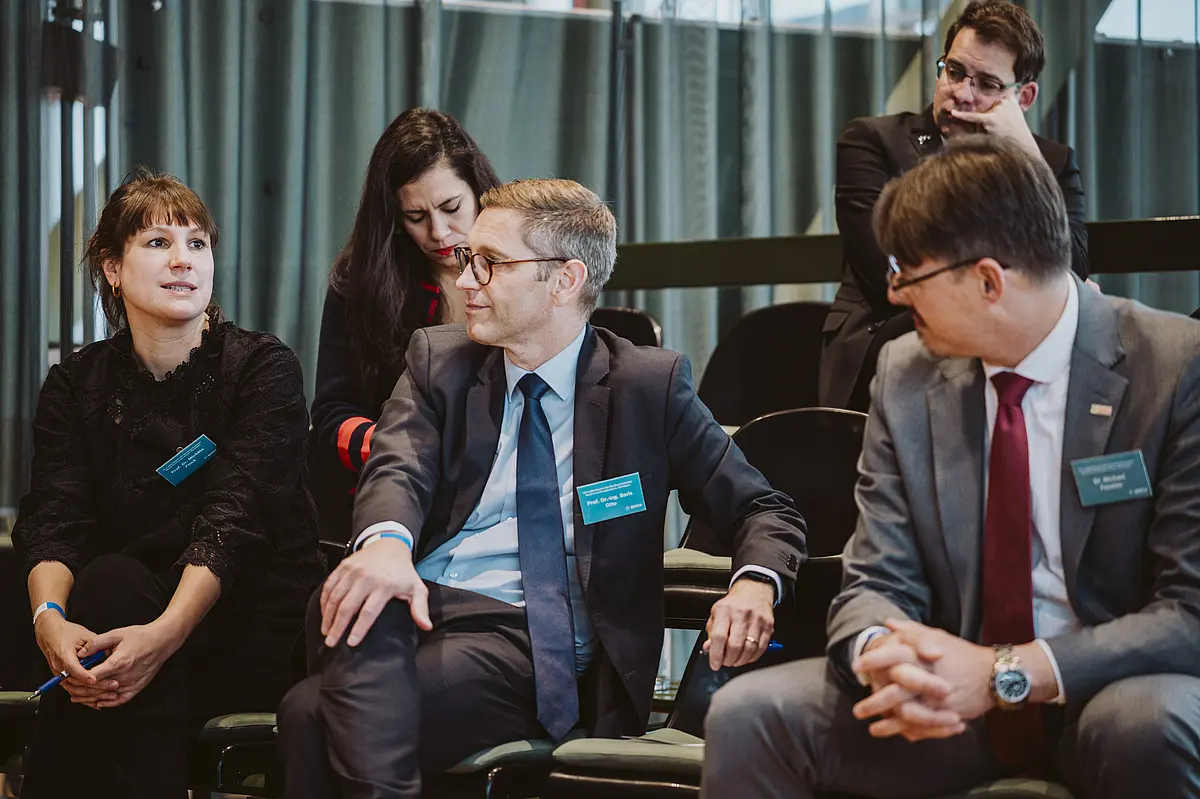
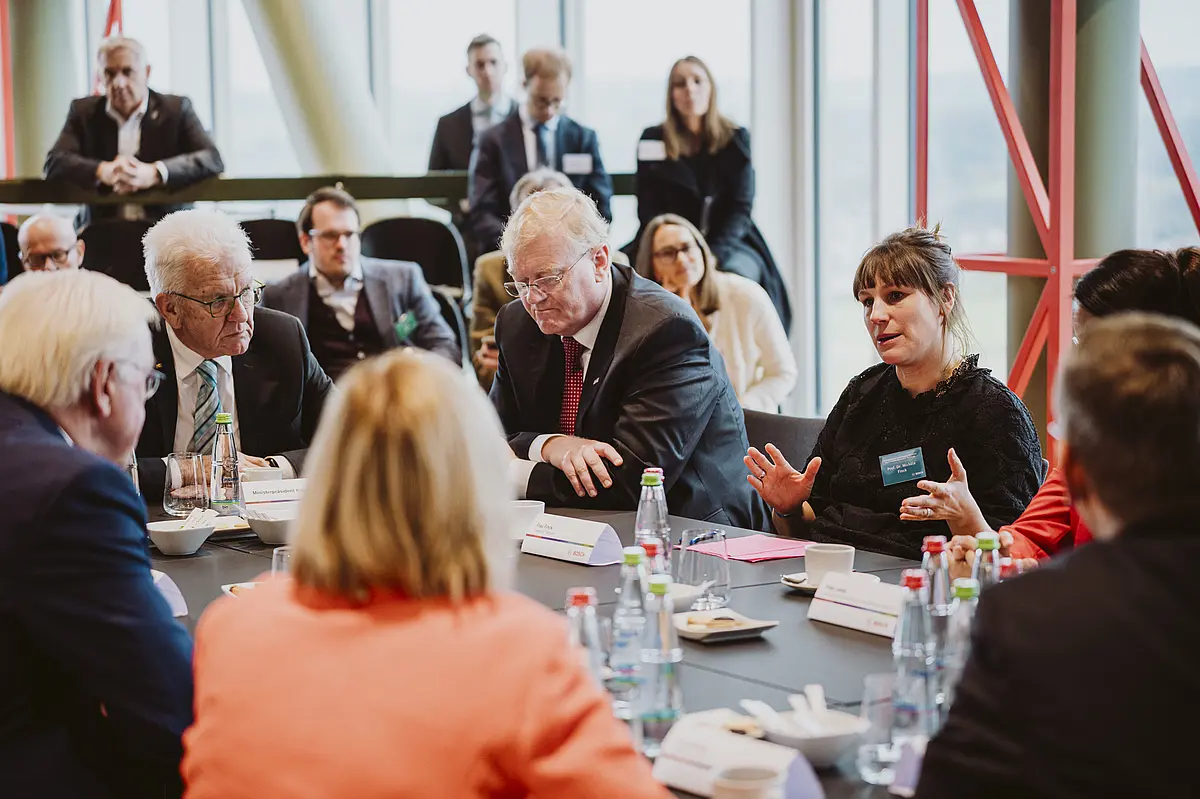
Michèle Finck recently had the opportunity for a direct discussion with the German President Frank-Walter Steinmeier. Their discussion covered critical topics such as AI regulation and its effective communication, the importance of interdisciplinary research, and strategies for building and fostering trustworthy AI.

This discussion occurred as part of the event series Werkstatt des Wandels hosted by Federal President Frank-Walter Steinmeier. 

The event featured other prominent participants, including Michael Bolle, Chairman of the Foundation Board of the Carl-Zeiss-Stiftung; Gisela Lanza, Professor and Director at the WBK Institute of Production Science at KIT Karlsruhe; Boris Otto, Director of the Fraunhofer Institute for Software and Systems Technology (ISST) and Professor of Industrial Information Management at TU Dortmund; Philippe Souidi, SAP Vice President; Dr. Michael Fausten, Senior Vice President of Corporate Research and Division Head for Artificial Intelligence and Systems at Bosch; Vanessa Cann, Managing Director at Accenture; and Stefan Hartung, CEO at Bosch.