Korean Studies

“Youth climate movement in South Korea and beyond: discourse and networks”

Yi Hyun Kang
Lund University

December 17th, 2025

Bio. Yi Hyun Kang is a Postdoctoral Researcher in the Department of Political Science at Lund University in Sweden. She previously worked at UCLouvain Saint-Louis Bruxelles, Belgium, as a postdoctoral researcher, and earned her PhD at the Technical University of Munich. Her research explores the role of civil society and technology in environmental politics and governance. Her research interests have
Abstract. Youth climate activism has grown fast in South Korea (Korea), especially after the Fridays for Future (FFF) movement spread worldwide. Youth 4 Climate Action, a Korean branch of FFF, filed a lawsuit in 2020, arguing that inadequate Korean governmental climate action violates constitutional rights. Four years later, the Constitutional Court ruled that the government’s policy is partly unconstitutional for failing to set long-term emissions-reduction targets, underscoring the impact of a youth climate movement in Korea. In this lecture, I will first present an overview of major youth climate organizations active in Korea. Also, their horizontal and international, regional, and local network-building strategies will be introduced. Finally, I will explain the particularity of Korean youth climate activism in the broader context of global youth climate movements. Her research interests have been shaped by professional experiences in journalism (PRESSian, Korean online newspaper), international development (International Labour Organization), and applied research (Korea Environment Institute). Website: http://yihyunkang.com/

Abstract. Youth climate activism has grown fast in South Korea (Korea), especially after the Fridays for Future (FFF) movement spread worldwide. Youth 4 Climate Action, a Korean branch of FFF, filed a lawsuit in 2020, arguing that inadequate Korean governmental climate action violates constitutional rights. Four years later, the Constitutional Court ruled that the government’s policy is partly unconstitutional for failing to set long-term emissions reduction targets, showing the impact of the youth climate movement in Korea. In this lecture, I will first present an overview of major youth climate organizations active in Korea. Also, their horizontal network-building as well as their international, regional and local network-building strategies will be introduced. Finally, I will explain the particularity of Korean youth climate activism in the broader context of global youth climate movements.


“Fake News and Free Speech in South Korea: Legal Challenges in a Polarized Democracy”

December 3rd, 2025

Bio. Ahran Park is an Associate Professor in the College of Media & Communication at Korea University. Her research focuses on media law, platform governance, and digital journalism. She has published extensively on issues related to Internet law and regulation. She received her B.A and M.A. from Seoul National University and her Ph.D. from the School of Journalism and Communication at the University of Oregon.

Abstract. South Korea offers a distinctive and revealing case of how democracies struggle to regulate disinformation while safeguarding freedom of expression. This presentation examines the evolution of Korean legislative efforts to combat disinformation—from authoritarian-era controls on “rumor-mongering” to contemporary debates over platform responsibility and press accountability. Drawing on my chapter in Disinformation, Misinformation, and Democracy (Cambridge University Press, 2025), I analyze major regulatory strategies that have emerged since 2017. This presentation show how political polarization, historical sensitivities over state censorship, and Korea’s platform-dominated news ecosystem complicate these efforts. The presentation argues that while the demand for stronger tools against harmful disinformation is growing, regulatory attempts risk chilling legitimate expression unless narrowly tailored and accompanied by clear procedural safeguards. South Korea’s ongoing debate illustrates the broader global challenge of balancing democratic free-speech values with the urgent need to limit the harms of false information in the digital age.


"Economic Development and Child Stunting in South Korea" 

November 26th, 2025 

Bio. Young-Jun Cho is a Professor in the Department of Economics at Seoul National University. His research focuses on Korean and East Asian economic history from the late Chosŏn period to the modern era. Drawing on historical documents and quantitative data, his work explores how economic structures, trade networks, and nutrition patterns evolved over time. He earned his Ph.D. in Economics from Seoul National University, where he now teaches courses in economic history and other topics. His recent research investigates long-term trends in nutrition, height, and economic development in Korea, contributing to a deeper understanding of how socioeconomic and public health changes shape human well-being across generations. 
Abstract. This study explores the long-term relationship between economic development and child stunting in South Korea, showing how rapid gains in living standards and public health eradicated stunting within a single generation. Using historical data on children’s height and weight, per capita GDP, and nutrition, it empirically examines the links between growth, nutrition, and health. In the early 20th century, stunting exceeded 70% due to poverty, malnutrition, and disease, and conditions worsened under colonial rule and war. From the 1960s to 1980s, however, South Korea achieved one of the world’s fastest stunting declines through rapid growth, better diets, sanitation, and maternal-child healthcare. By the 1980s, stunting had virtually vanished, and Korea became a model of public health success. The findings show that child stunting is socially and economically reversible, underscoring that sustained growth and investment in nutrition, education, and health are vital for improving child well-being in developing nations.


 "Czechoslovakia and DPRK: Cultural Policy of the 1950s"
Miriam Lowensteinová
Charles University, Prague

November 19th, 2025

Bio. Miriam Löwensteinová is a professor of Korean Literature at Charles University, Prague, and Director of its Center for Korean Studies. Her research focuses on pre-modern Korean literature, including chronicles, historical prose, diaries, and the p’aesŏl genre. She has translated over 20 volumes of classical and modern Korean literature and authored numerous studies on Korean cultural tradition. Co-editor of The Lives and Legacy of Kim Sisŭp (1435–1493): Dissent and Creativity in Chosŏn Korea (Brill, 2024). Recipient of several awards, including the Best Translation Award (2013), Hangeul Development Award (2014), and Charles University Medal (2018).

Abstract. After the 1948 coup, Czechoslovakia aligned with the USSR and pursued a pro–North Korean policy. Though not militarily involved in the Korean War, it participated in the Neutral States Supervision and Repatriation Commissions and provided extensive aid—building hospitals, supplying machinery, and sending experts. Cultural and humanitarian assistance included support for Korean film, hosting orphans, and education programs.During the 1950s, cultural exchanges and visits flourished, notably dancer Ch’oe Sǔnghǔi’s 1956 performance. Relations later declined as the DPRK distanced itself from the Soviet bloc, focusing on the Third World. By the 1980s, economic crises and political shifts reduced ties to a minimal, symbolic level after 1989.


Theme: “My Korean Postcard – 나의 엽서 만들기”

Who can participate?

  • Learners enrolled at the King Sejong Institute Tübingen

  • Korean Studies students at the University of Tübingen

How it works

  1. Write your favorite Korean word or sentence
    (from a book, poem, quote, novel, song, etc.).

  2. Decorate the postcard creatively (drawings, stickers, etc.).

  3. Explain in Korean why you like this word/sentence.

  4. Send a photo/scan to: mail@sejong.uni-tuebingen.de

  5. In your email, include your affiliation, e.g.
    Max Mustermann, Student, Sejong Institute

Key dates

  • Submission deadline: Wednesday, 26 November 2025

  • Online exhibition: 3–26 December 2025

  • Voting: 3–9 December 2025
    (Voting is limited to Sejong Institute learners and Korean Studies students.)

  • Winners announced: 10 December 2025
    → via email and on the Sejong Institute website

Prizes 1st–3rd place: Eco bag, toiletry bag, USB stick (8 GB)

PDF download 

King Sejong Institute Tübingen
Eberhard Karls Universität Tübingen
Wilhelmstr. 133, 72074 Tübingen
Email: mail@sejong.uni-tuebingen.de
Questions? Please contact Kyung Jin Oh by email.


Master orientation for bachelor students


Job advert for the Korea Zentrale für Tourismus in Frankfurt


Tübinger lecture series - Han Chung-il

Download: Poster


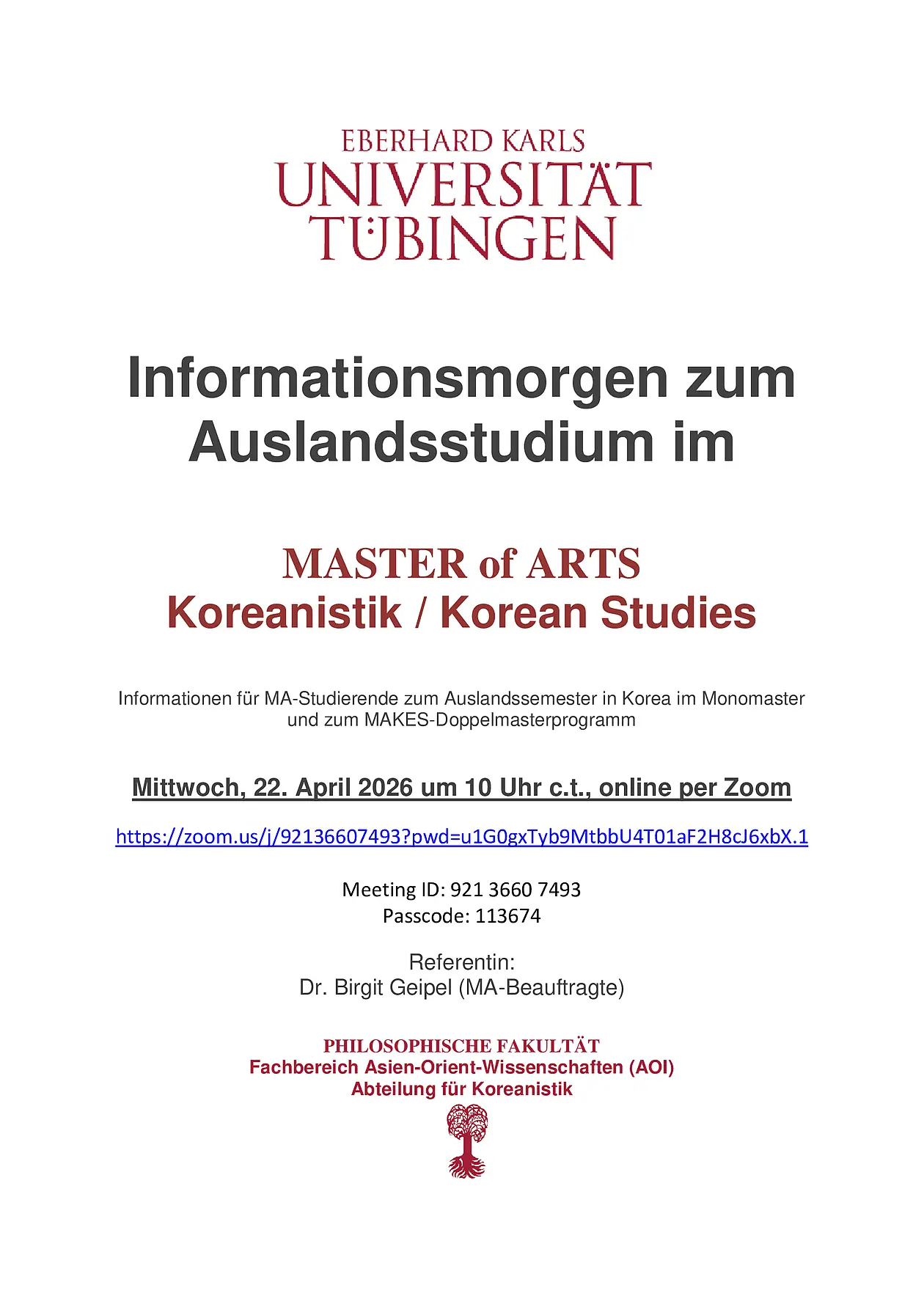
Information morning for students in the master's program, October 22


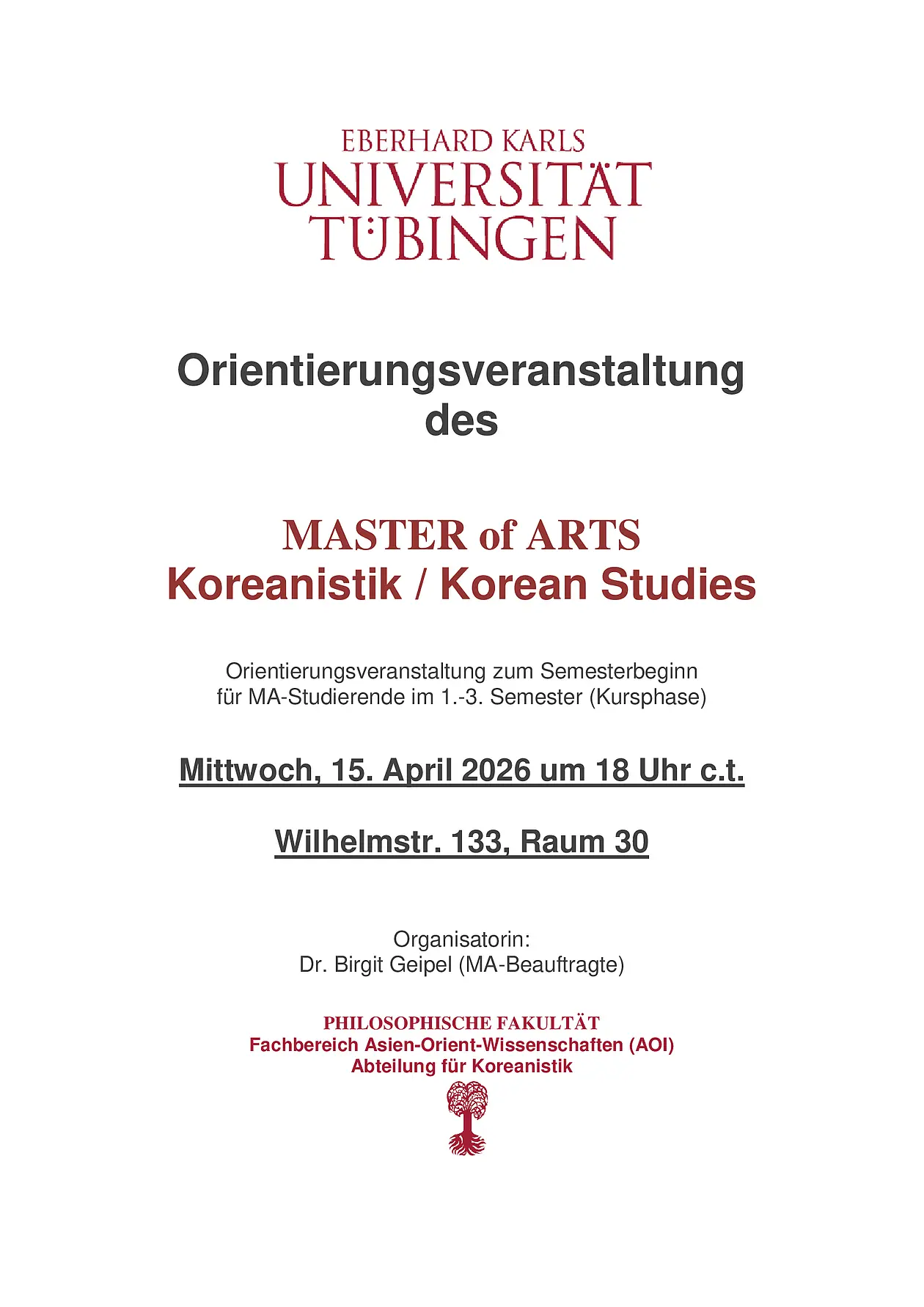
Orientation Events Winter semester 2025/26


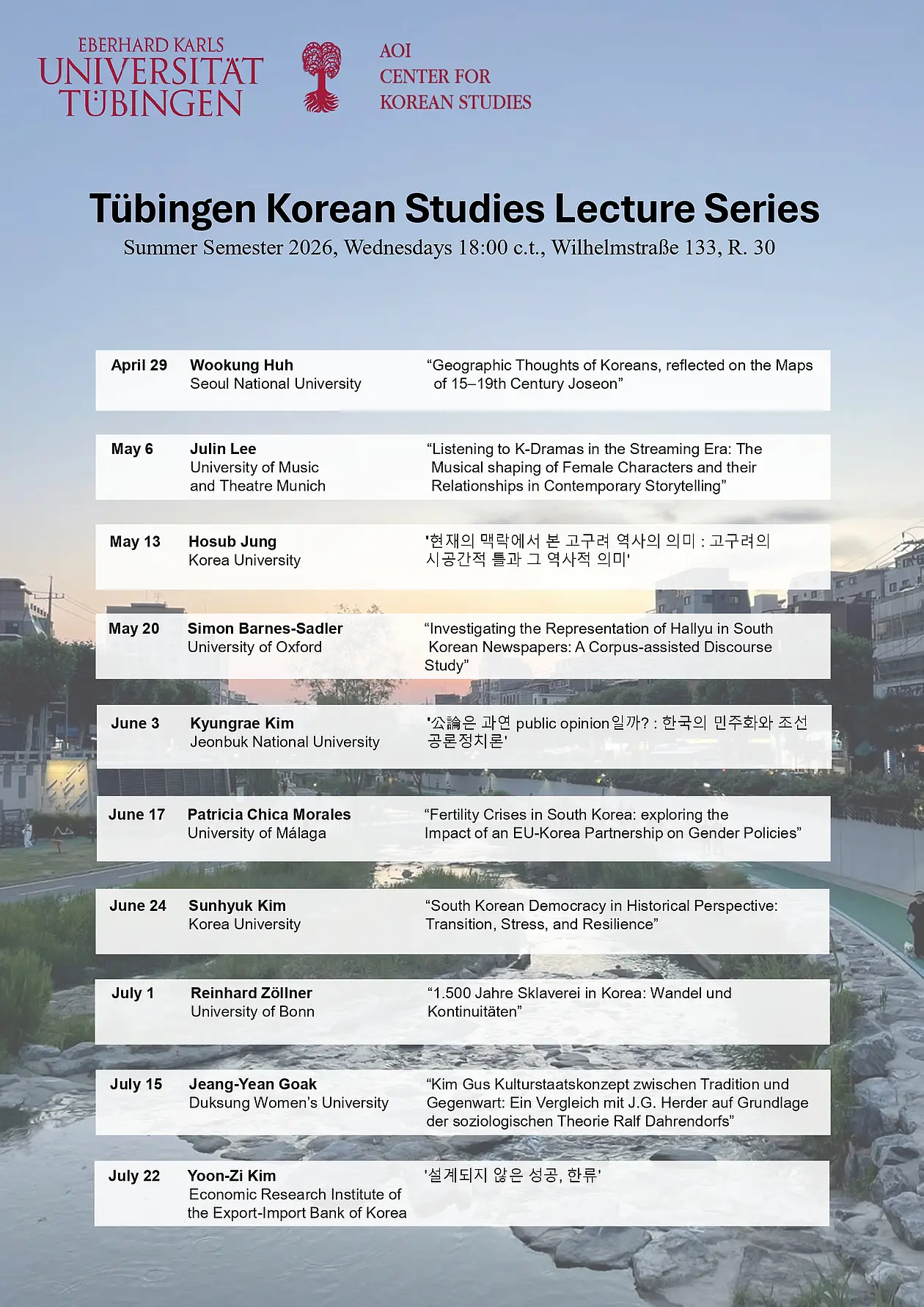
Poster Lecture Series Winter Semester 2025/26

Download: Poster


Berlin Fieldtrip program version from October,13 2025