
19.11.2026
Design Thinking for Researchers
When faced with a challenge, our first instinct is often to start brainstorming solutions. But what if we haven't fully understood the problem yet? What if the most promising ideas emerge not from thinking harder on our own, but from questioning assumptions, exploring different perspectives, and experimenting together? That's exactly what Design Thinking is all about.
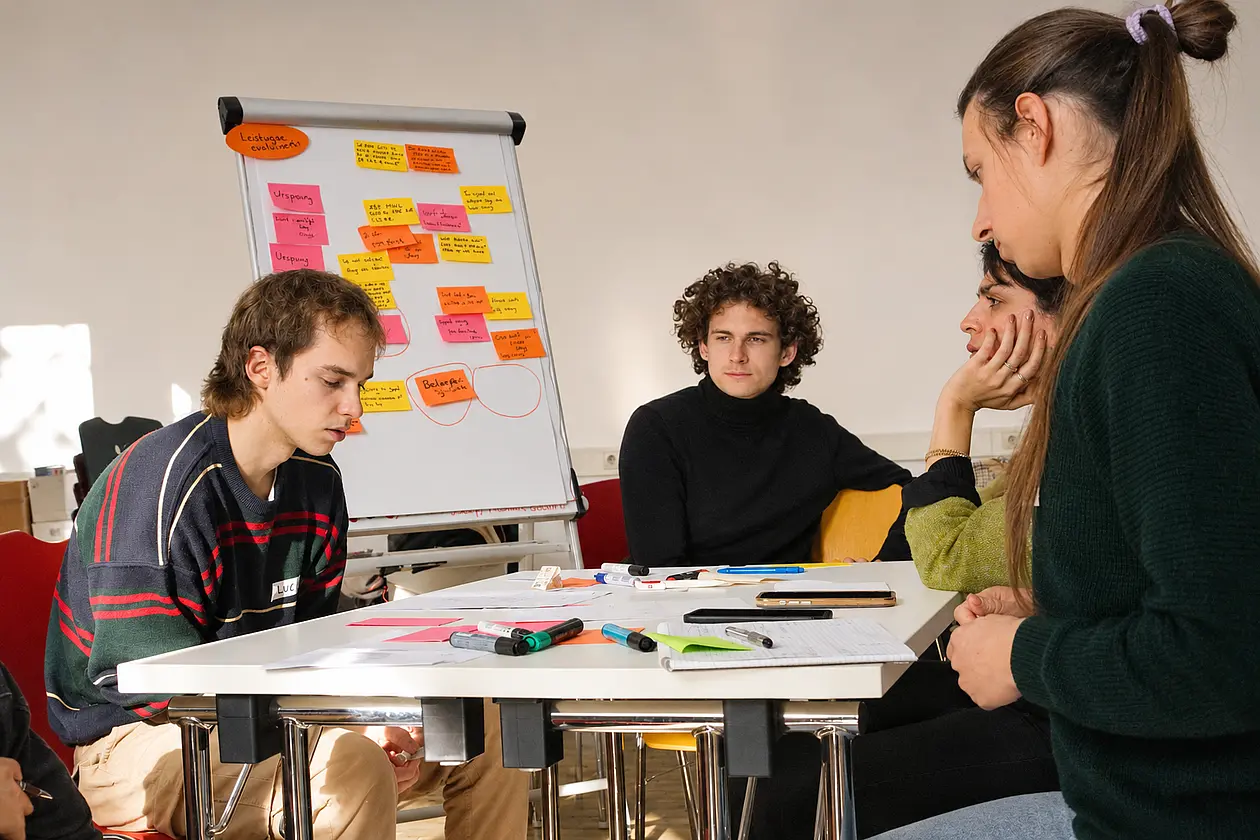
In October, advanced Master's students, PhD candidates, and postdoctoral researchers came together for our hands-on Design Thinking workshop to discover a different approach to solving complex challenges. With academic backgrounds ranging from machine learning and life sciences to the humanities, participants brought diverse perspectives to the table. Together, they explored how a user-centered mindset, creative collaboration, and rapid experimentation can turn complex challenges into opportunities for innovation.
Learning by Doing
Following a brief theoretical introduction, participants had the opportunity to put Design Thinking into practice. Working in interdisciplinary teams, they selected one of four predefined challenges and worked their way through the six stages of the Design Thinking process:
- Understand: Explore the challenge and establish a shared understanding within the team.
- Observe: Step into the users' shoes and gain insights into their needs and perspectives.
- Define Point of View: Bring together the insights and formulate a clear problem statement.
- Ideate: Generate, explore, and select creative approaches to solving the problem.
- Prototype: Turn promising ideas into tangible concepts.
- Test: Gather direct feedback from potential users, identify blind spots, and discover opportunities for improvement.
One of the biggest challenges for participants was resisting the urge to jump straight into finding solutions. Instead, they were encouraged to spend time exploring the problem, questioning assumptions, and developing a shared understanding of the actual needs behind the challenge.
Only then did the teams move on to generating ideas, using different brainstorming techniques to explore possible solutions. Through rapid prototyping and testing, they made their ideas tangible and gathered valuable feedback.
By presenting their prototypes and exchanging feedback, participants experienced firsthand how ideas can evolve through collaboration, testing, and continuous improvement.
Three Key Design Thinking Lessons for Researchers
While Design Thinking is widely used in innovation and product development, its principles are equally valuable for researchers looking to translate knowledge into practical solutions. Here are three key takeaways from the workshop:
1. Fail Early, Fail Often – and Learn Fast!
Design Thinking is not about getting everything right on the first attempt. It is about moving quickly from ideas to action, testing assumptions, and learning from what works and what doesn't.
An important element of this approach is timeboxing: setting strict time limits for individual activities. Rather than limiting creativity, these constraints encourage teams to make decisions, experiment, and move forward without getting stuck in perfectionism.
And because Design Thinking is an iterative process, ideas don't have to be perfect from the beginning. Teams can revisit individual steps, incorporate feedback, and continuously improve their solutions.
2. Spend Time in the Problem Space Before Entering the Solution Space
One of the core principles of Design Thinking is to understand the problem deeply before trying to solve it. In fact, a significant part of the process is dedicated to exploring the problem space.
This requires switching between divergent and convergent thinking. During divergent phases, teams open up their perspectives, gather information, and explore different possibilities. During convergent phases, they identify the most relevant insights, narrow down their focus, and make decisions about which directions to pursue.
For researchers, this approach can be particularly valuable: Instead of immediately applying an existing technology or research finding to a perceived problem, Design Thinking encourages them to question whether they are addressing the right problem in the first place.
3. Put Yourself in the User's Shoes!
Even the most innovative technology has little impact if people don't need it, understand it, or know how to use it.
That's why user-centered thinking lies at the heart of Design Thinking. Understanding users' actual needs, behaviors, and everyday challenges is essential for developing solutions that create real value.
For researchers, this means looking beyond the technical or scientific potential of an idea and considering the people who might ultimately benefit from it. By involving potential users early in the process, teams can challenge their assumptions and develop solutions that are not only innovative but also relevant and practical.
Innovation Starts with Experimentation
One of the most important lessons from the workshop was simple: You don't need the perfect idea to get started.
What matters is being open to different perspectives, embracing experimentation, exchanging ideas, and learning from feedback.
Design Thinking is more than just a set of methods and tools. It is a mindset that encourages curiosity, collaboration, and a willingness to challenge assumptions. For researchers, it offers a practical way to step beyond the boundaries of their own academic disciplines and explore how scientific knowledge can be transformed into innovative ideas and real-world solutions.
Curious to experience Design Thinking yourself? The Startup Center offers design Thinking workshops for advanced Master's students, PhD candidates, and postdocs every semester.
Check out our website for the next course!