
22.09.2020
"I have always been fascinated by the brain's ability to switch 'gears' and function in different modes depending on the context and goal at a particular moment."
In Conversation with Research Alumnus Prof. Dr. Georgios A. Keliris, Assistant Professor in the Department of Biomedical Sciences at the University of Antwerp, Belgium
What is your connection with Tübingen and the University?
To me, Tübingen is synonymous with several important highlights of my academic career as well as personal fulfillments. Having spent 15 years (2000-2015) in this picturesque university town, I enjoyed its exceptional cultural and intellectual vibes, its hospitality and international character and explored each centimeter of its historical streets and buildings. My Tübingen journey started when I enroled in the international MSc program in Neural and Behavioral sciences – a career turning point from physics to neuroscience – and continued with obtaining my PhD in Neuroscience at the Max-Planck Institute for Biological Cybernetics under the supervision of Professor Nikos Logothetis. I further continued my scientific work at MPI, first as a post-doctoral fellow and then as a project leader – thereby taking my first step towards independence. Given all of the above, I see Tübingen as the Alma Mater of my scientific career. During those wonderful years, I had the joy of meeting many amazing people and building everlasting friendships. Last but not least, it was the place I met my wife and where our beautiful daughter was born. Thus, Tübingen holds a very special place in the life of my family and remains very close to our hearts.
Where are you based?
Currently, I hold the post of Assistant Professor at the University of Antwerp, Department of Biomedical Sciences, Bio-Imaging lab, in Belgium.
What is your main area of research?
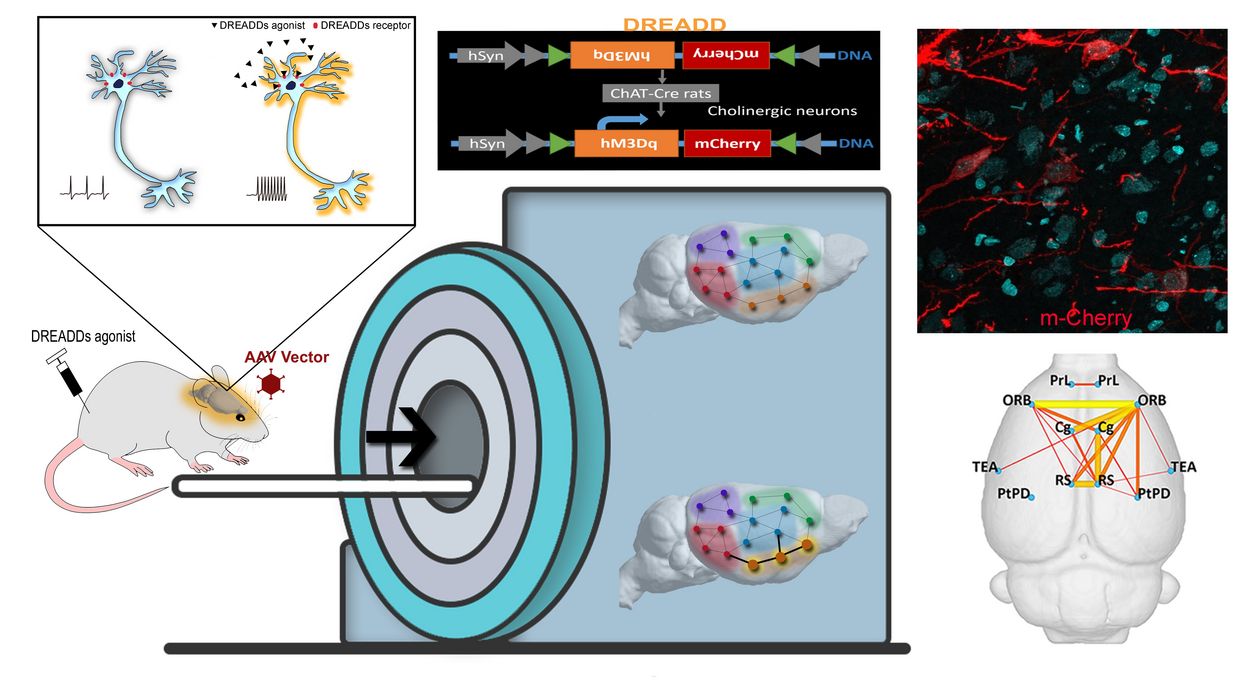
My main scientific interest and area of research is currently focused on studying the effects of neuromodulatory systems on brain networks by using a multi-modal approach involving techniques such as functional magnetic resonance imaging, electrophysiology, optical imaging, and genetic tools in small animal models. Furthermore, my team is exploring the potential for theranostic applications by modulating the activity of neuromodulatory networks in the context of neurodegenerative diseases such as Alzheimer’s disease.
What are your latest publications about?
My latest publications in this research field deal with the employment of a relatively novel neuromodulation tool namely Designer Receptors Exclusively Activated by Designer Drugs (DREADDs) in combination with MRI. More specifically, we recently published an article [https://dx.doi.org/10.1016/j.neuroimage.2020.117088], where we demonstrated that DREADDs can be used to induce temporally reversible lesions in the prefrontal cortex in mice – a hub area related to multiple higher cognitive functions such as attention and perception – and through it identified brain wide changes in functional networks. In another recent paper [https://dx.doi.org/10.1016/j.isci.2020.101455], we exploited the use of DREADDs to stimulate cholinergic neuromodulation in rats that is important in processes such as attention and memory, and demonstrated specific changes in a network that is also found to be compromised in many neurodegenerative diseases including Alzheimer’s disease. In addition, we recently published a review article on the advantages of using neuroimaging in combination with DREADDs as an approach towards developing neurotheranostic applications [https://dx.doi.org/10.1111/bph.14885].
What fueled your interest in this topic?
I have always been fascinated by the brain’s ability to switch “gears” and function in different modes depending on the context and goal at a particular moment. I am yet puzzled on how the brain achieves the quick alternation between brain states and my hypothesis is that neuromodulation circuits play a significant role in this process. To this end, I am interested in neural perturbation techniques that would be able to modulate the activity of neuromodulatory systems. The arrival of optogenetics during the last decade, a technique that can target and manipulate the activity of specific neuronal types, has offered new ways of neurostimulation and impacted the neuroscience field substantially. However, optogenetics uses light as a medium to exert its effects and this comes with the challenge of delivering light in the areas of interest including deep brain structures that need invasive approaches to be accessed. On the contrary, DREADDs offer similar selectivity for neuronal types but can be activated by injections of inert chemical agents systemically or even by oral intake. In my view, this gives DREADDs an advantage for future theranostic applications as they can be applied for example via traditional pharmacological approaches such as a pill. Moreover, the recent development of approaches to express the DREADD receptors themselves non-invasively in specific neurons could potentiate a minimally invasive application of this methodology in the future.
List of publications
Peeters, L.M., Hinz, R., Detrez, J.R., Missault, S., De Vos, W.H., Verhoye, M., Van der Linden, A., and Keliris, G.A., Chemogenetic silencing of neurons in the mouse anterior cingulate area modulates neuronal activity and functional connectivity. Neuroimage, 2020. 220: p. 117088. https://dx.doi.org/10.1016/j.neuroimage.2020.117088
Peeters, L.M., van den Berg, M., Hinz, R., Majumdar, G., Pintelon, I., and Keliris, G.A., Cholinergic Modulation of the Default Mode Like Network in Rats. iScience, 2020. 23(9): p. 101455. https://dx.doi.org/10.1016/j.isci.2020.101455
Peeters, L.M., Missault, S., Keliris, A.J., and Keliris, G.A., Combining designer receptors exclusively activated by designer drugs and neuroimaging in experimental models: A powerful approach towards neurotheranostic applications. Br J Pharmacol, 2020. 177(5): p. 992-1002. https://dx.doi.org/10.1111/bph.14885
Contact details
Prof. Dr. Georgios A. Keliris
UNIVERSITEIT ANTWERPEN
Department of Biomedical Sciences
Campus Drie Eiken – UC.107
Universiteitsplein 1 - 2610 Wilrijk - Belgium
T +32 3 265 27 72
Georgios.Kelirisspam prevention@uantwerpen.be
https://www.uantwerpen.be/en/staff/georgios-keliris/