Uni-Tübingen
Got Skills?

Unser Qualifizierungsprogramm

Hier finden Sie unsere aktuelles Programm. Diese haben wir chronologisch sortiert und in unsere beiden Qualifizierungsprogramme eingeteilt, dem Doctoral Researcher Development Program (DRDP) für Promovierende und dem Researcher Development Program (RDP) für promovierte Wissenschaftlerinnen und Wissenschaftler.

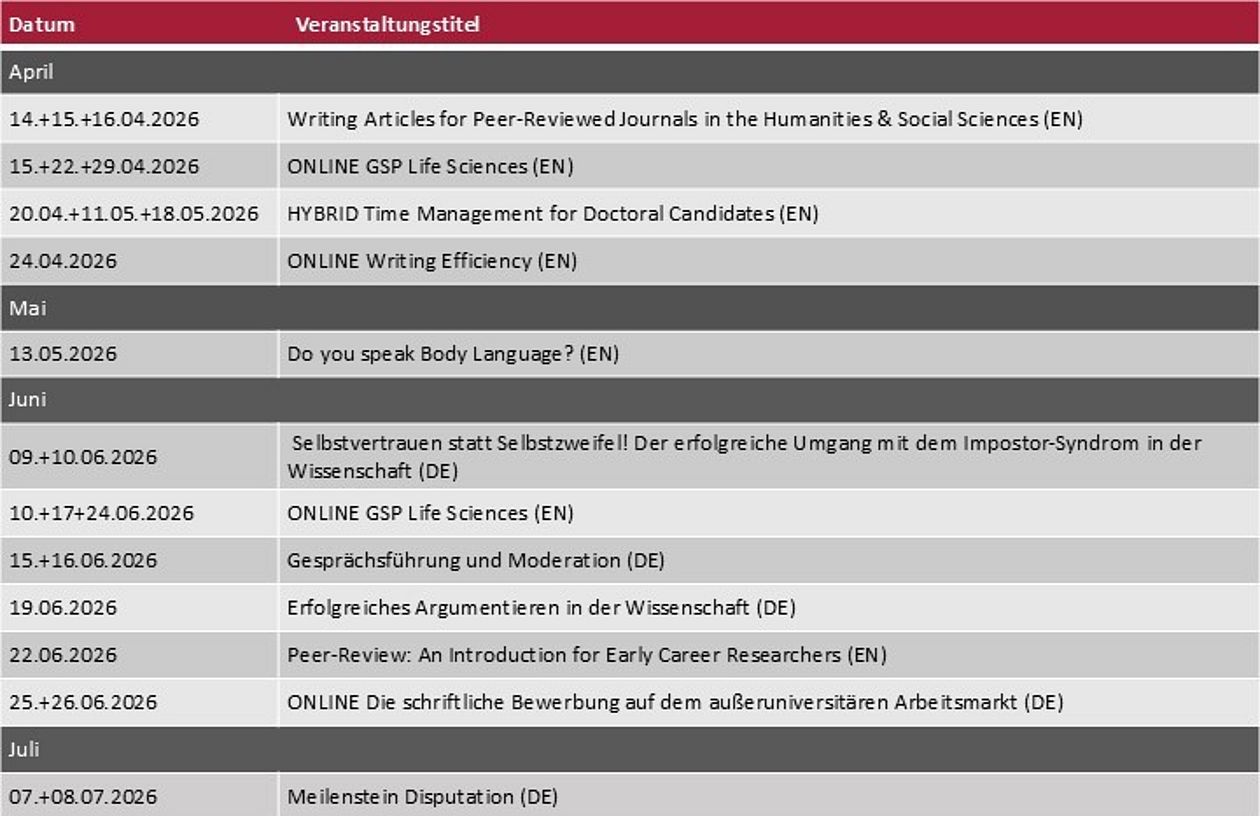
Übersicht aktuelle DRDP-Kurse (April bis Juli 2026)

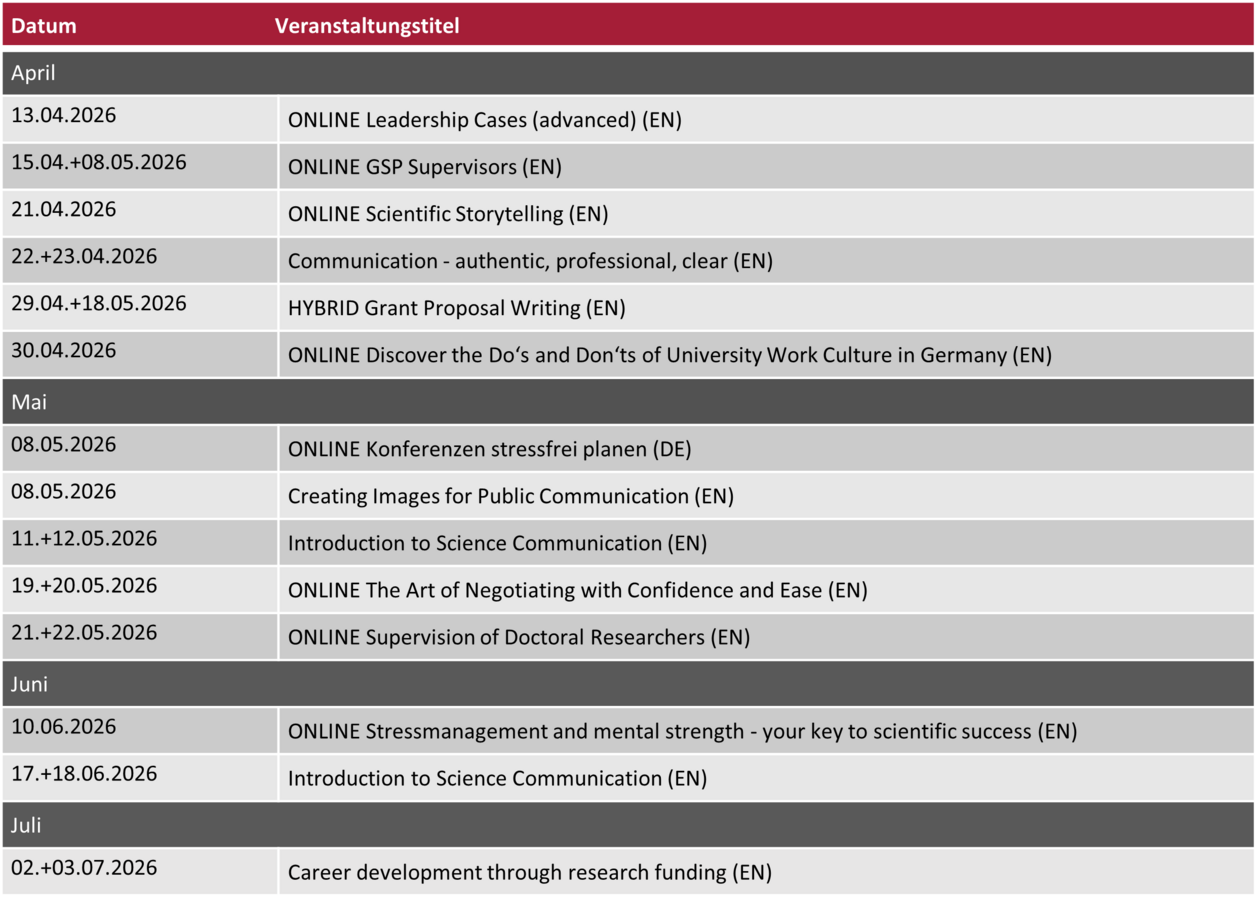
Übersicht aktuelle RDP-Kurse (April bis Juli 2026)

Registrierung für unser Qualifizierungsprogramm

Für die Anmeldung an unseren Veranstaltungen ist es notwendig, dass Sie auf unserer ILIAS-Plattform registriert sind: Graduiertenakademie

Loggen Sie sich bitte auf der Plattform ein. Wenn Sie über eine zentrale Universitäts-Kennung (zx..... oder qz.....) verfügen, können Sie sich mit dieser einloggen. Klicken Sie dazu auf "Login mit Universitäts-Account". 

Sollten Sie diese nicht haben, können Sie sich alternativ auch durch das Klicken auf "Neues Benutzerkonto registrieren" unten links auf der Login-Seite einen neuen Account unter Angabe einer beliebigen E-Mailadresse erstellen.  

Dann treten Sie bitte dem Kurs “Programmübersicht - Programme Overview” bei. 

Sobald Sie zugelassen sind, können Sie in der neuen Ilias Instanz unser Kursangebot einsehen und Kurse buchen.  

Eine detailierte Beschreibung der Anmeldung finden Sie auch hier: Registrierung ILIAS Plattform | Universität Tübingen

Doctoral Researcher Development Program

Wissenschaft & Verantwortung

Research Data Management for PhD Students (EN)

The Research Support Unit of the University of Tübingen offers a self-learning course (with complimentary in-person lectures) on Research Data Management, which is specifically tailored to PhD students. More information on the course and a link to registration can be found here: https://uni-tuebingen.de/de/271149 

In case of questions, please contact rdm@zv.uni-tuebingen.de

(Please note: this course is hosted on the University's central ILIAS plattform (not the Graduate Academy ILIAS plattform). To sign in, please use your University Login ID.)
 

ONLINE Writing Articles for International Publication - Peer-Reviewed Journals in Humanities & Social Sciences (EN)

Register by 04.04.2026; 23:55 CET

14.–16.04.2026, 10:00–17:00, online – Josie Dixon


Target Group

  • Doctoral candidates in the research phase
  • Advanced Doctoral Candidates
  • Postdoctoral Researchers


Objectives

  • Understanding what differentiates journals and making an informed choice about where to publish
  • Understanding journal editors’ criteria for selection, and the ability to apply those to your own draft article
  • Clarity on the target readership and what they will gain from reading the article
  • Understanding how to present a scholarly argument effectively
  • Developing a confident critical engagement with secondary sources
  • Preparation for the peer review and publishing process
  • Understanding authors’ responsibilities on copyright, licensing and open access


Content

  • Why publish, and where to publish?
  • What journal editors look for
  • Addressing your readership
  • Writing tips
  • Presenting a scholarly argument
  • Use of secondary scholarship
  • Case studies and their larger implications
  • Peer Review
  • Open Access
  • Writing an Abstract


Methods and Schedule:
Discussion, reflection, writing exercises, step-by-step structure for drafting an abstract, mutual editing.


Registration

In order to sign up for our workshops, it is necessary that you are registered on our ILIAS platform.

If you have a central login-ID (zx..... or qz.....), you can log in with it. To do so, click on "Login mit Universitäts-Account".

If you do not have a login-ID, you can create a new account by clicking on "Neues Benutzerkonto registrieren" at the bottom left of the login page, by providing any email address.

Workshop Link

ONLINE - Good Scientific Practice in the Life Sciences (EN) 04/26

Register by 07.04.2026; 23:55 Uhr

Start: 15.04.2026; Webinars: 22.04. + 29.04.2026, 15:00-17:00, online - Dipl. Biol. Gisela Bauer-Haffter, Dr. Martina Bross, Dr. Tanja Rieß

Target Group
- Doctoral Candidates starting their project (1st year)
- Doctoral Candidates in the research phase (2nd and 3rd year)
- Doctoral Candidates from Medicine and the Life Sciences

This online course consists of two webinars and material participants have to work on in their own time. The course starts 1 week before the first webinar. During that week, participants work on the first set of online assignments. Please note that all assignments and tasks will have to be completed in that week in order to be able to participate in the webinars. There will be additional online assignments to complete in the week between the two webinars as well.

In this interactive workshop you will learn about:

  • general principles of good scientific practice
  • work on and reflect guidelines for good scientific practice and regulations at our University
  • historic cases of scientific misconduct (to provide some context)
  • scientific misconduct, your personal "no-gos" and values in science,
  • data documentation
  • how authorship should be defined

 
In addition we will discuss:

  • special pitfalls during different stages of your PhD research and where and how you can find support during your PhD time
  • your personal experiences, questions and doubts

Registration

In order to sign up for our workshops, it is necessary that you are registered on our ILIAS platform.

If you have a central login-ID (zx..... or qz.....), you can log in with it. To do so, click on "Login mit Universitäts-Account".

If you do not have a login-ID, you can create a new account by clicking on "Neues Benutzerkonto registrieren" at the bottom left of the login page, by providing any email address.

Workshop Link

ONLINE Writing Efficiency: Tools and Techniques (EN)

Register by 14.04.2026; 23:55 CET

24.04.2026, 8:15–18:00, 8:15–9:45 (group session) + 10:00–18:00 (coaching sessions + self-learning units), online – Dr. Philipp Mayer


Please note: This online course consists of a group meeting at 08:15-09:45 a.m., followed by individual coaching sessions + self learning units. See "Methods and schedule" below for details.


Target Group
Doctoral Candidates of all disciplines in all stages of their doctorate


Objectives:
In this workshop, we focus on the process of preparing research articles and doctoral theses. We do not discuss issues related to text quality but talk about getting started, keeping momentum, and finishing in time.


Content:

  • working techniques and software tools for efficient writing
  • stages in the writing process: collecting information, developing text structures, drafting, revising
  • setting targets and scheduling writing sessions
  • avoiding self sabotage
  • writing in teams


Methods and Schedule:
This online course contains five elements.

  1. A ZOOM meeting on April 24, 2026, between 8:15 am and 9:45 am.
  2. A 1:1 coaching session with the trainer on April 24. The aim of this session is to discuss techniques, tools, tactics, approaches for efficient writing. The 1:1 coaching session will be held via ZOOM and will take 25 minutes. The session will be scheduled between 10:00 am and 6:00 pm.
  3. Self-learning units: Participants will receive a document with detailed instructions.
  4. An email every participant sends to the trainer describing two or three main challenges related to efficient writing. The email helps the trainer to structure the coaching session.
  5. A PDF document including the slides shown in the meeting. Also included: lists of helpful software tools and websites.

Participants are expected to invest a total workload of 6.5 hours.


Registration

In order to sign up for our workshops, it is necessary that you are registered on our ILIAS platform.

If you have a central login-ID (zx..... or qz.....), you can log in with it. To do so, click on "Login mit Universitäts-Account".

If you do not have a login-ID, you can create a new account by clicking on "Neues Benutzerkonto registrieren" at the bottom left of the login page, by providing any email address.

Workshop Link

Selbstvertrauen statt Selbstzweifel! Der erfolgreiche Umgang mit dem Imposter-Syndrom in der Wissenschaft (DE)

Anmeldung bis 29.05.2026; 23:55 Uhr

09.–10.06.2026, 9:00–15:00 Uhr, Raum: Seminarraum 246 (Lothar-Meyer-Bau) – Dr. Angelika Wolf


Zielgruppe

- Promovierende zu Beginn der Promotion
- Promovierende in der Forschungsphase
- Promovierende in der Abschlussphase
- Postdocs / Promovierte WissenschaftlerInnen (i.d.R. 1-2 Jahre nach der Promotion)


Ziele

- Kenntnisse über theoretische Hintergründe und Erklärungsansätze für das Imposter Phänomen, insbesondere in der Wissenschaft
- Die eigene Biografie analysieren und reflektieren
- indivuelle Lösungstrategien entwickeln für einen erfolgreichen Umfang mit negativen Gedanken und für mehr Selbstbewusstsein

Gemeinsam werden wir herausarbeiten, warum das Imposter-Phänomen immer mehr Wissenschaftler*innen betrifft und welche Verbindungen zur psychischen Gesundheit bestehen.
Anschließend wird der Fokus auf der Erarbeitung von Strategien liegen, um effektiv gegen die negativen Gedanken zu arbeiten. In praktischen Einzel- und Gruppenübungen zur Reflexion, Austausch und konstruktivem Feedback soll das Selbstbewusstsein gestärkt werden.


Inhalte

Das Impostor Phänomen beschreibt das Gefühl von stetigen Selbstzweifeln an der eigenen Kompetenz und den eigenen Leistungen. Es beinhaltet das Gefühl, ein*e Hochstapler*in zu sein und Gefahr zu laufen, jeden Moment aufzufliegen. Daher wird es auch als "Hochstapler-Syndrom" bezeichnet. Dieses Konzept wird vor allem für hochleistungsfähige Menschen und häufig für Wissenschaftler*innen beschrieben, die Erfolge nicht auf ihre eigenen Leistungen und Fähigkeiten zurückführen bzw. anerkennen.

Zunächst werden verschiedene wissenschaftliche Erklärungsansätze betrachtet, die die Entstehung begünstigen. In Einzel- und Gruppen-Übungen werden wir auf die eigene Biografie der persönlichen und beruflichen Entwicklung schauen und verdeckte Glaubenssätze identifizieren, sowie zukünftige Lösungsstrategien entwickeln.

Gemeinsam werden wir herausarbeiten, warum das Impostor-Phänomen immer mehr Wissenschaftler*innen betrifft und welche Verbindungen zur psychischen Gesundheit bestehen. Durch Reflexion, Austausch und konstruktivem Feedback soll das Selbstbewusstsein gestärkt werden.


Methoden

- Theoretischer Input in Form von Impulsvorträgen

- Tools zur Identifikation und Reflexion eigener Biografie und (verdeckten) Glaubenssätzen

- Praktische Einzel- und Gruppenübungen zur Erarbeitung von Strategien zur Stärkung des Selbstbewusstseins und des Selbstwertes.


Anmeldung

Für die Anmeldung an unseren Veranstaltungen ist es notwendig, dass Sie auf unserer ILIAS-Plattform registriert sind.

Wenn Sie über eine zentrale Universitäts-Kennung (zx..... oder qz.....) verfügen, können Sie sich mit dieser einloggen. Klicken Sie dazu auf "Login mit Universitäts-Account".

Sollten Sie diese nicht haben, können Sie sich alternativ auch durch das Klicken auf "Neues Benutzerkonto registrieren" unten links auf der Login-Seite einen neuen Account unter Angabe einer beliebigen E-Mailadresse erstellen.

Workshop-Link

ONLINE - Good Scientific Practice in the Life Sciences (EN) 06/26

Register by 03.06.2026; 23:55 Uhr

Start: 10.06.2026; Webinars: 17.06. + 24.06.2026, 15:00-17:00, online - Dipl. Biol. Gisela Bauer-Haffter, Dr. Martina Bross, Dr. Tanja Rieß

Target Group
- Doctoral Candidates starting their project (1st year)
- Doctoral Candidates in the research phase (2nd and 3rd year)
- Doctoral Candidates from Medicine and the Life Sciences

This online course consists of two webinars and material participants have to work on in their own time. The course starts 1 week before the first webinar. During that week, participants work on the first set of online assignments. Please note that all assignments and tasks will have to be completed in that week in order to be able to participate in the webinars. There will be additional online assignments to complete in the week between the two webinars as well.

In this interactive workshop you will learn about:

  • general principles of good scientific practice
  • work on and reflect guidelines for good scientific practice and regulations at our University
  • historic cases of scientific misconduct (to provide some context)
  • scientific misconduct, your personal "no-gos" and values in science,
  • data documentation
  • how authorship should be defined

 
In addition we will discuss:

  • special pitfalls during different stages of your PhD research and where and how you can find support during your PhD time
  • your personal experiences, questions and doubts

Registration

In order to sign up for our workshops, it is necessary that you are registered on our ILIAS platform.

If you have a central login-ID (zx..... or qz.....), you can log in with it. To do so, click on "Login mit Universitäts-Account".

If you do not have a login-ID, you can create a new account by clicking on "Neues Benutzerkonto registrieren" at the bottom left of the login page, by providing any email address.

Workshop Link

Erfolgreiches Argumentieren in der Wissenschaft (DE)

Anmeldung bis 09.06.2026; 23:55 Uhr

19.06.2026, 9:00-17:00 Uhr, Raum: Seminarraum 246 (Lothar-Meyer-Bau) - Simon Wolf


Zielgruppe

  • Promovierende in der Forschungsphase
  • Promovierende in der Abschlussphase
  • Postdocs / Promovierte WissenschaftlerInnen (i.d.R. 1-2 Jahre nach der Promotion)


Ziele

  • Die Teilnehmenden kennen kennen wichtige Argumentationsarten sowie Argumentationsstrukturen und können diese auf ihre eigenen wissenschaftlichen Themen anwenden.
  • Die Teilnehmenden kennen Muster der Gegenargumentation und können mit argumentativen Verteidigungsstrategien adäquat darauf reagieren.
  • Die Teilnehmenden können eigene wissenschaftliche Argumentationsgänge durch argumentative Selbstkritik eigenständig verbessern.
  • Die Teilnehmenden können die Trainingsthemen sowohl mit Vorbereitungszeit als auch in Echtzeit-Kommunikation einsetzen.
  • Zu traininierende Fähigkeit: Argumentationskompetenz


Inhalte

Der wissenschaftliche Austausch setzt in allen Disziplinen vor allem auf ein Medium: Gute Argumente. In Publikationen formulieren Sie schriftliche Argumente, auf Forschungskolloquien, Konferenzen oder im Gespräch mit der Betreuerin/dem Betreuer müssen Sie Ihre Positionen mündlich verteidigen. Während die Methoden jeder einzelnen Disziplin intensiv eingeübt werden, wird die Argumentationskompetenz dagegen selten aktiv trainiert.
 

Im Praxisworkshop „Erfolgreiches Argumentieren in der Wissenschaft“…

  • … lernen Sie verschiedene Argumentationsarten und Argumentationsstrukturen kennen
  • … wenden Sie diese direkt auf Ihre eigenen wissenschaftlichen Themen an
  • … erfahren Sie, mit welcher Art von Gegenargumenten Sie rechnen müssen
  • … formulieren Sie Ihre Positionen durch selbst erhobene Gegenargumente von Anfang an überzeugender
  • … trainieren Sie in vielen kleineren und einer größeren Übung, Ihre Positionen auch „live“ zu vertreten und zu verteidigen
  • … übertragen Sie die Trainingsinhalte auf die eigene Fachkultur

Durch den Praxisworkshop können Sie eigene Positionen schneller und besser formulieren und auf Konferenzen, in Publikationen oder in der Verteidigung überzeugender vertreten.
 

Methoden

Impulsvortrag durch Trainer, Partner- und Gruppenübungen, Einzelreflexion zur Transfersicherung, fachspezifisches Coaching


Anmeldung

Für die Anmeldung an unseren Veranstaltungen ist es notwendig, dass Sie auf unserer ILIAS-Plattform registriert sind.

Wenn Sie über eine zentrale Universitäts-Kennung (zx..... oder qz.....) verfügen, können Sie sich mit dieser einloggen. Klicken Sie dazu auf "Login mit Universitäts-Account".

Sollten Sie diese nicht haben, können Sie sich alternativ auch durch das Klicken auf "Neues Benutzerkonto registrieren" unten links auf der Login-Seite einen neuen Account unter Angabe einer beliebigen E-Mailadresse erstellen.

Workshop-Link

ONLINE Peer Review in the Humanities and Social Sciences - An Introduction (EN)

Register by 12.06.2026; 23:55 CET

22.06.2026, 10:00-17:00, online - Josie Dixon


Target Group

  • Doctoral candidates in the research phase
  • Advanced Doctoral Candidates
  • Postdoctoral Researchers


Objectives

  • To gain an overview of the purposes and processes of peer review, including questions relating to anonymity and disclosure, and systems of open review
  • To understand key differences between peer review in publishing for articles and books, peer review for conferences, and peer review for funding applications
  • To develop critical skills and put them into practice
  • To learn how to structure a peer-review report
  • To understand the ethical responsibilities of peer reviewer
  • To gain a sensitive understanding of tone and phrasing
  • To practice wording criticism constructively
  • To learn about new developments determining the future of peer review in the digital age 


Content

  • What is peer review? Its origins and a brief history
  • Pros and Cons – why is peer review controversial?
  • Variations between subject areas
  • What makes peer review effective?
  • How are reviewers chosen? Anonymity and disclosure
  • Reviewing conference abstracts – developing your critical skills
  • Ethics in peer review
  • Respectful and constructive advice – tone and phrasing in your report
  • Peer review in publishing
  • Process, guidelines and criteria. Structuring your report
  • Your critique of a sample article
  • Peer review for research funding
  • The future of peer review


Methods and schedule:
Presentation, group discussion, practical exercises.


Registration

In order to sign up for our workshops, it is necessary that you are registered on our ILIAS platform.

If you have a central login-ID (zx..... or qz.....), you can log in with it. To do so, click on "Login mit Universitäts-Account".

If you do not have a login-ID, you can create a new account by clicking on "Neues Benutzerkonto registrieren" at the bottom left of the login page, by providing any email address.

Workshop Link

Meilenstein Disputation – Sicher und souverän verteidigen (DE)

Anmeldung bis 27.06.2026; 23:55 Uhr

07.-08.07.2026, 9:00-17:00 Uhr, Raum: Seminarraum 246 (Lothar-Meyer-Bau) - Dr. Christine Kohistani


Zielgruppe

  • Promovierende in der Abschlussphase, die bereits eingereicht haben oder kurz vor der Einreichung ihrer Dissertation stehen


Ziele
In diesem Workshop werden Promovierende auf ihren großen Meilenstein Disputation vorbereitet. Sie gewinnen den Überblick über den formalen Ablauf der Verteidigung, wie sich die Prüfungskommission zusammensetzt und was noch alles bis zur Disputation zu organisieren ist. Sie erhalten den Einblick in fachspezifische Besonderheiten der Disputation. Sie lernen typische Prüfungsfragen kennen und üben den Umgang mit Antworten, Argumenten, Einwänden, Nervosität und Lampenfieber. Außerdem erhalten die TeilnehmerInnen die Möglichkeit, sich mit praktischen Übungen aktiv auf die Disputation vorzubereiten. Mit Coaching-Techniken gewinnen die DoktorandInnen Sicherheit bei Vortrag und Disputation und trainieren individuelle Bewältigungsstrategien.


Inhalte

  • Der formale Ablauf – den Überblick gewinnen
  • Umgang mit (schwierigen) Prüfungsfragen, Argumenten und Einwänden
  • Dos und Don’ts in der Verteidigung
  • Individuelle Bewältigungsstrategien für Nervosität, Aufregung und Lampenfieber entwickeln
  • Letzte Schritte planen


Methoden

  • Theorieinput
  • Gruppenarbeit
  • Coaching


Anmeldung

Für die Anmeldung an unseren Veranstaltungen ist es notwendig, dass Sie auf unserer ILIAS-Plattform registriert sind.

Wenn Sie über eine zentrale Universitäts-Kennung (zx..... oder qz.....) verfügen, können Sie sich mit dieser einloggen. Klicken Sie dazu auf "Login mit Universitäts-Account".

Sollten Sie diese nicht haben, können Sie sich alternativ auch durch das Klicken auf "Neues Benutzerkonto registrieren" unten links auf der Login-Seite einen neuen Account unter Angabe einer beliebigen E-Mailadresse erstellen.

Workshop-Link

Kommunikation & Management

HYBRID Time Management for Doctoral Candidates (EN)

Register by 10.04.2026; 23:55 CET

Start Video Access: 20.04.2026; Live sessions: 11.+18.05.2026, 13:00–17:30, online – Dr. Matthias Mayer


Please note: This is a hybrid seminar format, which requires that you watch 3–4 hours of video in the three weeks before our first live online meeting! Watching all videos fully before the online meetings is mandatory.


Target Group

  • Doctoral candidates of all disciplines


Objectives

One of the most important skills scientists need next to subject related expertise is the ability to realistically plan and organize their research in the long term - and to effectively structure every single workday. This seminar gives you space to reconsider your existing behavior and to learn about well-proven powerful techniques.


Goals:

  • Know how to use powerful time planning methods
  • Know how to balance professional and private life
  • Know how to control your inner state using concentration and relaxation techniques
  • Exchange of experiences with other participants


Content

  • Time planning on three horizons: long term (master plan), weekly, daily
  • Setting priorities (Eisenhower Method, Pareto Principle)
  • Finding your balance: research project – job – private life
  • Getting rid of your most severe time-killers
  • Making decisions and developing initiative
  • How can you stay motivated? How to deal with lows?
  • How to gain highest concentration
  • Controlling your inner state, e.g. using relaxation techniques
  • Reflecting current habits & setting clear goals for improvement


Methods
This is a hybrid seminar: It requires you watching 3-4 hours of videos in the two weeks before the first live online meeting, and also between both meetings. Watching all videos and working on specific tasks before and between the meetings is required. Methods involve trainer input (partly on video), individual, partner, and group work; relaxation exercises; brief presentations by participants; group reflection. Highly interactive live-online-meetings, including small group work and break-out-sessions.


Registration

In order to sign up for our workshops, it is necessary that you are registered on our ILIAS platform.

If you have a central login-ID (zx..... or qz.....), you can log in with it. To do so, click on "Login mit Universitäts-Account".

If you do not have a login-ID, you can create a new account by clicking on "Neues Benutzerkonto registrieren" at the bottom left of the login page, by providing any email address.

Workshop Link

Do You Speak Body Language? - Unlock the Power of Nonverbal Communication (EN)

Register by 03.05.2026; 23:55 CET

13.05.2026, 9:00–17:00, Venue: Seminar room 246, Lothar-Meyer-Bau – Erika Magyarosi


Target Group:
- Doctoral Candidates and Postdoctoral Researchers of all disciplines


Objectives

  1. ​​​​​​​Understand the importance of nonverbal communication and how it impacts their interactions with others.
  2. Identify and interpret different types of body language cues, such as facial expressions, gestures, and posture.
  3. Develop greater self-awareness of their own body language and learn how to use it to convey confidence, trustworthiness, and approachability.
  4. Learn techniques to improve their nonverbal communication skills, such as active listening, mirroring, and matching body language to the message they want to convey.
  5. Practice applying these skills in different exercises to enhance their overall communication effectiveness.


Content

This interactive workshop will help you to unlock the potential of nonverbal communication and enhance your interactions with others, both in your personal and professional life.

During this workshop, you will learn about the importance of nonverbal communication and how it impacts your ability to effectively communicate your research, build relationships with colleagues, and deliver compelling presentations. You will also develop greater self-awareness of your own body language and learn techniques to improve your nonverbal communication skills.

I will guide you through a variety of practical exercises and activities to help you identify and interpret different types of nonverbal cues, such as facial expressions, gestures, and posture. You will learn how to use your nonverbals to convey confidence, trustworthiness, and approachability, and how to match your body language to the message you want to convey. By the end of this workshop you will see more in your daily interactions and have more confidence in engaging and connecting with others.


Methods
Trainer input, role games, and video analysis.


Registration

In order to sign up for our workshops, it is necessary that you are registered on our ILIAS platform.

If you have a central login-ID (zx..... or qz.....), you can log in with it. To do so, click on "Login mit Universitäts-Account".

If you do not have a login-ID, you can create a new account by clicking on "Neues Benutzerkonto registrieren" at the bottom left of the login page, by providing any email address.

Workshop Link

Gesprächsführung und Moderation (DE)

Anmeldung bis 05.06.2026; 23:55 Uhr

15.-16.06.2026, 9:00-17:00 Uhr, Seminarraum 246, Lothar-Meyer-Bau - Simon Wolf


Zielgruppe
- Promovierende in allen Phasen der Promotion


Ziele
Nach der Veranstaltung…

  • … kennen Sie wichtige Grundtechniken der Moderation,
  • … können Sie die Moderationstechniken auf ihre eigenen Gesprächssituationen übertragen und dort erfolgreich anwenden,
  • … sind Sie insbesondere mit Grundtechniken der Interaktionsregulierung (Aktivierung / Steuerung) vertraut und können diese anwenden,
  • … kennen Sie Techniken für die überzeugende Vertretung eigener Positionen und können diese aktiv anwenden.


Inhalte
Die Promotion bringt neben der fachlichen Herausforderung auch eine Reihe neuer Kommunikationssituationen mit sich: Von der Diskussionsleitung in Veranstaltungen über Dienstbesprechungen bis hin zu der Steuerung von Projektteams. Im Intensivworkshop “Gesprächsführung und Moderation” lernen Sie, wie Sie sich gut auf Ihre Gesprächssituationen einstellen, welche Steuerungsinstrumente Sie wann einsetzen können, und wie Sie durch gute Gesprächsführung gemeinsam das bestmögliche Ergebnis erreichen. Unsere Schwerpunkte sind:

  • Starten – Steuern – Landen: Die Phasen eines ergiebigen Gesprächs
  • „Stille BeobachterInnen“ involvieren
  • „AlleinunterhalterInnen“ freundlich lenken
  • Toolbox Moderationstechniken
  • Eigene Positionen überzeugend vertreten
  • Individuelles Coaching
  • Video-Feedback (optional)
  • Ihre speziellen Themen & Fragen

 
Damit wir gleich einsteigen können, überlegen Sie sich bitte vor dem Seminar: In welchen Situationen ist eine gute Gesprächsführung / Moderation für Sie im Rahmen Ihrer Promotion besonders wichtig?
 

Methoden
Kurzinput durch Trainer, Partner- und Gruppenübungen, Einzelreflexion zur Transfersicherung, Coaching & Peer Coaching, optionales Videotraining.


Anmeldung

Für die Anmeldung an unseren Veranstaltungen ist es notwendig, dass Sie auf unserer ILIAS-Plattform registriert sind.

Wenn Sie über eine zentrale Universitäts-Kennung (zx..... oder qz.....) verfügen, können Sie sich mit dieser einloggen. Klicken Sie dazu auf "Login mit Universitäts-Account".

Sollten Sie diese nicht haben, können Sie sich alternativ auch durch das Klicken auf "Neues Benutzerkonto registrieren" unten links auf der Login-Seite einen neuen Account unter Angabe einer beliebigen E-Mailadresse erstellen.

Zur Veranstaltung

Karriereentwicklung

ONLINE Die schriftliche Bewerbung für den außeruniversitären Arbeitsmarkt (DE)

Anmeldung bis 15.06.2026; 23:55 Uhr

25.-26.06.2026, 9:00-13:00 Uhr, online - Evelyn Hochheim


Zielgruppe
- Promovierende in der Abschlussphase
- Postdocs / Promovierte WissenschaftlerInnen (i.d.R. 1-2 Jahre nach der Promotion)


Ziele

  • Die Teilnehmenden sind in der Lage Anschreiben und Lebenslauf zu erstellen bzw. bereits existierende Unterlagen weiterzuentwickeln.
  • Sie wissen, über welche Kompetenzen, Erfahrungen und Stärken sie verfügen und können diese angemessen und authentisch formulieren. Dabei berücksichtigen sie sowohl Fach- als auch Methoden-, Sozial- und persönliche Kompetenzen.
  • Die Teilnehmenden beziehen bei der Erstellung und Überarbeitung ihrer Bewerbungsunterlagen die Perspektive potenzieller ArbeitgeberInnen ein.
  • Sie kennen die formalen und inhaltlichen Anforderungen, die bei der Erstellung von Bewerbungsunterlagen zu berücksichtigen sind.


Inhalte

  • Zahlen und Fakten zum Berufseinstieg Promovierter
  • Übungen zur Identifikation von Erfahrungen und Fähigkeiten
  • Kommunikation des eigenen Profils im Bewerbungsprozess
  • Bestandteile und Übermittlungswege der schriftlichen Bewerbung
  • Anschreiben
  • Lebenslauf

Eine überzeugende schriftliche Bewerbung erhöht Ihre Chancen auf ein Vorstellungsgespräch und kann damit Ihre Eintrittskarte in den Arbeitsmarkt sein. In diesem Workshop erfahren Sie, wie Sie Ihre Bewerbungsunterlagen optimal zusammenstellen. Anhand guter und weniger gelungener Beispiele arbeiten wir heraus, worauf es bei Aufbau und Formulierung von Anschreiben und Lebenslauf ankommt.
Um sich potenziellen ArbeitgeberInnen gut präsentieren zu können, müssen Sie zunächst selbst Ihre Potenziale kennen. Ein zusätzlicher Übungsteil gibt Ihnen deshalb Impulse zur Analyse Ihrer Kompetenzen und Fähigkeiten. Anschließend lernen Sie Strategien kennen, Ihre Stärken im Bewerbungsverfahren zu kommunizieren.
 

Methoden
Impulsvortrag, Einzelarbeit, Arbeit in Kleingruppen, Gruppengespräch


Anmeldung

Für die Anmeldung an unseren Veranstaltungen ist es notwendig, dass Sie auf unserer ILIAS-Plattform registriert sind.

Wenn Sie über eine zentrale Universitäts-Kennung (zx..... oder qz.....) verfügen, können Sie sich mit dieser einloggen. Klicken Sie dazu auf "Login mit Universitäts-Account".

Sollten Sie diese nicht haben, können Sie sich alternativ auch durch das Klicken auf "Neues Benutzerkonto registrieren" unten links auf der Login-Seite einen neuen Account unter Angabe einer beliebigen E-Mailadresse erstellen.

Zur Veranstaltung


Researcher Development Program

Lehre

Hochschuldidaktische Angebote der Arbeitsstelle Hochschuldidaktik

Zielgruppe

  • Promovierende und promovierte WissenschaftlerInnen, die aktuell in der Lehre tätig sind
  • Promovierende und promovierte WissenschaftlerInnen, die in den nächsten 6 Monaten Aufgaben in der Lehre übernehmen werden

Bitte beachten

  • Melden Sie sich direkt über die Seiten der Arbeitsstelle Hochschuldidaktik an.
  • Es gelten die aktuell gültigen Anmelde und Teilnahmebedingungen der Arbeitsstelle Hochschuldidaktik.

Arbeitsstelle Hochschuldidaktik
Bitte informieren Sie sich auf den Webseiten der Arbeitsstelle Hochschuldidaktik der Universität über aktuelle Veranstaltungen.

Sollten Sie einmal ein Thema vermissen, können Sie uns gerne kontaktieren - wir kooperieren mit der Arbeitsstelle Hochschuldidaktik und geben Ihre Vorschläge gerne weiter.

ONLINE - Good Scientific Practice for Supervisors (EN)

Register by 08.04.2026; 23:55 CET

Start: 15.04.2026 

Webinar : 08.05.2025 09:00-11:00, online - Dr. Martina Bross

Target Group
- researchers supervising early career researchers

Please note: This course IS recognized by the Faculty of Science as a course on supervision. Researchers of the Medical Faculty should register for the specific courses of the Medical Faculty via their website. If you are unsure which course to take please make sure to contact us: info@graduiertenakademie.uni-tuebingen.de

This course consists of an asynchronous online phase via ILIAS. You should expect to work on material independently for approx. 3 hours spread over 10 days. The asynchronous phase starts on the date specified above. On this first day of the course, you will receive an email with instructions. Completing work on all of the material is required for participation in the webinar. The course finishes with a 2-hour long webinar via Zoom. The date of the webinar is specified above. The link will be sent to everyone who has completed the material the day before the webinar takes place.

Course description

For researchers, following the rules of good scientific practice is a central tenet of their work and their work ethics. Knowing and following the rules set out in the University of Tübingen’s Guidelines for Safeguarding Good Scientific Practice and the DFG Code of Conduct on Research Integrity not only ensures that researchers can fulfill their obligation to the public to use resources efficiently and contribute to important developments in science and society in a reliable and integer manner. It also ensures that the working culture within the academic setting is based on mutual respect and responsibility. Especially for researchers in an early phase of their career, their supervisors and team leaders are important role models. As the DFG Code of Conduct states, researchers should be instructed and receive training on the rules of Good Scientific Practice as early in their career as possible.

In this online workshop, we will have a twofold perspective: We will refresh our knowledge of the rules as set out in the documents mentioned above, but we will also reflect on how they come into the process of doctoral supervision.

Content

  • general principles of good scientific practice
  • data/research documentation and management
  • plargiarism prevention
  • regulations for authorship
  • guidelines for supervision
  • ombudspersons and the procedure in cases of reported misconduct

Registration

In order to sign up for our workshops, it is necessary that you are registered on our ILIAS platform.

If you have a central login-ID (zx..... or qz.....), you can log in with it. To do so, click on "Login mit Universitäts-Account".

If you do not have a login-ID, you can create a new account by clicking on "Neues Benutzerkonto registrieren" at the bottom left of the login page, by providing any email address.

Workshop Link

Führung

ONLINE Leadership Cases (EN)

Register by 05.04.2026; 23:55 CET

13.04.2026, 09:00-17:00 Online - Wolfgang Leybold

Target Group

  • Postdoctoral Researchers

Content

Being a young researcher brings along many challenging situations that you face in your role as a young leader. Communicating into all different directions, towards your supervisor, your colleagues, your students and many more people requires quite some flexibility and might sometimes also bring a challenge. 

In this format, we want to invite you to share your experiences, talk about individual cases, reflect your role and find areas of improvement together. 

Methods

  • The workshop is designed to be an interactive platform for input, individual experiences and discussions to acquire new insights into an inspiring approach to leadership. It will also help to train relevant insights for the pursuit of careers outside the academic world.

Workshop topics

  • Discussion of leadership experiences: which are challenging situations and why? 

  • Different aspects of your role as a leader: how do you see yourself and how are you conveying your vision to others? 

  • Clustering of leadership challenges and analysis of roles, needs and communication aspects 

  • Looking at your individual examples, best practices and questions 

  • Finding out how you can best use your leadership toolbox and be effective in these situations 

Registration

In order to sign up for our workshops, it is necessary that you are registered on our ILIAS platform.

If you have a central login-ID (zx..... or qz.....), you can log in with it. To do so, click on "Login mit Universitäts-Account".

If you do not have a login-ID, you can create a new account by clicking on "Neues Benutzerkonto registrieren" at the bottom left of the login page, by providing any email address.

Workshop Link

ONLINE The Art of Negotiating with Confidence and Ease (EN)

Register by 11.05.2026; 23:55 CET

19.05.2026, 09:00-16:00 + 20.05.2026, 09:00-13:00, online - Dr. Michael Gordian

Target Group
- Doctoral Candidates 
- Postdoctoral Researchers

Objectives
- Learning and trying out practical negotiation techniques 
- Managing discussions and shaping conflicts sustainably 
- Understanding and applying the psychological principles of negotiations

Content
- The “empathy formula” as a simple and effective method of communicating understanding 
- The use of specific adjectives and clarity of expression 
- The Harvard concept: from point of view to interest and other key ideas

 Methods
Individual and group exercises, relaxation modules, structured discussion rounds, compact input sessions and supervisory feedback from the trainer


Registration

In order to sign up for our workshops, it is necessary that you are registered on our ILIAS platform.

If you have a central login-ID (zx..... or qz.....), you can log in with it. To do so, click on "Login mit Universitäts-Account".

If you do not have a login-ID, you can create a new account by clicking on "Neues Benutzerkonto registrieren" at the bottom left of the login page, by providing any email address.

Workshop Link

ONLINE Supervision of Doctoral Researchers (EN)

Register by 13.05.2026; 23:55 CET

21.+22.05.2026, 9:00-12:00 Uhr, online - Dr. Annika Bartsch

Target Group
- Postdoctoral Researchers, who have leadership responsibilities or who will take on leadership responsibiities within the next 6 months

Objectives

Participants know and are able to:

- Develop their supervision concept
- Define their expectations of the supervision process, competencies of doctoral researchers, and how collaboration should be done
- Develop a fruitful and positive way of communication by using different means and situations
- Create a good structured approach to do onboarding and to support learning processes of PhD-students

Content

Part 1 How to structure supervision - developing and reflecting on one's own supervision concept

- What is good supervision of doctoral researchers?
-The doctorate as a learning process - making the learning process visible and structuring it
- How do I want to supervise? Clarify your own expectations and include them in the process.
- Closeness and distance, support and personal responsibility: reflecting on the advantages and disadvantages of different supervision concepts.
- How to recruit and select doctoral candidates on the basis of one's own expectations.

Part 2 Supervision practice - from the supervision agreement to feedback and conflict resolution

- Starting point: joint clarification of expectations
- The supervision agreement as a way of clarifying expectations
- Onboarding and development of collaboration
- Giving feedback and doing fruitful meetings
- Dealing well with conflicts and motivation problems
- How to support doctoral researchers to finish their dissertation?

Methods
short talks, exchange of experiences, joint development of solutions, shor role plays

Registration

In order to sign up for our workshops, it is necessary that you are registered on our ILIAS platform.

If you have a central login-ID (zx..... or qz.....), you can log in with it. To do so, click on "Login mit Universitäts-Account".

If you do not have a login-ID, you can create a new account by clicking on "Neues Benutzerkonto registrieren" at the bottom left of the login page, by providing any email address.

Workshop Link

Karriereentwicklung

Scientific Storytelling (EN)

Register by 03.04.2026; 23:55 CET

21.04.2026, 09:30-17:00, Venue: Wilhelmstraße 56, Room 246 - Dr. Georg Hafner

Target Group
Postdoctoral Researchers

Objectives
This workshop teaches how to communicate scientific concepts using the structural framework of stories.

Content
Communication of scientific results is an integral part of research. Storytelling is a powerful technique to convey messages effectively. This workshop brings the best of storytelling to science. You will learn to structure your research findings as a logically consistent narrative so that an audience can understand them easily. You will gain a new perspective on your research project that translates into effective communication and focused scientific thinking.

Methods

Through a blend of interactive exercises, individual tasks, discussions, and instructive presentations participants will:  
• Learn the components of storytelling and their scientific equivalents
• Identify the central message of their research story
• Construct a compelling narrative around their scientific project

Registration

In order to sign up for our workshops, it is necessary that you are registered on our ILIAS platform.

If you have a central login-ID (zx..... or qz.....), you can log in with it. To do so, click on "Login mit Universitäts-Account".

If you do not have a login-ID, you can create a new account by clicking on "Neues Benutzerkonto registrieren" at the bottom left of the login page, by providing any email address.

Workshop Link

Communication: authentic - professional - clear (EN)

Register by 04.04.2026 23:55 CET

22.+23.04.2026, 08:30-16:30, Venue: Seminar room 246, Lothar-Meyer-Bau - Dr. Angelina Topan

Target Group
Postdoctoral Researchers 

Objectives
Clear and professional communication is essential in everyday business life. Especially when things get heated, when you have to react to unforeseen events, or when you want to express your own emotions appropriately, it is helpful to have a solid toolkit.
In this training:

  • Participants deal theoretically and practically with conversation management and their own communication behavior
  • participants learn how to systematically prepare and manage conversations
  • participants practice concrete conversation situations from their everyday work and receive tips on how they can improve their conversation skills

Content

  • Basics of communication (characterisitics of communication, Your own communication style, setting conversation goals, techniques and strategies for conversations
  • Critical conversation situations (giving and taking feedback, constructively conducting critical discussions, mastering negotiation meetings with confidence, getting into contact at conferences)

Methods
A varied mix of methods including keynote speeches, role plays, exercises, individual and group work support the participants in gaining more competence, clarity and sovereignty in communication situations. We work with the cases of the participants.

Registration

In order to sign up for our workshops, it is necessary that you are registered on our ILIAS platform.

If you have a central login-ID (zx..... or qz.....), you can log in with it. To do so, click on "Login mit Universitäts-Account".

If you do not have a login-ID, you can create a new account by clicking on "Neues Benutzerkonto registrieren" at the bottom left of the login page, by providing any email address.

Workshop Link

HYBRID Grant Proposal Writing (EN)

Register by 21.04.2026; 23:55 CET

29.04.2026, 09:00-13:00 online + 06.05.2026, 09:00-16:00 in person +  18.05.2026. 09:00-13:00 online - Christine Schmidt
Venue: Seminar room 246, Lothar-Meyer-Bau

Target Group

Postdoctoral Researchers

Objectives

This workshop focuses on
a) how to delevop your idea for a project into a sound work programme
b) how to match it to the requirements of the funding programme
c) how to facilitate the communication with the reviewer by presenting your complex ideas in an easy-to-understand way

Content

  • Funding programmes and how to read the documents
  • Develop your idea into a work plan
  • Communicate your project convincingly
  • Impact and Budget

Some more content information may be added.

Methods

This is an online workshop including presentations, group work and individual work. Some "homework" will be provided for those, who want to use the time between the sessions to work on their grant proposal. There will be the opportunity to obtain some feedback - either in the group or individually - on the homework.

Registration

In order to sign up for our workshops, it is necessary that you are registered on our ILIAS platform.

If you have a central login-ID (zx..... or qz.....), you can log in with it. To do so, click on "Login mit Universitäts-Account".

If you do not have a login-ID, you can create a new account by clicking on "Neues Benutzerkonto registrieren" at the bottom left of the login page, by providing any email address.

Workshop Link

ONLINE Konferenzen stressfrei PLANEN (DE)

Anmelden bis 30.04.2026; 23:55 CET

08.05.2026, 08:30-13:00, Venue: Online - Moritz Colmant

Zielgruppe
- Postdocs / Promovierte WissenschaftlerInnen 

Ziele
Bringen Sie Ihre Fähigkeiten in der Konferenzorganisation auf ein neues Level! Dieses Training ist besonders geeignet für diejenigen, die nie gedacht hätten, dass das Organisieren von Konferenzen ein so zeitintensiver Teil ihres Berufslebens werden würde. Gemeinsam sorgen wir dafür, dass Ihre Veranstaltungen effizient zu einem Erfolg werden! Um erfolgreich Konferenzen durchzuführen, ist ein besonderes methodisches Know-how nötig. Viele Personen im Hochschulkontext haben ihre Kernkompetenzen in anderen Bereichen. Die Kom-plexität von Veranstaltungen wird daher häufig unterschätzt, Der Aufwand rund um den Veranstal-tungstag höher als erwartet. In diesem Training erhalten Sie das notwendige methodische Know-how für eine erfolgreiche Ver-anstaltungsplanung Hochschulkontext. Sie erfahren, welche Projektphasen in welcher Reihenfolge durchlaufen werden, wie Sie Ziele und Aufgaben SMART im Team definieren und eine klare Rollen-verteilung umsetzen. Durch den Austausch mit anderen Teilnehmenden und die Arbeit mit prakti-schen Arbeitshilfen und Checklisten werden Sie zukünftig in der Lage sein, Veranstaltungen stressfrei zu planen.

Inhalte

  • Souverän planen und koordinieren: Sie gewinnen Sicherheit in der Veranstaltungsplanung und steigern Ihre Fähigkeiten, Events erfolgreich zu organisieren
  • Effiziente Kommunikation und Steuerung: Sie trainieren Ihre Koordinations- und Kommunikationskompetenzen, um alle Beteiligten zielgerichtet einzubinden.
  • Fokus auf die richtigen Ziele: Sie lernen, klare Ziele mit der SMART-Meilensteinen zu definieren und diese konsequent zu verfolgen.
  • Netzwerk erweitern: Sie knüpfen wertvolle Kontakte und profitieren vom Erfahrungsaustausch mit anderen Veranstaltungsplanenden.
  • Hilfreiche Tools und Checklisten: Sie nutzen praktische Arbeitshilfen, die Ihre Planung und Durchführung effizienter und einfacher machen.
  • Strukturiertes Projektmanagement: Sie erfahren, wie Sie Projekte mit einem klaren Kick-Off starten und diese strukturiert umsetzen - auch ohne formale Weisungsbefugnis

Methoden
Vorträge, Präsentationen, Best Practice Beispiele: Checklisten, Vorlagen, etc.

Anmeldung

Für die Anmeldung an unseren Veranstaltungen ist es notwendig, dass Sie auf unserer ILIAS-Plattform registriert sind.

Wenn Sie über eine zentrale Universitäts-Kennung (zx..... oder qz.....) verfügen, können Sie sich mit dieser einloggen. Klicken Sie dazu auf "Login mit Universitäts-Account".

Sollten Sie diese nicht haben, können Sie sich alternativ auch durch das Klicken auf "Neues Benutzerkonto registrieren" unten links auf der Login-Seite einen neuen Account unter Angabe einer beliebigen E-Mailadresse erstellen.

Zur Veranstaltung

Creating Images for Public Communication photography-based hands-on workshop (EN)

Register by 30.04.2026; 23:55 CET

08.05.2026, 09:00-17:00, Venue: Seminar Room 0.27, Brechtbau, Wilhelmstraße 50 - Viktorija Völker

***Please note: This Seminar is only for participants certificate program Science Communication***

Target Group
Postdocs in the certificate program Science Communication

Objectives
Create a folder full of images that can be used for personal science communication needs. Plus, acquire skills and basic knowledge to make such images independently in the future.


Content
Development of a rhetorical visual strategy, creation of images from scratch with minimal effort, basics of photography and composition, an overview of software choices. And, most importantly, a hands-on opportunity to make a variety of photographs in our pop-up photo studio.
 
Methods
Training, coaching, discussions, tutorial, experimental photography

Registration

In order to sign up for our workshops, it is necessary that you are registered on our ILIAS platform.

If you have a central login-ID (zx..... or qz.....), you can log in with it. To do so, click on "Login mit Universitäts-Account".

If you do not have a login-ID, you can create a new account by clicking on "Neues Benutzerkonto registrieren" at the bottom left of the login page, by providing any email address.

Workshop Link

Introduction to Science Communication (EN)

Register by 03.05.2026; 23:55 CET

11.+12.05.2026, 09:00-13:00, Venue: Seminar Room 246, Lothar-Meyer-Bau, Viktorija Völker

***Please note: This Seminar is only for participants certificate program Science Communication***

Target Group
Postdocs in the certificate program Science Communication

Objectives
- Introduce researchers to core aspects and basic strategies of science communication
- Foster the active development of communication skills.
- Provide a common foundation for the specialized practical courses of the certificate program "Science Communication and Media Competence"


Content
- Introduction to the opportunities and challenges of science communication
- Overview of formats and media of science communication
- Formulating addressee-oriented core messages
- Self-reflection: Find your own topic and approach to science communication
- Hands-on Science Communication: Getting started
 
Methods
- (interactive) inputs
- group discussions / peer feedback
- short presentations
- breakout sessions
- individual assignments

Registration

In order to sign up for our workshops, it is necessary that you are registered on our ILIAS platform.

If you have a central login-ID (zx..... or qz.....), you can log in with it. To do so, click on "Login mit Universitäts-Account".

If you do not have a login-ID, you can create a new account by clicking on "Neues Benutzerkonto registrieren" at the bottom left of the login page, by providing any email address.

Workshop Link

ONLINE Stress Management and Mental Strength - Your Key to Scientific Success (EN)

Register by 02.06.2026; 23:55 CET

10.06.2026, 9:00 - 17:00, online - Dr. Julia Schmidt

Target Group
- Postdoctoral Researchers
 

Objectives
The goal of the workshop is to help participants manage stress and challenges, build mental strength, and improve emotional balance. Participants will learn to identify stressors, overcome limiting beliefs, and apply practical techniques for emotional regulation. The workshop also supports personal growth and fosters a mindset for achieving career goals while enhancing everyday well-being. 

Content

  • Stress management and self-regulation
    • Identification of personal sources of stress and their effects
    • Techniques for immediate stress reduction and promotion of self-regulation
  • Analysing and improving inner beliefs and self-image
    • Analysing and reflecting on personal beliefs and their influence on stress management
    • Recognising and overcoming self-sabotage patterns
    • Strengthening positive beliefs and self-image
  • Strengthening emotional and mental resources
    • Developing emotional intelligence and practical applications to promote a growth mindset
    • Strengthening mental resilience through visualisation exercises
  • Reflecting on personal motivation and successes
    • Analysing personal motives and values
    • Reflection on individual strengths, successes and personal growth
    • Development of concrete implementation strategies for everyday life


Methods

  • (Impulse) Lecture
  • Discussion
  • Group Work
  • Self-reflection
  • Written Preliminary questionnaire and reflection sheet after the workshop

Registration

In order to sign up for our workshops, it is necessary that you are registered on our ILIAS platform.

If you have a central login-ID (zx..... or qz.....), you can log in with it. To do so, click on "Login mit Universitäts-Account".

If you do not have a login-ID, you can create a new account by clicking on "Neues Benutzerkonto registrieren" at the bottom left of the login page, by providing any email address.

Workshop Link

Introduction to Science Communication (EN)

Register by 09.06.2026; 23:55 CET

17.+18.06.2026, 09:00-13:00, Venue: Seminar Room 246, Lothar-Meyer-Bau, Viktorija Völker

***Please note: This Seminar is only for participants certificate program Science Communication***

Target Group
Postdocs in the certificate program Science Communication

Objectives
- Introduce researchers to core aspects and basic strategies of science communication
- Foster the active development of communication skills.
- Provide a common foundation for the specialized practical courses of the certificate program "Science Communication and Media Competence"


Content
- Introduction to the opportunities and challenges of science communication
- Overview of formats and media of science communication
- Formulating addressee-oriented core messages
- Self-reflection: Find your own topic and approach to science communication
- Hands-on Science Communication: Getting started
 
Methods
- (interactive) inputs
- group discussions / peer feedback
- short presentations
- breakout sessions
- individual assignments

Registration

In order to sign up for our workshops, it is necessary that you are registered on our ILIAS platform.

If you have a central login-ID (zx..... or qz.....), you can log in with it. To do so, click on "Login mit Universitäts-Account".

If you do not have a login-ID, you can create a new account by clicking on "Neues Benutzerkonto registrieren" at the bottom left of the login page, by providing any email address.

Workshop Link

Career Development through Research Funding (EN)

Register by 24.06.2026; 23:55 CET

02.+03.07.2026, 09:00-17:00, Venue: Seminar room 246, Lothar-Meyer Bau - Dr. B. Elija Bleher

Please note: The course consists of a joint workshop on 26 June and individual coaching slots on 27 June. 

Target Group

  • Advanced Doctoral Candidates
  • Postdoctoral Researchers

Objectives
In the German and European science system, third-party funding is becoming increasingly important both for scientific institutions and their continued existence as well as for individual career development. Often, however, such third-party funding is acquired without systematic strategic planning and without taking into account the potentials and goals of the researchers involved. This workshop therefore chooses a fundamentally different approach by focusing on the previous experiences and respective plans of the participants. In this respect, it pursues the goal of opening up strategies for obtaining funding to the participants against the background of their individual plans and interests in terms of content, and to mirror their plans externally through a coaching offer.

Content

  • Individual status analysis & prospection: Analysis of status quo & goals
  • Basics of the German and European science system
  • Further development of the scientific career: Typology of research funding
  • Dealing with program prose, project planning and change of perspective
  • Research funding - do's and don'ts of the application & review perspectives.
  • On the 2nd day of the event: Individual discussion in short coaching sessions.

Some more content information may be added.

Registration

In order to sign up for our workshops, it is necessary that you are registered on our ILIAS platform.

If you have a central login-ID (zx..... or qz.....), you can log in with it. To do so, click on "Login mit Universitäts-Account".

If you do not have a login-ID, you can create a new account by clicking on "Neues Benutzerkonto registrieren" at the bottom left of the login page, by providing any email address.

Workshop Link

Ihre Ansprechpersonen

Doctoral Researcher Development Program

Dr. Martina Bross

Ansprechperson für Promovierende und Promotionsinteressierte

+49 7071 29-76464

m.bross@uni-tuebingen.de

Researcher Development Program

Dr. Marisa Köllner

Ansprechperson für Postdocs, Nachwuchsgruppenleiter*innen und Juniorprofessor*innen
+49 7071 29-72500
marisa.koellnerspam prevention@uni-tuebingen.de