
attempto online
20.08.2026
€1.8 million for new approaches to tackling antibiotic-resistant bacteria
The foundation Carl-Zeiss-Stiftung funds Maik Wolfram-Schauerte’s phage research at the University of Tübingen
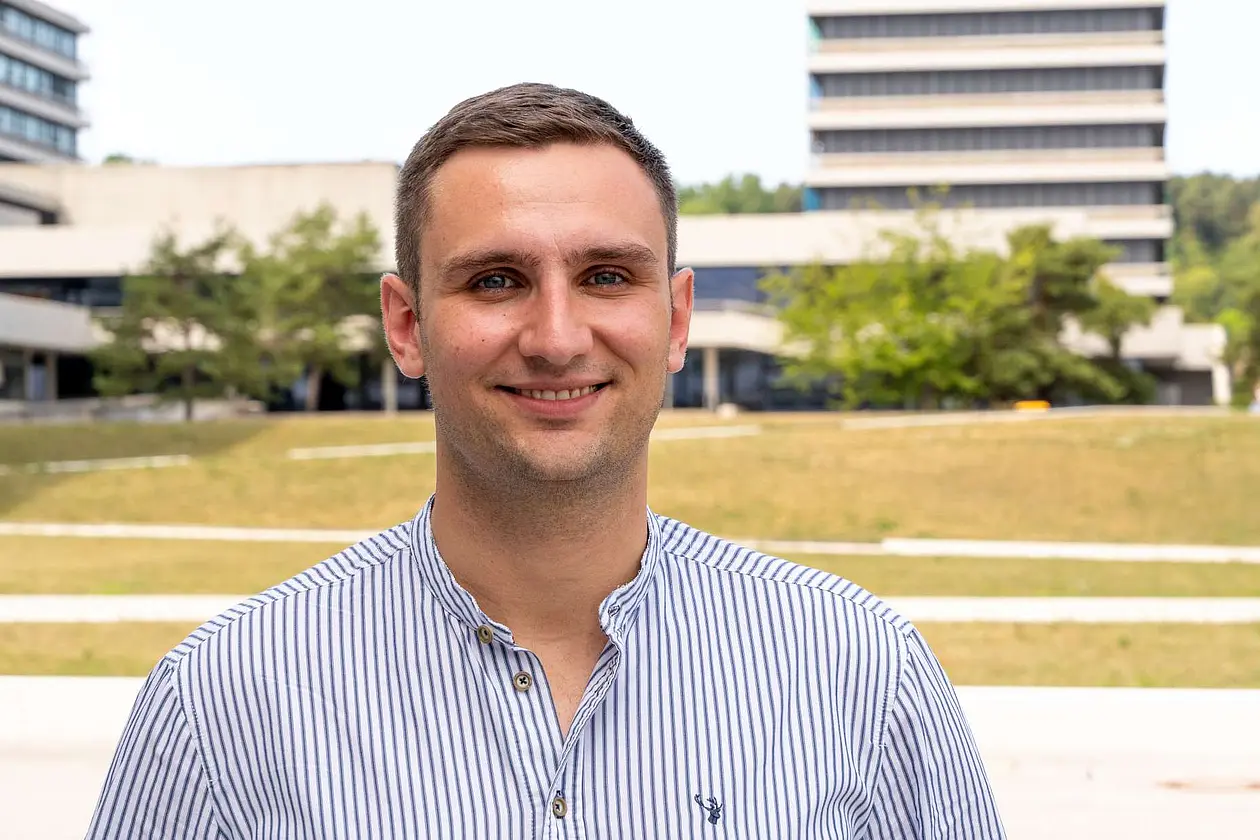
Dr Maik Wolfram-Schauerte from the Integrative Transcriptomics research group at the University of Tübingen’s Interfaculty Institute for Bioinformatics and Medical Informatics (IBMI) has received €1.8 million in funding from the foundation Carl-Zeiss-Stiftung as part of the CZS Nexus program. Wolfram-Schauerte is also an associated researcher at the Cluster of Excellence “Controlling Microbes to Fight Infections” (CMFI). The funded project is entitled “Phage-encoded host takeover: from molecular insight to biotechnological innovation” and will run from October 2026 to September 2031.
The project focuses on bacteriophages, or phages for short. Phages are specialized viruses that infect bacteria. During an infection, phages can interfere profoundly with processes within bacterial cells and, for example, control gene expression. However, the details of how this takeover works are still poorly understood. Wolfram-Schauerte and his project team aim to uncover previously unknown mechanisms of phage–host interactions. Their findings could open up new possibilities for specifically targeting antibiotic-resistant bacteria.
To achieve this, the project combines methods from bioinformatics, artificial intelligence research and experimental biology. Extensive omics data will be used to identify previously unknown phage RNA molecules and proteins. AI-based models will help predict their functions and select particularly promising mechanisms. These will then be tested in the laboratory and examined for their biotechnological potential. In the long term, the findings could contribute to the development of new antimicrobial strategies and future phage therapies against bacterial infections.
Maik Wolfram-Schauerte studied Molecular Biotechnology and Biochemistry at Heidelberg University and completed his doctorate at Philipps-Universität Marburg. For several years, his research has focused on how bacteriophages affect their host cells and how these processes can be investigated using omics data and computational methods.
About the Carl-Zeiss-Stiftung
The Carl-Zeiss-Stiftung funds science and teaching in the STEM disciplines of Science, Technology, Engineering, Mathematics. As a partner to outstanding science, it provides funding opportunities for basic and applied research. The foundation was established in 1889 by Ernst Abbe in Jena and is today one of the large private research funding organizations in Germany. It is the sole owner of Carl Zeiss AG and SCHOTT AG. The funding activities are made possible by dividends from the two foundation companies.