
Article
24.09.2026
Farewell to Monique Scheer as Vice-President for International Affairs and Diversity
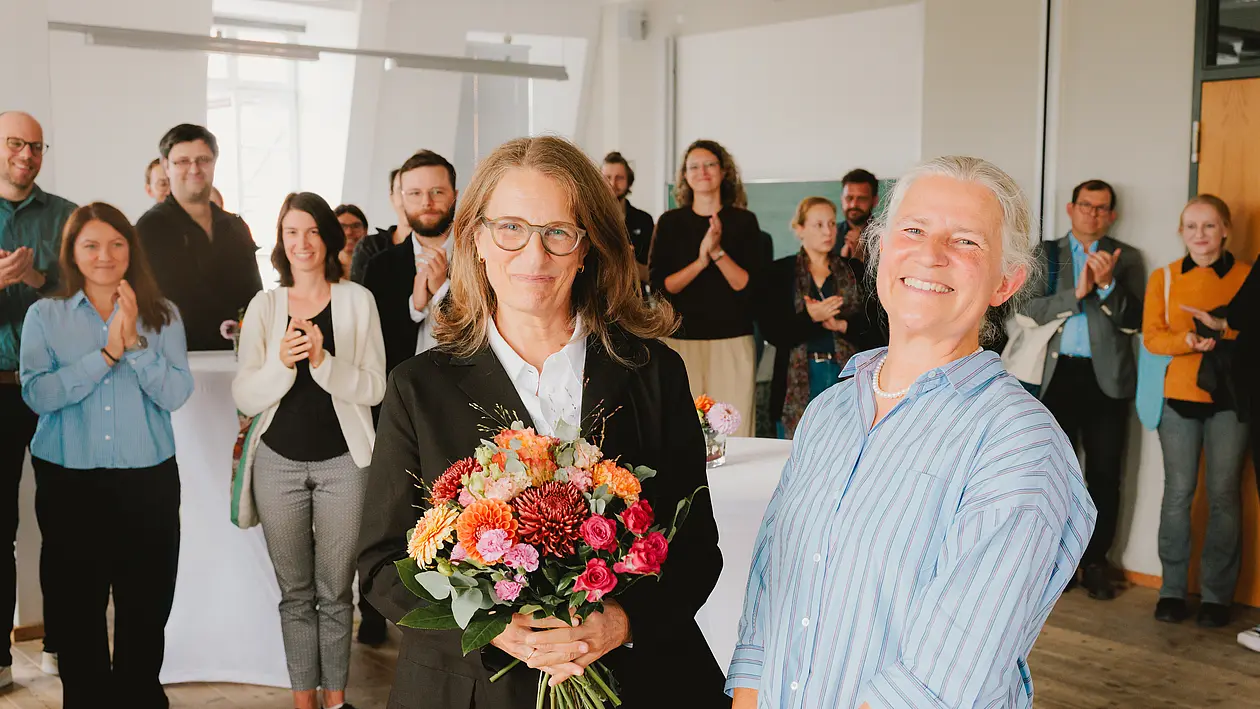
Professor Monique Scheer was honored today at the University of Tübingen’s Senate meeting as she stepped down after ten years as Vice-President for International Affairs and Diversity. President Pollmann thanked Scheer for her dedication, saying: “For over a decade, Monique Scheer has helped guide our University with great foresight and integrity. She has brought together differing perspectives, has reinforced our international relations for the long term, and has provided important impetus which contributed to a more open and respectful University culture. I offer my warmest thanks for her extraordinary dedication, and I am very pleased that she will continue to contribute to the University in research and teaching.”
Monique Scheer has been a professor of Historical and Cultural Anthropology at the University of Tübingen since 2014, focusing on cultural variety. Prior to her election as Vice-Dean of Teaching and Learning, she was director of the Ludwig Uhland Institute of Historical and Cultural Anthropology as well as Vice-Dean of Academic Affairs for the Department of Social Sciences.
Scheer, 49, was born in Tulsa in the US state of Oklahoma and studied Modern History at Stanford. She came to Germany in 1989, working initially as an editor for a publishing house in Stuttgart. She then studied Historical and Cultural Anthropology and the Study of Religion at the University of Tübingen and completed her Master’s degree. And it was at the University of Tübingen that she completed her doctorate, subsequently working withing the collaborative research center titled “War experience - War and society in modern times.” From 2008 to 2011 she carried out research at the Max Planck Institute for Human Development in Berlin before returning to Tübingen as an assistant professor at the Ludwig Uhland Institute.
On 1 October 2016 Monique Scheer succeeded Heinz-Dieter Assmann in the job of Vice-President for International Affairs, which was then a part-time post. “At that time, the University was seeking continued funding as a University of Excellence from 2019. It was important to me to support our application in the area of international affairs,” Monique Scheer recalls. An important event in her first term in office was the founding of the European university alliance CIVIS, catalyzed by President Macron’s speech at the Sorbonne in September 2017. “The process of founding CIVIS jointly with seven other European research universities and drafting a joint application for funding was a very intensive period of project work that was immensely important for internationalization at the University,” says Scheer.
The years since its founding have shown that CIVIS is a vibrant network. “CIVIS has grown tremendously. Three additional European universities have joined, and we’ve also established an association with a network of six research-intensive universities in Africa. New forms of teaching collaboration have emerged, combining virtual meetings with in-person gatherings. These classes are open to every student in the alliance.” Scheer says the universities have also grown closer administratively, too. This has made things like mobility and joint supervision less bureaucratic. “With these and other partnerships, the University of Tübingen is now well positioned to continue providing a variety of high-quality mobility opportunities to its students and researchers, she adds.
In 2020, Monique Scheer was reappointed for a second term, this time as a full-time vice-president. Her portfolio was expanded to enable her to advance the University’s diversity with a clear diversity strategy. Monique Scheer sees a clear thematic connection: “A diverse and discrimination-sensitive University community strengthens its international appeal, while international collaborations and perspectives enrich cultural diversity and openness on campus. Shaping the University in this way was an issue close to my heart.” In the area of diversity, the University underwent the “Shaping Diversity” re-audit during Scheer’s tenure and adopted a new diversity concept under her leadership. The anti-discrimination counseling service and the complaints management system were restructured.
During her ten-year tenure, Monique Scheer advocated for greater internal internationalization by supporting the participatory development of guidelines for multilingualism on campus. Under her leadership as Vice-President, the University pursued the post-pandemic international strategy “Raising Global Awareness” from 2021 to 2026. Among the goals were attracting more international students and researchers, as well as offering more mobility and language-learning opportunities for students and administrative staff.
Building high-quality relationships with strategic partners and raising Africa’s profile as a hub for science and collaboration were other key parts of her work. This was linked to the decision made by the President’s Office and the Senate in 2024 to establish a new strategic partnership with the University of the Witwatersrand in South Africa.
Monique Scheer is stepping down from her position in politically turbulent times. “Internationalization faces new challenges in a world where more and more countries are governed by parties that oppose academic freedom. But one thing is clear: without our international partners, we will not achieve major scientific breakthroughs. To meet the challenges that lie ahead, all countries must be able to work together,” Scheer says.
“I’m stepping down from my position with the satisfaction of knowing that the University is in a strong position,” says Scheer. “I’m especially looking forward to my return to teaching at the Ludwig Uhland Institute. In my research, I plan to continue exploring the history of emotions, including in the context of artificial intelligence, but I’m also preparing a publication on the relationship between humans and nature, so as to open up new areas of research.”