
Article
10.09.2026
Joint leaders’ statement by the African Research Universities Alliance and The Guild: Transformative science relationships are indispensable to address common global challenges
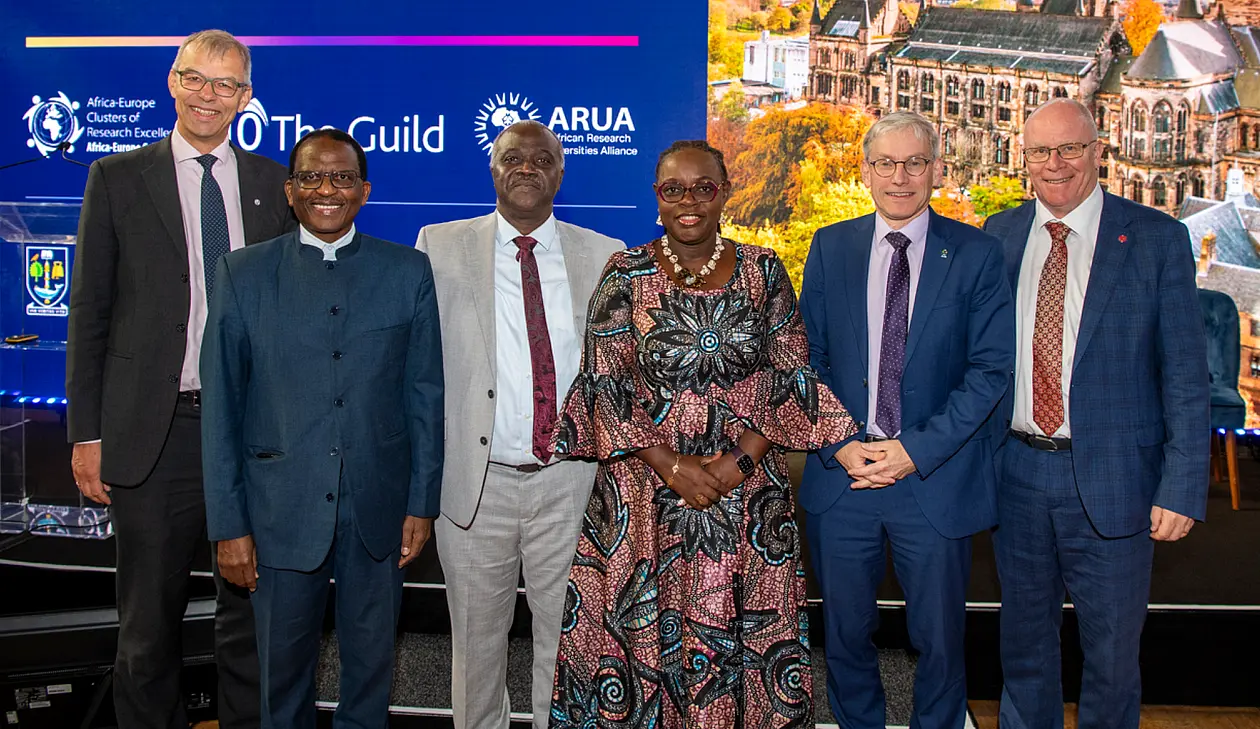
At the African Research Universities Alliance (ARUA)-The Guild Summit, held at the University of Glasgow in June, Vice-Chancellors and Presidents of 46 leading universities in Africa and Europe resolved to redouble their efforts to address humanity’s common challenges in health, digital transformation, environmental degradation, technological shifts, cultural tensions and geopolitical strife together. As a representative from the University of Tübingen’s President’s Office, Professor Dr. Katja Schenke-Layland, Vice-President for Research, Innovation, and Transfer, participated in the meeting. The Guild is a network comprising 23 leading research-intensive universities from across Europe, including Tübingen. The partners aim to engage with policy makers, enhance public debate and collaborate with private and public institutions to solve global problems.
To achieve their common aim, ARUA and The Guild members will strengthen equitable, long-term collaboration through the Africa-Europe Clusters of Research Excellence (CoRE), which bring together more than 400 researchers from over 120 institutions across both continents and beyond. In this way, they confirm their commitment to implementing the AU-EU Innovation Agenda, the African Union’s Science, Technology and Innovation Strategy for Africa (STISA 2034) and the European Union’s Global Gateway strategy. Researchers from the University of Tübingen are involved as co-leads in two CoREs dedicated to public health issues: Advanced Infectious Diseases Research and Training (Professor Steffen Borrmann, Institute for Tropical Medicine) and Genomics for Health in Africa (Professor Olaf Rieß and PD Dr. Tobias Haack, Institute for Medical Genetics and Applied Genomics).
But more needs to be done. Africa’s resources in talent, human development, and science requires systemic change to reach ARUA’s and The Guild’s aspirations. It is therefore an imperative that Africa’s science capacity is strengthened through equitable partnerships that develop ideas and solutions that are scalable, inclusive, and transformative – not just for higher education and research, but for the societies they serve. To this end, ARUA-The Guild leaders call on African and European policymakers, national and global research funders, and local and global industry partners committed to this transformation to work with the networks and all R&I stakeholders to:
- Encourage and incentivise excellent innovative models for R&I collaboration.
- Invest in addressing local phenomena of global societal challenges, in this way creating new solutions for all.
- Strengthen the human talent pipeline, including marginalised groups, through new pedagogical tools, by investing in higher education.
- Maximise return on investment by aligning development assistance with highly beneficial research infrastructures and R&I investment.
- Recognise the diversity of the African and European continents as opportunities, rather than obstacles, as research builds on the challenges and ideas of all.
At this time of geopolitical rupture, Universities must acknowledge that global science has also been predicated on power inequalities and it is by addressing this issue effectively that universities, funders and governments can build trust-based networks that provide a more effective response to the politics of division that characterises the present-day international order.
After an article by The Guild