
Article
31.07.2026
eROSITA delivers the most comprehensive census of the high-energy Universe to date
Second data release nearly doubles the previously known eROSITA X-ray sources to two million
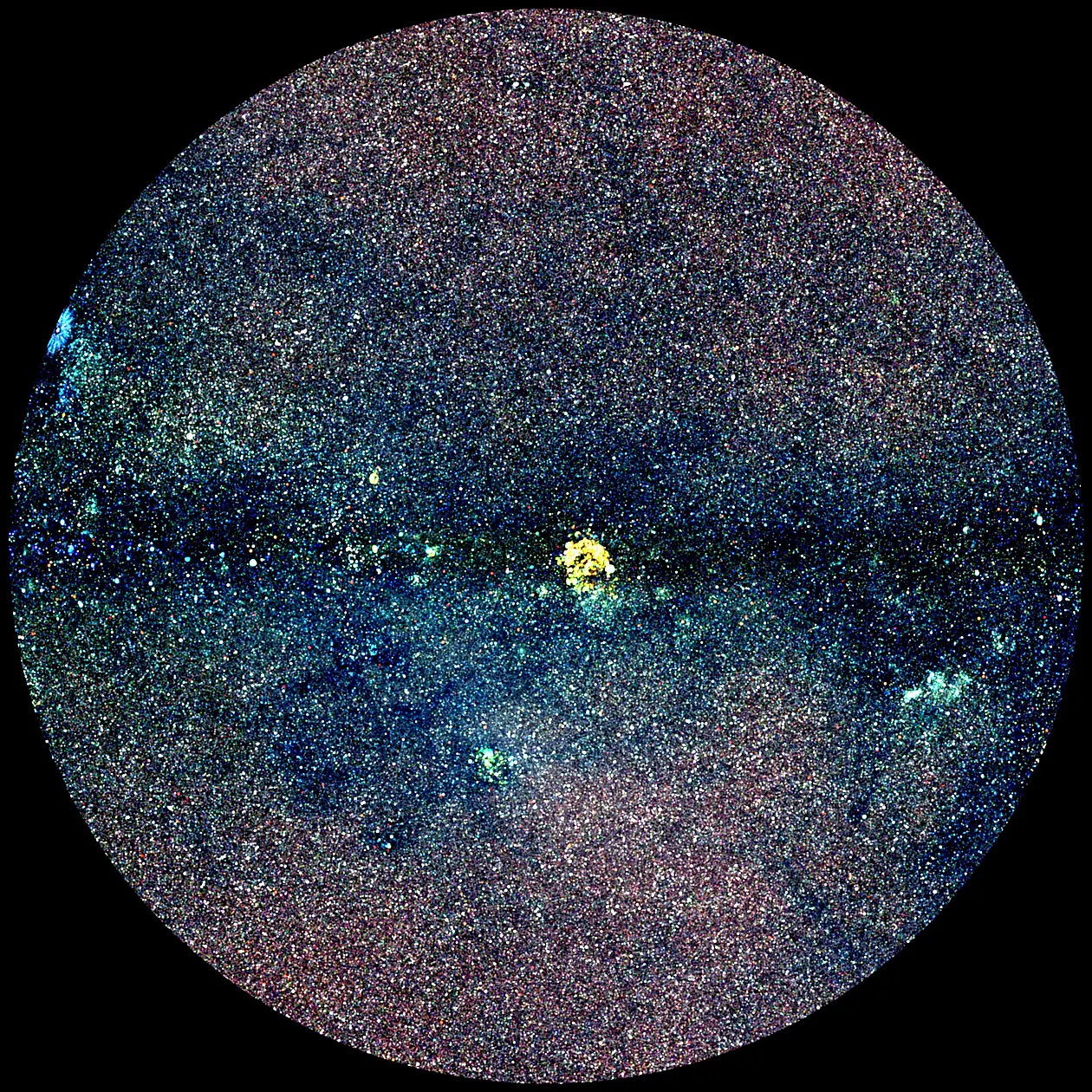
The German eROSITA Consortium (eROSITA-DE), led by the Max Planck Institute for Extraterrestrial Physics (MPE)and with the participation of the Institute of Astronomy and Astrophysics at the University of Tübingen (IAAT), has released its second major public dataset, eROSITA Data Release 2 (DR2). The new catalogue comprises close to two million X-ray sources—approximately doubling the number of previously released eROSITA sources in the X-ray sky and marking a major step forward in mapping the high-energy Universe.
Built from the first three all-sky scans of the eROSITA telescope aboard the Spectrum-Roentgen-Gamma (SRG) mission, DR2 provides the most comprehensive catalogue of the X-ray Universe currently available to the scientific community. By combining multiple passes over the sky, the release significantly increases the survey depth and reveals large populations of previously undetected sources.
The main DR2 catalogue contains nearly two million X-ray sources detected in the 0.2–2.3 keV band and includes more than 1.9 million point-like sources, primarily stars and actively accreting supermassive black holes, as well as around 64,000 extended sources such as galaxy clusters, nearby galaxies, and supernova remnants. Compared to the first data release, the number of detected sources has roughly doubled.
A complementary hard-band catalogue adds nearly 15,000 sources detected at higher energies (2.3–5.0 keV), tracing heavily obscured and intrinsically energetic systems that are often missed at softer X-ray energies. Together, these catalogues capture the full diversity of the X-ray sky, from nearby stellar coronae to distant supermassive black holes and massive galaxy clusters. Many of these objects are newly identified in X-rays, while others can now be studied with substantially improved precision.
After the start of operations in December 2019, eROSITA surveyed the entire sky every six months, progressively increasing depth and sensitivity. DR2 combines data collected over the mission’s first 556 days, spanning three full sky surveys (eRASS1–3). By stacking these observations, the survey reaches significantly fainter fluxes than the first release, enabling the large increase in detected sources.
“DR2 is the best inventory of the X-ray sky we have to date and opens the door to robust statistical studies of cosmic populations,” says Dr. Miriam E. Ramos-Ceja, Ground Segment Manager of the eROSITA instrument and lead author of the DR2 publication.
A joint milestone with SDSS
The release coincides with the twentieth data release of the Sloan Digital Sky Survey (SDSS), which includes extensive optical spectroscopy of eROSITA-DE sources. Together, these datasets represent the culmination of nearly a decade of collaboration between the German eROSITA Consortium and the SDSS collaboration. Spectroscopic reconnaissance and characterization of the eROSITA detections is often vital for understanding the nature of the X-ray source.
eROSITA at IAAT
The High-Energy Astrophysics group (HEA) at IAAT under the lead of Professor Andrea Santangelo has contributed to the development of the mission, making IAAT one of the five core institutes of the German eROSITA consortium. Professor Beate Stelzer, lead of the Space Based Astrophysics group (SBA) at IAAT, explains that “with its capacity to cover the full sky in X-ray light, eROSITA gives us a unique chance to understand the typical properties of a certain class of stars. We are not forced to restrict our studies to a small number of objects that are interesting but often not representative for their class.” Combining the expertise of the HEA and SBA groups all kinds of stellar objects in the eROSITA sky are studied at IAAT, from the cradle of star formation to the endpoints in the stellar life including white dwarfs, neutron stars and black holes.
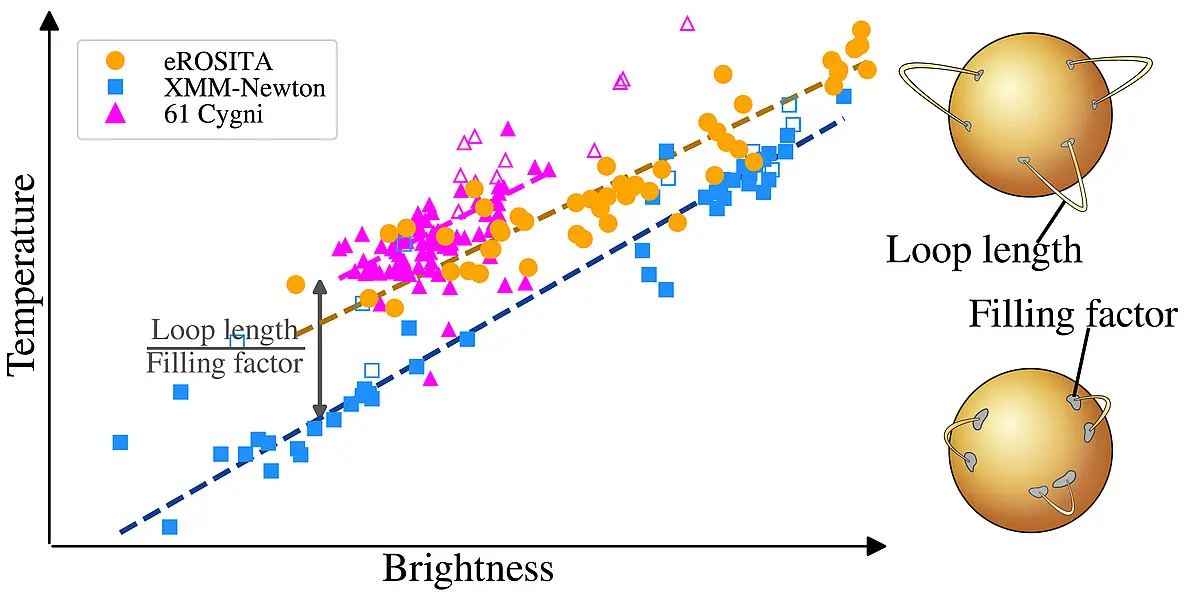
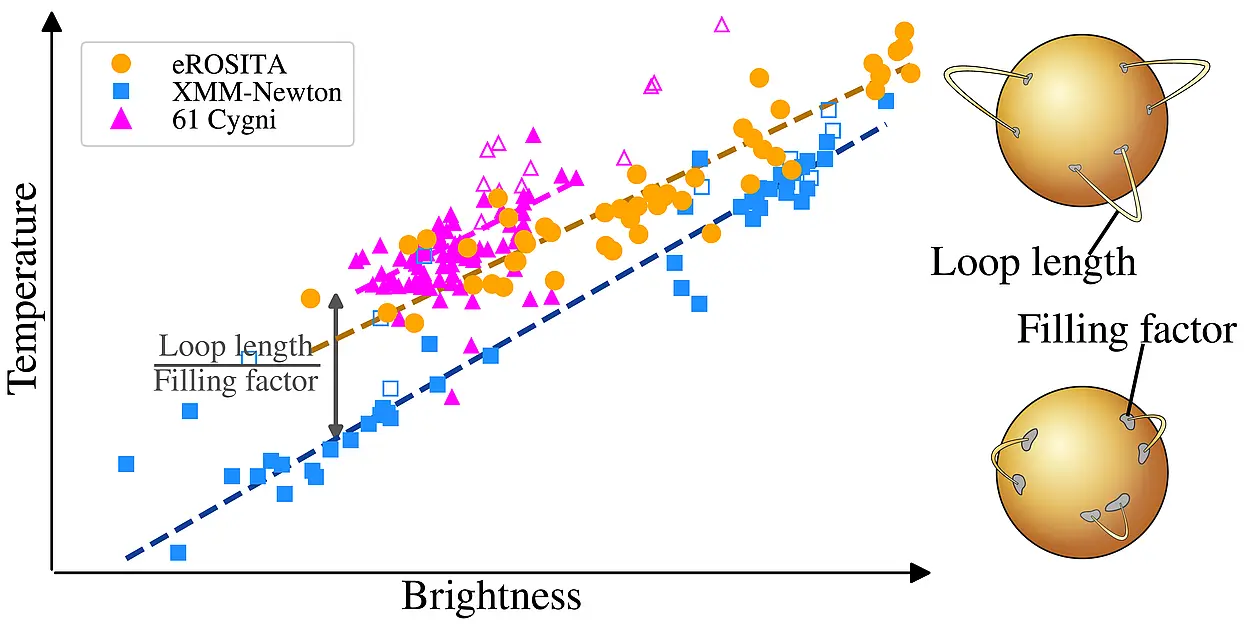
“Surprisingly, even in our closest neighborhood, some stars emit no detectable X-rays, suggesting they might be in a 'Grand Minimum' state similar to the Sun’s historic quiet phase from 1645 to 1715", explains Marcel Bennedik. He is lead author on a study that links eROSITA observations of X-ray temperature and brightness in solar-like stars to a seminal, nearly 50-year-old model of our Sun's coronal magnetic field loops (see Fig.2). Three of the new papers that appear today alongside with the data release are led by doctoral students or young researchers from the SBA group at IAAT.
A focused, catalogue-driven release
In contrast to the first public data release, DR2 is a catalogue-focused release. It provides rigorously validated source lists derived from the combined eRASS:3 observations, along with an updated upper-flux-limit service that allows researchers to quantify non-detections across the sky.
The data cover the western Galactic hemisphere, reflecting the agreed data-sharing arrangement between the German and Russian eROSITA consortia. Within this region, DR2 represents the largest and most homogeneous public X-ray dataset currently available.
Enabling the next wave of discoveries
“This is a dataset of unprecedented scale and completeness, now in the hands of the global astronomical community,” says eROSITA Principal Investigator Andrea Merloni. “With nearly 2 million sources, DR2 provides a unique foundation for discoveries ranging from rare objects to large-scale population studies.” MPE Director Kirpal Nandra adds: “eROSITA just set another world record in terms of X-ray source numbers – and it won’t be the last.”
The eROSITA-DE DR2 catalogues, upper-flux-limit server, and full documentation are publicly accessible via the eROSITA-DE Science Data-Archive.
Contact:
Prof. Beate Stelzer
Institut für Astronomie & Astrophysik, Universität Tübingen
Tel +49 7071 29 76132
E-mail: stelzer@astro.uni-tuebingen.de
Marcel Bennedik
Institut für Astronomie & Astrophysik, Universität Tübingen
Tel +49 7071 29 75471
E-mail: bennedik@astro.uni-tuebingen.de
Dr. Gerd Pühlhofer
Institut für Astronomie & Astrophysik, Universität Tübingen
Tel +49 7071 29 74982
E-mail: Gerd.Puehlhofer@astro.uni-tuebingen.de