Uni-Tübingen

Discovering Tübingen

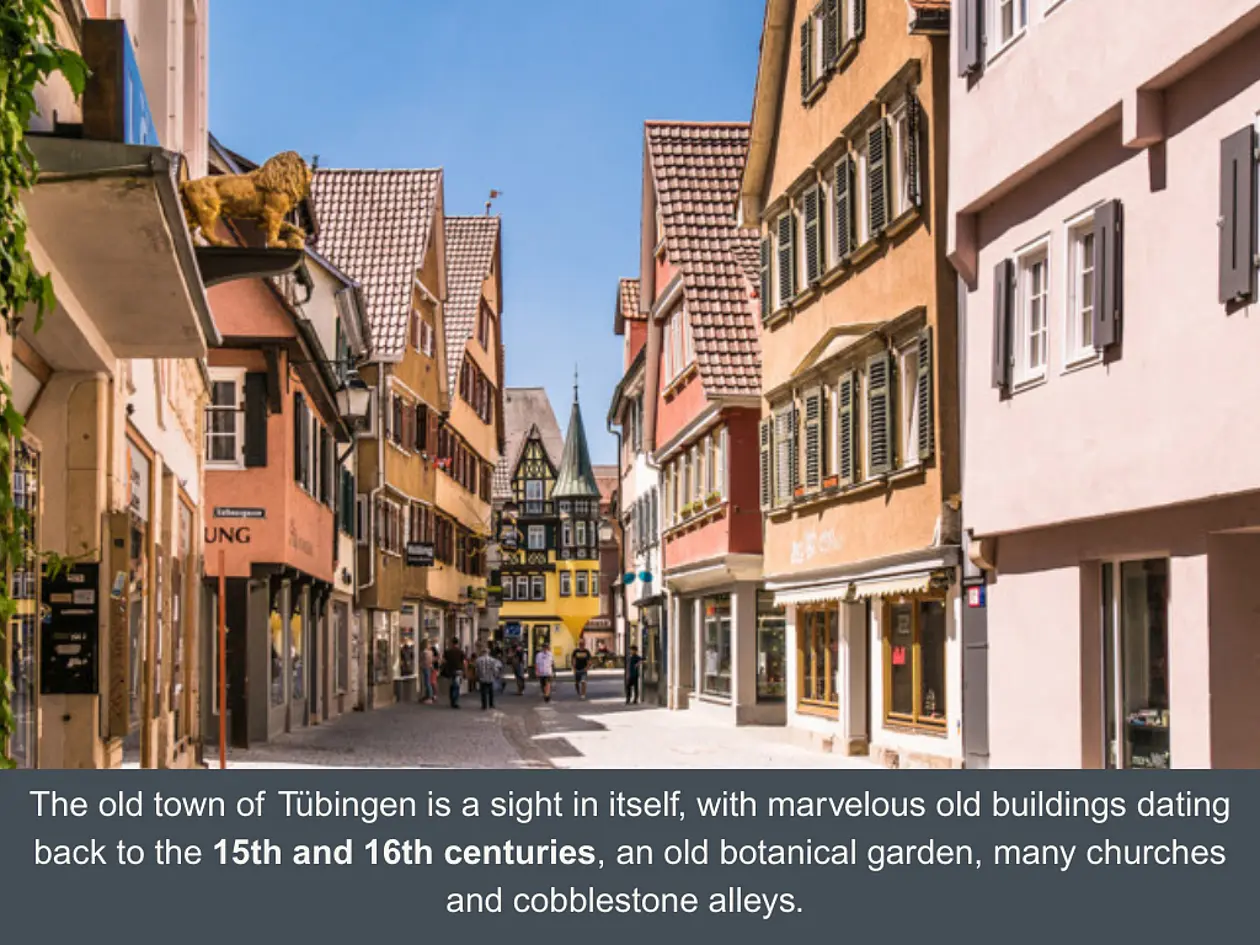
Tübingen lies in the heart of Europe, in one of Germany’s most scenic and economically dynamic regions. Just 30 km south of Stuttgart, it’s nestled between the Schönbuch Natural Park and the Swabian Alb. The city is known for its unique flair – a charming historic city center (German) paired with the lively energy of a young, international student town. Nearly one third of the population are students, and with an average age of just 39, Tübingen ranks among Germany’s youngest cities. Here, centuries-old history meets with cutting-edge science, and festivals and events (German) bring the city to life year-round.

Start your journey by exploring the city's sights and the interactive city map (both in German), and check out the highlights and local overview below.

Local Map Neighborhoods Outskirts


Sustainability

Tübingen is known as one of Germany’s greenest cities, with a strong commitment to sustainability and climate protection (German). The city has an ambitious plan to become climate neutral by 2030, making it a role model for environmental action  – read up on it here Tübingen klimaneutral 2030 (German). From reusable coffee cups to eco-friendly waste systems, sustainable living is part of everyday life here. Tübingen’s compact size and bike-friendly infrastructure make it easy – and fun – to get around on two wheels. If you're looking to study in a city that cares about the planet, you came to the right place!

Safety

Tübingen is generally considered a safe city, with low crime rates compared to larger urban areas in Germany. Most students feel comfortable walking or biking around the city, including in the evenings. Like anywhere, it's still important to take basic precautions, such as locking your bike and keeping an eye on your belongings. The local police ( German emergency numbers) and university support services ( Advice and counseling for international students) are available if needed. 

Equity & diversity

Tübingen is a very liberal city and generally a safe place to live, regardless of your sexual orientation or gender identity. Same-sex marriage is legal in Germany, and anti-discrimination laws protect minorities. The city goes great measures to ensure a safe and includig environment for all its inhabitants and takes this responsibility seriously. For this, the city of Tübingen was in 2023 awarded the Gender Award for gender equality work! Read up more on Tübingen's mission on the city's own websits: Gender Equality and Queer Equality of Opportunity (translatable into English).

The University of Tübingen itself is also committed to fostering a diverse and inclusive academic environment. The Equity Team of the university supports this vision by offering advice, support and mediation in cases of disadvantage and discrimination, for example on the basis of ethnic origin, age, social and religious background, disability or sexual identity during studies and in the workplace. They give information, advice and services on the topics of diversity, gender equality and care and on a wide range of other counseling services at the University of Tübingen.


Tübingen's Neighborhoods and Outskirts

Tübingen consists not only of the main city area, but includes a variety of smaller villages, which have been integrated into its municipal administration. Eight of these districts are geographically separate villages that became part of the municipal administration in the 1970s. 

The map below gives you an impression of where the different districts are located and their distances from the city center. You can also find information about the different neighborhoods and outskirts on the website of the City of Tübingen (German).


Tübingen Neighborhoods

Waldhäuser Ost (WHO)

In the North of Tübingen, WHO is popular with students because there is a large student village with dormitories. It's a residential area with an international population, close to the Schönbuch forest.

Public Transport

Bus lines 2, 3, 4, 5, and 6

Infrastructure

Supermarket, bakeries, butcher shops, bank, medical practice, pharmacy, kindergarten, elementary school, secondary schools, swimming pool.

Distance to Tübingen City Center

2 km

Schönblick & Winkelwiese

The Max Planck Campus is located on a beautiful slope in this district with a view of the Swabian Alb.

Public Transport

Bus lines 3, 4, and 17

Infrastructure

Bakery, medical practice, kindergarten, elementary school.

Distance to Tübingen City Center

2 km

Südstadt

As the name suggests this part of Tübingen is located south of the city center and a very green residential area. The small river Steinlach runs through the area and the Volkshochschule (vhs) is located in the Loretto area.

Public Transport

Bus lines 3, 5, 8

Infrastructure

Supermarket, bakeries, butcher shop, bank, medical practice, pharmacy, kindergarten, elementary school, secondary schools.

Distance to Tübingen City Center

1,5 km

Wanne

Wanne is a residential suburb that has both student dorms and shared flats that are cheaper than those available in the city center. It also has a lot of facilities in the vicinity, as those listed below.

Public Transport

Bus lines 5, 13, 17

Infrastructure

Supermarket, bakery, butcher shop, bank, medical practice, pharmacy, kindergarten, elementary school.

Distance to Tübingen City Center

1 km

Weststadt

As the name suggests, this area is located to the West of the city center, which makes it very convenient to reach both the inner city and the University Hospitals and research institutes located on the Schnarrenberg and Morgenstelle campus sites.

Public Transport

Bus lines 8, 12, 14, 16, and 30

Infrastructure

Supermarket, bakeries, bank, medical practice, pharmacy, kindergarten, elementary schools.

Distance to Tübingen City Center

1 km

Derendingen

South of the city center of Tübingen you will find the city's second largest district. Besides plenty of facilities, Derendingen has its own rich community life with a lot of sports clubs.

Public Transport

Bus lines 3 ,5, 31, 16, and train

Infrastructure

Supermarket, bakeries, butcher shop, bank, medical practice, pharmacy, kindergarten, elementary school, secondary schools.

Distance to Tübingen City Center

2 km
Lustnau

The largest district (approx. 9,500 inhabitants) in the east of Tübingen, has a bustling community life with lots of local associations.

Public Transport

Bus lines 1, 7, and 22.

Infrastructure

Supermarket, bakeries, butcher shop, bank, medical practice, pharmacy, kindergarten, elementary school.

Distance to Tübingen City Center

2 km.

Österberg

This is a purely residential area up on one of the two hills in Tübingen's center. The residential area of Österberg can be entered by car only via one street (Doblerstrasse), but there are many access options for pedestrians and cyclists. The northern part of the hill is not developed; therefore, a huge meadow provides a large space for recreation. The Österberg area and the Österberg itself is a good place for taking walks and is a popular hang-out place for Tübingen residents, mostly even all year round.  

Public Transport

Bus line 10

Infrastructure

Medical Practice, kindergarten

Distance to Tübingen City Center

1 km

Unterer Wert

This area east of the city center and south of the river Neckar is predominantly an industrial area with some commerce, but there are residential spots as well. The district is home to the former goods railway station, but is probably most known for housing the bouldering centre “B12” and other sports facilities and fields. 

Public Transport

Bus line 21

Infrastructure

Grocery store, bakery, bank, kindergarten, B12 bouldering centre and sport fields.

Distance to Tübingen

1 km


Tübingen Outskirts

Bebenhausen

Located at the outskirts of the Schönbuch Natural Park, north of Tübingen. A very quiet and beautiful small village (ca. 350 inhabitants) characterized by a Cistercian monastery from 1187.

Public transport

Bus lines 754, 826 and 828 (airport sprinter)

Infrastructure

Medical practice, kindergarten.

Distance to Tübingen City Center

4 km

Bühl

Situated southwest of Tübingen in the Neckar valley, Bühl has around 2,000 inhabitants of its own and boasts its very own renaissance castle in the center of the village. It's located between Kilchberg and Kiebingen. Two nature reserves, one close to the forest Rammert and the other in the direction of the river Neckar, provide an opportunity to explore the flora and fauna of the Neckar valley. Bühl has a long carnival tradition which you have to experience.

Public Transport

Bus line 7622/19

Infrastructure

Supermarket, bakeries, bank, medical practice, kindergarten, elementary school.

Distance to Tübingen City Center

6 km

Hagelloch

This small village with around 1,500 inhabitants is situated northwest of Tübingen's city center at the southern edge of the Schönbuch natural park.

Public transport

Bus lines 8, 18 and N97 (night bus)

Infrastructure

Bakery, medical practice, kindergarten, elementary school.

Distance to Tübingen City Center

5 km

Hirschau

A nice village west of Tübingen in the Neckar valley at the bottom of the Spitzberg, a nature reserve, Hirschau is one of the larger districts with over 3,000 inhabitants. There's a lake close by which is open for swimming. You will find lots of nice bike paths, also in the direction of Tübingen.

Public transport

Bus line 18

Infrastructure

Bakeries, butcher shop, bank, medical practice, pharmacy, kindergarten, elementary school.

Distance to Tübingen City Center

6 km

Kilchberg

West of Tübingen in the Neckar valley, at the edge of the forest Rammert, Kilchberg conserves its village character. A castle from 1200 with a beautiful garden is part of the village.

Public Transport

Bus line 7622/19

Infrastructure

Grocery store, medical practice, kindergarten, elementary school.

Distance to Tübingen City Center

5 km

Pfrondorf

Pfrondorf lies northeast of Tübingen city center at the outskirts of the natural park Schönbuch. It is located on a plateau above the river Neckar and provides a beautiful view of the Swabian Alb mountains.

Public Transport

Bus lines 1 and 7

Infrastructure

Supermarket, bakeries, butcher shop, bank, medical practice, kindergarten, elementary school.

Distance to Tübingen City Center

6 km

Unterjesingen

West of Tübingen city center in the Ammertal valley, Unterjesingen is a scenic village surrounded by vineyards reflecting a century-old tradition of wine growing.

Public Transport

Bus lines 777 and 791, Ammertal train

Infrastructure

Grocery store, bakeries, butcher shop, bank, medical practice, kindergarten, elementary school.

Distance to Tübingen City Center

6 km

Weilheim

Situated south of Tübingen in the Neckar valley, Weilheim is home to around 1,500 inhabitants.

Public Transport

Bus line 7622/19

Infrastructure

Supermarket, bakery, bank, medical practice, pharmacy, kindergarten, elementary school.

Distance to Tübingen City Center

3 km