Uni-Tübingen

Going to the Doctor – Health, Illness, and Emergencies

We all aim to stay healthy, but what if you fall ill? Navigating the German healthcare system can be tiring, but you’re not alone: Below you find a quick guide, important contacts and further key information – Take care and stay healthy!

Doctor's Visit Emergencies Mental Health Preventive Health Programs

While this site focuses on medical and emergency ressources, exchange students with chronic illnesses please check out the additional guidance on adjusting study conditions

Emergency, crisis & illness

If you become ill or find yourself in a dangerous or difficult situation (physical or psychological), there are various points of contact for you: from special counseling units at the university or the city to doctors or hospitals.

  • Our Emergency & Medical Services Guide informs about the most important contacts and explains what to consider when seeing a doctor in Germany.
  • An illustrated health dictionary from the German Student Union illustrates important vocabulary for visiting the doctor and explains the basics of emergency and illness in German and Englisch.
  • The General Student Counseling Service of the University outlines further mental health support services for crisis situations and preemptive health management of students in Tübingen.

The Incoming Team (incomingspam prevention@uni-tuebingen.de), other members of the International Office and further departments at Tübingen University are also available for an initial consultation. Do not hesitate to contact us: The counselling is confidential.

Multilingual healthcare broschures

For those interested, you find below further brochures which inform about the German healthcare system in multiple languages:

  1.  Health for all - A guide to the German health care system, offered by the German Federal Ministry of Health, comes in 15 languages. It provides clear and detailed information to help newcomers understand how to access medical services in Germany. Similarly, the leaflet
  2. With the EHIC in Germany, found under the “Urlaub in Deutschland” section of the DVKA website, is available in six languages. It offers practical advice and is aimed at EHIC and GHIC holders, as well as visitors from Switzerland, who are staying in Germany for a limited period.

Doctor's Visit

During your stay as an exchange student you remain either insured in your home country (e.g. EHIC holders), take out public German statutory health insurance, or take out private health insurance. Depending on your insurance type, slightly different procedures will apply for the doctor's visit and the payment. Finding medical support, however, is the same. Let us start with the basics: 

Doctor's office vs. hospital - when to go where

In Germany, if you're unwell but not in an emergency or very acute situation, your first point of contact is typically a general practitioner (GP), rather than a hospital. Hospitals are reserved for emergencies and advanced treatments that cannot be provided by local doctors.

Your GP, known as Allgemeinmediziner or as your family doctor, Hausarzt in German, serves as main point of contact. They oversee your general health and can refer you to specialists, Fachärzte, or the hospital, if needed. For dental care or routine check-ups with specialists such as gynecologists, ophthalmologists, or dermatologists, you can directly book appointments.

Finding a doctor (GP / specialist / English speaking doctor ...)

You can relatively freely choose a medical practitioner in Germany, allowing you to find one conveniently located. Consultations are on weekdays, with appointments usually required in advance. Finding a suitable doctor is easy:

1. Choose a practitioner from our contact list of English-speaking doctors.

2. Ask your Tübingen buddy / friends for a recommendation of a medical practitioner.

3. Use the search function on the website Arztsuche (search for a doctor): https://arztsuche.116117.de (German). Enter Tübingen as Ort and leave the field Wen/Was blank to receive a comprehensive list; or use the filter via Wen/Was to find a Hausarzt/Allgemeinmediziner (general practitioner). Click the button Suchen to search.

  • You do not know German and need an English speaking doctor?
    Filter the results via Weitere Suchkriterin for e.g. English as Fremdsprache: Only English-speaking doctors will be shown as aresult.
     
  • You need a Facharzt (specialist)?
    Filter the results via Weitere Suchkriterin for Fachgebiete (specialist fields; only in German) or choose the correct English specialist type at https://www.116117.de/de/englisch.php#content1292. Then, proceed with the local search.

Click an entry in the results list - you will see the office hours & contact details.

Please note: 

Seeing a doctor

Usually you need to make an appointment before you see the doctor. While digital booking is becoming more common, many practices still prefer scheduling an appointment via phone. If you have an acute condition, clearly state this to get a prompt appointment. Some doctors offer Offene Sprechstunde (open office hours) for walk-ins, though wait times may vary. 

Bring your health insurance card/proof and an ID card to the appoinment. When consulting with the doctor, describe your condition in detail: If medication is needed, the doctor will provide you with a prescription for the pharmacy. Should specialist care be required, you will receive a referral to an appropriate specialist or to the hospital. 

Medical certificate for missing classes

If you are unable to attend class or an exam due to illness and need an official sick note, be sure to inform the doctor during your visit. You will receive a document called a Krankschreibung (medical certificate), which you should send to your lecturer – and to the examination office if it affects an exam. 

Please check out Missing a class due to illness for information how and when you need to report yourself sick for classes or exams. 

Students from countries with a social-security agreement (not EHIC/GHIC)

If you are from a country with a social-security agreement with Germany which does not use the EHIC or GHIC system, you need to follow some extra steps before seeing a doctor or for receiving urgent medical care.

Doctor's visit

Before visiting a doctor, you must first go to a German statutory health insurance office and present the appropriate health insurance form from your home country. You will receive a treatment voucher (Behandlungsschein), which you must submit at your doctor’s appointment. The doctor will usually accept this voucher and bill the insurance provider directly.

It is recommended that you contact the health insurance company that issued your digital health insurance confirmation for enrollment. You can find a list of offices here:

Emergency and urgent medical treatment after-hours

Treatment vouchers are not issued in advance for emergency or urgent medical care outside regular office hours (e.g. evenings or weekends). As a result, you may be billed directly by the doctor at the time of treatment. In this case, you have the following options:

  • Pay the bill and seek reimbursement from your health insurance provider in your home country. Ensure that the bill is paid on time, either by you or your insurer.

  • Obtain a treatment voucher on the next working day from one of the listed health insurance offices. Once received, submit the voucher to the doctor and ask whether they can accept it in place of the bill.

Based on your health insurance type and plan, different regulations apply concerning the scope of treatments covered and the payment process for doctor's services and the medication.

German statutory health insurance

If you have German statutory health insurance with providers like AOK, Barmer, or TK, the doctor bills the insurance company directly. So you do not need to pay for the visit yourself.

When visiting a doctor for the first time in a calendar quarter (Jan-March, April-June, July-Sept, Oct-Dec), present your health insurance card, the EHIC for scanning. It does not need to be scanned again during the quarter, but it is recommended to bring it to each visit in case any issues arise.

Certain tests or treatments not deemed necessary by statutory health insurance, so-called IGEL services, must be paid by patients, typically in cash.

Insurance in the home country - via EHIC, GHIC, social-security agreement

For EHIC holders (from countries other than Germany), GHIC recipients, and students from countries with a social-security agreement with Germany, there is an important distinction between non-urgent treatments, which are typically covered only in your home country, and urgent treatments, which can be received while in Germany. For urgent medical treatment in Germany, the billing process is the same as for students insured with a German statutory health insurance provider: the doctor will bill the health insurance provider directly.

Students covered by a social-security agreement (not using EHIC or GHIC): To enable direct billing, you need to complete a few additional steps before your doctors' appointment.

Treatment Necessity

For treatments which are urgent and cannot be postponed for medical reasons, the standard benefits under German statutory health insurance apply. For instance, if you develop a high fever, a doctor prescribes standard medication, which you obtain from a German pharmacy. Even if this medication is not covered by your home country's insurance, it will be covered in Germany, as it falls under the standard provisions of German statutory health insurance. However, non-urgent medical support, such as vaccinations, routine blood tests and other non-acute or preventive treatments, are generally to be carried out in your home country. 

Chronic Illnesses

In the case of pre-existing chronic conditions, the EHIC, GHIC, social-security agreements take effect in Germany if a deterioration would occur without treatment. The EHIC etc. should also cover long-term medications when you are unable to obtain or bring a sufficient supply from your home country. If you have a severe chronic illness and wish to secure comprehensive medical support in Germany, even when your condition is stable, it may be beneficial to consider taking out additional health insurance with a German statutory provider. 

Private insurance - all providers

When choosing private health insurance as an international student in Germany plans of providers like Vela optimal, Dr. Walther provisit student, Care Concept or Mawista typically cover essential medical needs, including outpatient, inpatient, and emergency care. They also offer flexible contract duration, and competitive rates. Most students over 30 can only take out private insurance, as statutory student health insurance (KVdS) is no longer available to them due to age limits. 

Once you have opted for a private health insurance you can normally not switch back to the statutory health insurance as long as you study.

Limitations

That said, it’s important to be aware of potential limitations: coverage for pre-existing conditions can be excluded, and some services – such as dental treatment, mental health support, or maternity care – may be only partially covered, subject to waiting periods, or excluded entirely. Additionally, certain plans may restrict your choice of healthcare providers. Insurance providers typically offer a variety of plans, with the most budget-friendly plans usually covering only basic healthcare services.

Payment process

You'll need to pay upfront for doctor visits and medications at the pharmacy and then seek reimbursement from your insurer. Even if your insurance offers payment guarantees, some hospitals or doctors may still require advance payment - particularly if your insurer is based outside Germany. 

Carefully evaluate each plan's specifics to ensure it meets your own health needs and complies with visa and university requirements.

Receiving medication - all insurance types

In Germany, medications are exclusively available at pharmacies (Apotheke). Drugstores (Drogerie/ Drogeriemarkt) or supermarkets provide toiletries, nutrition supplements and health products, such as light cough syrups, nasal sprays and throat pastilles.

For those with German statutory health insurance or EHIC etc. from abroad, doctor prescriptions can be filled at any pharmacy. Your insurance usually covers the cost, minus a 5-10 € copayment (Zuzahlung) per medication. However, non-essential prescriptions like birth control normally require a private prescription, with you covering the full cost. For private insurance holders, prescribed medications require upfront payment. You can then submit the private prescription, along with the doctor's invoice and diagnosis, to your insurance provider for reimbursement

Over-the-counter drugs/non-prescriptive medication like mild painkillers, cough syrups, and light drugs for other temporary issues are not covered by insurance. You will need to purchase them directly at a pharmacy at your own expense. In case of doubt please see a doctor.

Emergency & After-Hours Medical Support

Learn about Germany's nationwide emergency numbers and how to access after-hours medical support for non-life-threatening situations.

German emergency numbers

112: The most important number for accidents or emergencies is the rescue coordination center (Rettungsleitstelle). 112 is valid in Germany and the other EU countries as the cental emergency number.

  • They can dispatch an ambulance, send a fire team, call the police etc.
  • Call 112 also, if you or someone with you is in a life-threatening medical situation and needs immediate medical care.

110: If you or somebedoy else is in a dangerous situation or victim of a crime please call the police (Polizei).

  • If necessary, the police can also arrange medical support.
  • 110 is an emergency number; if you need to call the police for non-emergency cases (e.g. you lost your wallet), please call the police in Tübingen 07071 9720.

For all central emergency numbers be prepared to give the following information: Where you are, Who you are, what has happened, how many people are involved. Wait for further questions. In German, these five aspects are also called the 5 W's for emergency calls: Wo, Wer, Was, Wie viele, Warten.

Emergency Rooms in Tübingen

Please go to the Emergency Room (ER) in case of a real emergency and if possible, call ahead before visiting. If you need medical assistance after-hours in non life-threatening situations, please see below medical support after-hours. You find several Emergency Rooms in the different clinics in Tübingen:

1. Emergency Hospital & General ER  (BG Unfallklinik)

  • Adress: Schnarrenbergstr. 95, 72076 Tübingen (Bus stop: Uni-Kliniken Berg)
  • Phone: 07071 / 606-1148
  • General ER for accidents and other emergencies. 

2. Central Emergency Room / Medical Clinic (UKT University Hospital)

  • Adress: Hoppe-Seyler-Straße 3, 72076 Tübingen, (Bus stop: Uni-Kliniken Berg)
  • Phone: 07071 / 29-82090
  • Central ER (Zentrale Notaufnahme, ZNA) with integrated Chest Pain Unit for general and internal / cardiac emergencies.

3. List of other Specialist Emergency Rooms at the University Hospital: https://www.medizin.uni-tuebingen.de/en-de/kontakt/notfall#notdienst

  • The majority of these ERs are part of the University clinics on the Schnarrenberg hill, therefore also called Kliniken Berg (Bus stop: Uni-Kliniken Berg).
  • The ERs for dental care and gynecological emergencies are part of the Kliniken Tal ('valley'; Bus stops: Uni-Kliniken Tal or Calwerstraße).

Medical support after-hours (no emergency)

Dial 116 117  (Germany-wide) for after-hours urgent medical care. This 24/7 service provides assistance for urgent but non-life-threatening situations outside regular doctor’s hours, including evenings, weekends, and holidays. They can also guide you to the nearest on-call doctor if needed.

In Tübingen, if you are ill / had a small accident, and you need urgent medical assistance after-hours, you can also visit the Family Doctor Emergency Practice in the Medical Clinic

  • Consultation hours: Mon - Thu: 7 p.m. - 10 p.m. / Fr: 4 p.m. - 10 p.m. / Sat, Sun, public holiday: 8 a.m. - 10 p.m.
  • Adress: Otfried-Müller-Straße 10, 72076 Tübingen (Bus stop: Uni-Kliniken Berg)

The poisoning information center (Giftnotruf) at 0761 / 19 24  is a regional  24/7 hotline in Baden-Württemberg for more specific support: Call them if you know which poisonous substance has been consumed and if the condition is non-life-threatening. If you do not know which substance has been consumed and/or the medical condition is severe, please call 112.

Receiving medication after-hours

If you need medicine after-hours, you can either call the out-of-hours Pharmacy Service at 0800 / 0022833 (from a landline) or 22833 (from a mobile). Or visit www.aponet.de (interactive German map) and enter your city or postal code and then choose a pharmacy close to you. Pharmacies also often post a sign at their entrance which indicates the closest pharmacy on emergency service. 

For medication bought after-hours, a small fee can be charged in addition to the regular price or copayments.

Mental Health

In acute emergencies such as suicidal tendencies, contact at 07071 / 29-82684 or 07071 29-82311 the Psychiatric University Outpatient Clinic in Tübingen or dial 112 for emergency services.

Living in a new country is exciting, yet it can bring stress, cultural changes, and academic pressures that might affect your mental well-being. We're here to support you: As an international exchange student, reach out to the Incoming Team whenever you need assistance. Remember, seeking help is a sign of strength, and you are not alone!

  • Our Emergency & Medical Services Guide provides on page 2 a list of mental health services with English-speaking support, including peer-to-peer assistance, 24/7 crisis chats, professional counseling for students, and psychotherapeutic clinics.
  • The University’s General Student Counseling Service (ZSB) website outlines a wide range of mental health support options for crisis situations, as well as preventive health management, available to all students in Tübingen, Germans and internationals. Be sure to explore these resources.

Feeling overwhelmed by the many options available? If you need help in choosing which service is the best fit for you, do not hesitate to contact us.

Preventive Health Programs

Prevention is often easier than cure: Both the University and statutory health insurance companies offer students several programs and options to maintain good health.

Preventive student health management

The University, along with statutory health insurance companies, provides students with various free health programs:

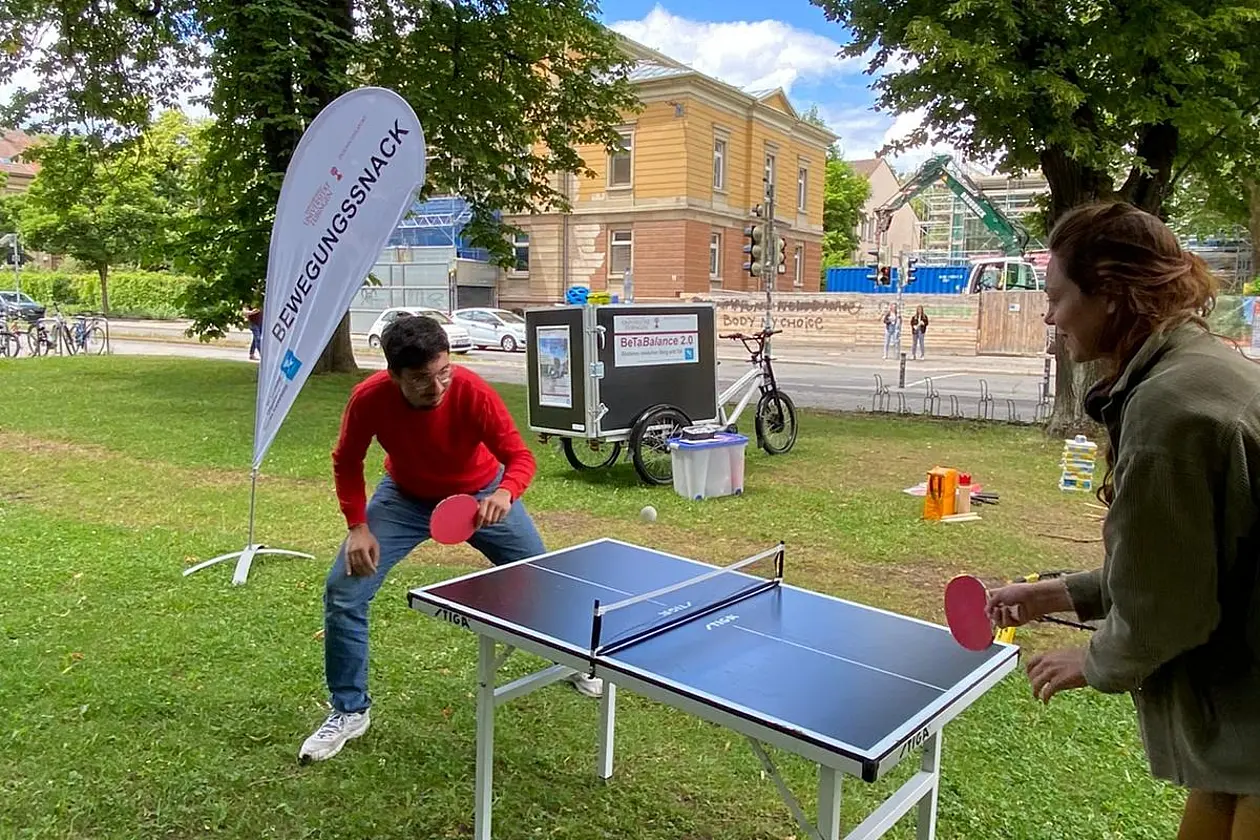
1. Student health management BeTaBalance of Tübingen University (in cooperation with Techniker health insurance company) includes offers for

2.  Health services for students by the AOK health insurance company:

  • these offers are for all students, not only for students who are insured with AOK
  • physical activities, stress management, nutrition, mental health tips
  • English and German offers on-sight
  • more information at AOK Campus Point Tübingen (German)

3. Health services for students by the Barmer health insurance company:

  • these offers are for all students, not only for students who are insured with Barmer
  • physical activities, stress management, nutrition, mental health tips
  • more information at Barmer Campus Coach (German)

Via the Barmer you have access for free to the 7Mind Study app which is a special student version of the 7Mind meditation and relaxation app. The registraton process is in German, but the app is available with English excercises and an English user interface.

Preventive health care & bonus programs - German statutory health insurance

If you are insured with a German statutory health insurance, you can profit from further benefits:

1. The German statutory health insurances cover free of charge

2. ‘Bonus programs’: Check out the bonus program of your health insurance company! German health insurance providers reward actions supporting your personal health with financial benefits or other bonuses. These actions are for instsance having a check-up with a doctor / taking part in specific (online) classes for sport, relaxation, nutrition / being a member in a sports club, etc.